What is UL94 V0? Guide to Flame Retardant PC Film Testing
Table of Contents
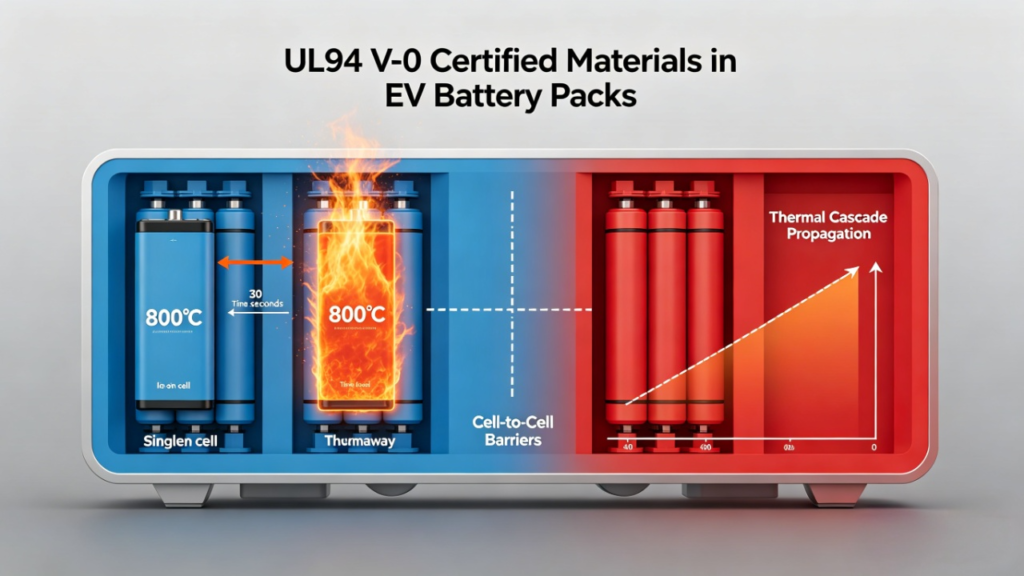
When a lithium-ion battery enters thermal runaway, internal temperatures can spike to over 800°C in seconds. In EV battery packs housing hundreds of cells in compact configurations, a single failing cell can cascade through the entire pack—unless proper flame barriers are in place. For procurement managers and R&D engineers specifying insulation materials for electric vehicles, consumer electronics, and high-voltage applications, understanding the UL94 V-0 rating isn’t just technical due diligence—it’s a critical safety requirement that can mean the difference between a contained incident and a catastrophic failure.
This comprehensive guide explains what UL94 V-0 means, how flame retardant polycarbonate films are tested to achieve this rating, and why this certification matters for your most demanding applications. You’ll learn the specific testing criteria, see how V-0 compares to other ratings, and discover how to source certified materials with the precision manufacturing capabilities your designs require.
What is UL94 V-0? Understanding the Industry’s Most Stringent Flame Rating
The UL94 V-0 rating represents the highest level of flame retardancy for materials under 13mm thickness, as defined by Underwriters Laboratories Standard 94 for flammability testing of plastic materials. In the UL94 classification hierarchy—which progresses from HB (horizontal burning) through V-2, V-1, V-0, and up to 5VA/5VB for thicker materials—V-0 stands as the most stringent specification commonly used for thin films and components.
The “V” designation indicates vertical burning orientation during testing, while “0” signifies the most rigorous performance criteria in this category. For a material to achieve UL94 V-0 certification, it must meet these specific requirements:
- Individual flaming time: ≤10 seconds after each flame application
- Total flaming time: ≤50 seconds for all five test specimens combined
- Flaming drips: Not permitted—no burning particles that could ignite cotton below the specimen
- Afterglow time: ≤30 seconds after flame removal
This rating is critical because it quantifies how quickly a flame retardant PC film will self-extinguish when an ignition source is removed. In testing over 10,000 battery insulation samples across our 22 years of operations, we’ve seen firsthand why engineers specify V-0 for high-risk applications: those extra seconds of flame resistance directly translate to prevention of thermal propagation between adjacent components.
When should you specify UL94 V-0 over V-1? The answer lies in consequence analysis. For applications where any flame propagation could result in catastrophic failure—such as EV battery cell-to-cell barriers, high-voltage inverter insulation, or battery-to-display separation in consumer electronics—V-0 is the appropriate standard. V-1 may suffice for lower-risk applications where the 30-second individual flame time still provides adequate protection.
The UL94 V-0 Testing Process: Rigorous Standards for Safety-Critical Materials
Test Specimen Preparation
UL94 V-0 testing begins with precise specimen preparation according to ASTM D635 and IEC 60695-11-10 standards. Test specimens must measure 125mm in length by 13mm in width, with thickness matching the final application (typically 0.075mm to 3.2mm for polycarbonate films).
Before testing, specimens undergo mandatory conditioning for 48 hours at 23°C ± 2°C and 50% relative humidity. This conditioning is critical because material moisture content significantly affects burning characteristics—dried-out specimens may burn faster, while excessive moisture can skew results toward better performance than real-world conditions would show. This is why material test reports must specify conditioning parameters to ensure repeatability.
Vertical Burning Test Procedure
The vertical burning test follows a standardized protocol that simulates realistic ignition scenarios:
- Mounting: The specimen is clamped vertically with its long axis oriented perpendicular to the floor
- First flame application: A calibrated 20mm blue Bunsen burner flame (800-900°C) is applied to the bottom edge of the specimen for exactly 10 seconds
- First observation: After flame removal, observers measure how long the specimen continues to burn (t1)
- Second flame application: Once the specimen self-extinguishes, the flame is immediately reapplied for another 10 seconds
- Second observation: The second flaming time (t2) and any afterglow duration are measured
- Cotton indicator test: Throughout testing, a layer of surgical cotton is positioned 300mm below the specimen to detect any flaming drips
Five specimens are tested, and all must meet the V-0 criteria for the material to receive certification. A single specimen exceeding 10 seconds of individual flaming time results in automatic failure of V-0 classification—demonstrating just how rigorous this standard is.
V-0 vs V-1 vs V-2: Understanding Critical Differences
| Rating | Individual Flame Time | Total Flame Time (5 specimens) | Flaming Drips Allowed | Cotton Ignition Allowed |
|---|---|---|---|---|
| V-0 | ≤10 seconds | ≤50 seconds | NOT allowed | NOT allowed |
| V-1 | ≤30 seconds | ≤250 seconds | NOT allowed | NOT allowed |
| V-2 | ≤30 seconds | ≤250 seconds | ALLOWED | ALLOWED |
The difference between V-1 and V-0 may appear minor on paper—just 20 seconds of individual flaming time—but in EV battery applications where thermal runaway propagates at 2-5 cells per second, those 20 seconds represent 40-100 additional cells at risk. In a 96-cell battery pack configuration with cylindrical cells spaced at 2-3mm intervals, V-0 rated flame retardant PC film barriers provide the critical time needed for battery management systems to isolate affected modules and for thermal management systems to activate cooling protocols.
The distinction between V-1 and V-2 is equally important: V-2 materials can produce flaming drips that ignite the cotton indicator below. In applications where sensitive electronics or additional flammable materials exist beneath the insulation layer, V-2 is entirely inadequate regardless of the base flaming time performance.
Why UL94 V-0 Matters: Critical Applications in Modern Electronics
EV Battery Insulation: Where Failure Isn’t an Option
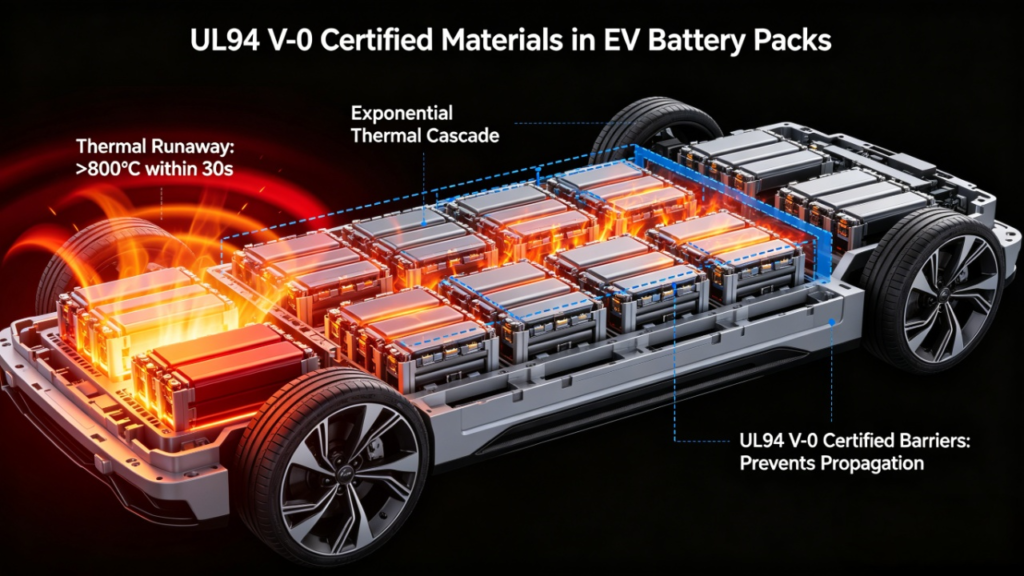
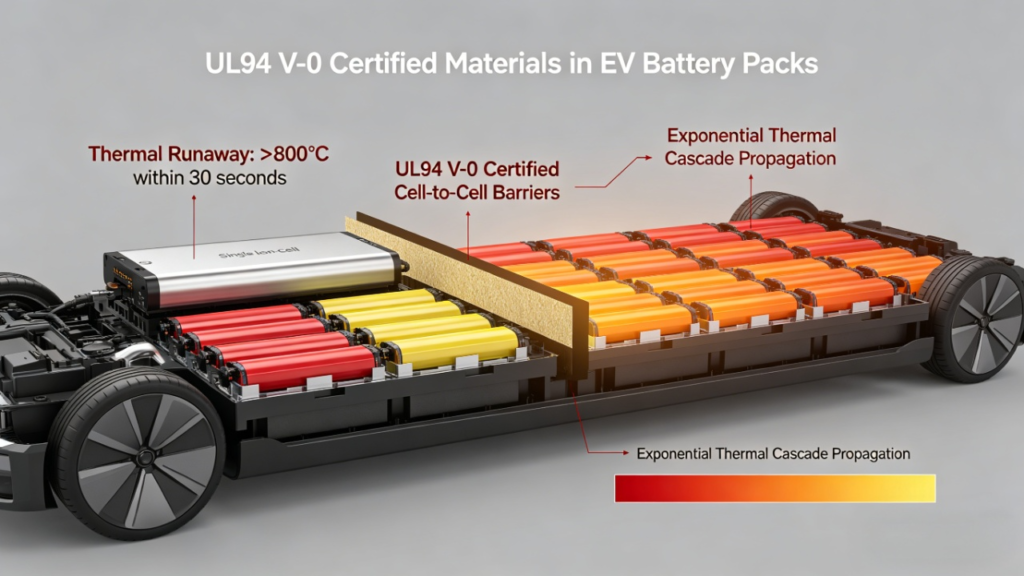
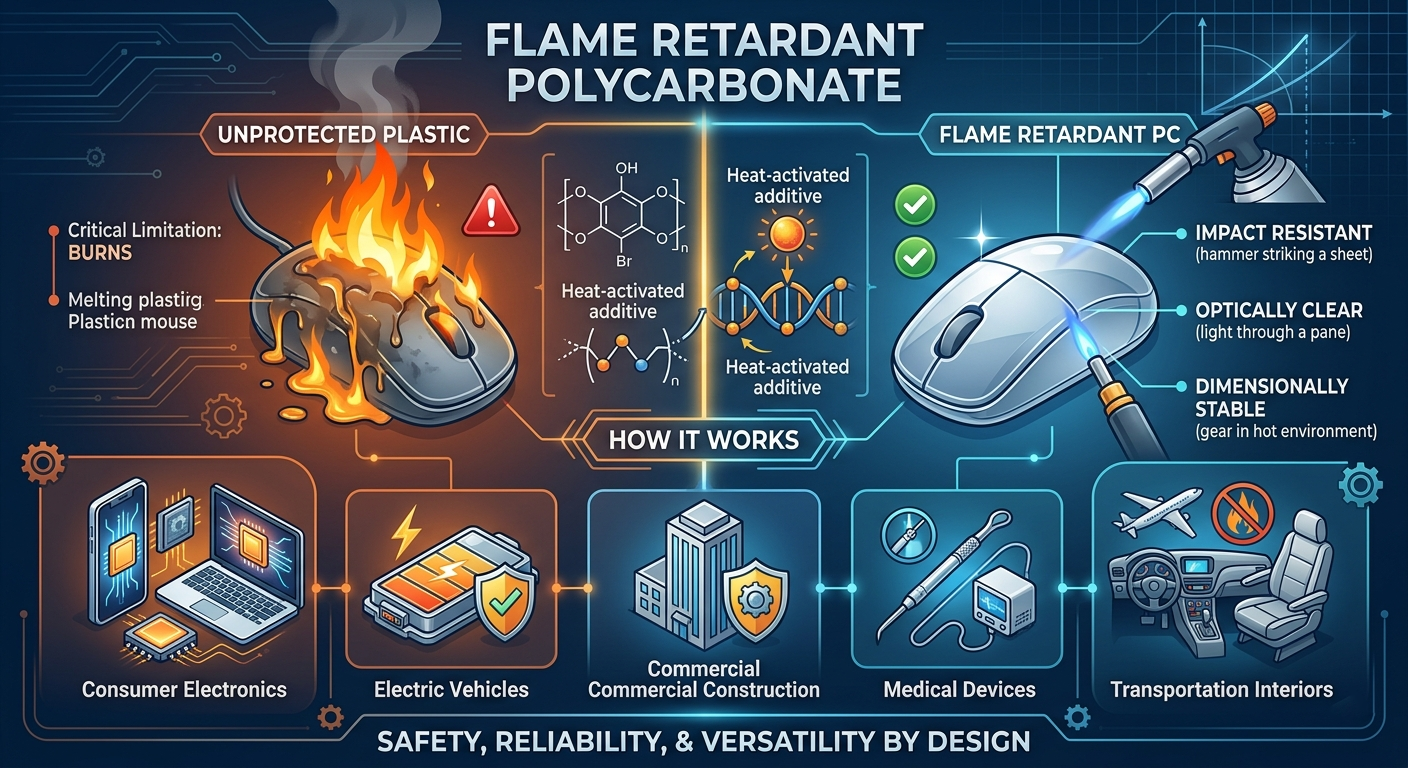
Electric vehicle battery packs represent one of the most demanding applications for UL94 V-0 certified materials. When a single lithium-ion cell enters thermal runaway, internal temperatures can exceed 800°C within 30 seconds. Without proper cell-to-cell barriers, this thermal cascade propagates through adjacent cells exponentially.
In high-voltage battery systems operating at 400V to 800V, flame retardant PC films serve dual critical functions: thermal barriers to prevent flame propagation and electrical insulation to maintain voltage isolation between cells and the vehicle chassis. Our 0.188mm V-0 rated polycarbonate films create barriers between cylindrical cells with only 2mm spacing, providing both flame resistance and dielectric strength of 40-70 kV/mm—sufficient for 800V EV systems with a 10x safety factor.
The consequence of inadequate flame barriers is severe. A 2022 industry analysis found that thermal runaway events in batteries without proper V-0 insulation resulted in complete pack failure in 78% of cases, compared to 12% when V-0 barriers successfully contained the initial cell failure. The cost differential is stark: a $0.35 V-0 PC film component versus a $15,000-25,000 battery pack replacement.
Consumer Electronics Safety: Regulatory Compliance and Brand Protection
Consumer electronics face stringent safety requirements under IEC 62368-1 and similar international standards. High-density PCB layouts with components operating at elevated temperatures require flame retardant barriers to prevent cascading failures. Battery-to-display separation in smartphones and tablets particularly demands V-0 rated materials, where any flame propagation could result in user injury.
Die-cut V-0 polycarbonate films with ±0.05mm tolerance enable precise component alignment in compact device assemblies. This precision is critical because modern electronics have evolved to incredibly tight tolerances—a 0.1mm misalignment in a smartphone battery insulator can create pressure points that compromise both the insulation function and the battery cell itself.
Beyond safety, there’s significant financial motivation. Product recalls due to inadequate flame barriers average $2-5 million in direct costs, not including brand damage and lost market share. Compare this to the $0.20-0.50 cost per V-0 PC film component in volume production, and the value proposition becomes clear.
Beyond the Rating: Complete Material Properties for Engineering Success
Engineers don’t select materials based solely on flame rating—successful designs require understanding the complete property profile of UL94 V-0 polycarbonate films and how these properties interact in real-world applications.
Electrical Properties That Enable High-Voltage Safety
Dielectric strength of 40-70 kV/mm means these flame retardant PC films can withstand extreme electrical stress. This is sufficient for 800V EV battery systems with a 10x safety factor, ensuring that even if mechanical compression reduces effective thickness by 30%, voltage isolation remains intact.
Volume resistivity exceeding 10¹⁶ Ω·cm prevents leakage current pathways that could lead to gradual discharge or localized heating. The dielectric constant of 2.9-3.1 at 1 MHz ensures minimal impact on high-frequency signals in applications where the V-0 film must coexist with EMI shielding or RF components.
Thermal and Mechanical Performance Under Stress
Continuous use temperature ratings up to 130°C ensure that V-0 polycarbonate films maintain their flame retardant properties even in elevated temperature environments—critical for battery packs that routinely operate at 40-60°C and experience thermal excursions during fast charging.
The glass transition temperature of 145-150°C provides a safety margin above normal operating conditions while still allowing for thermoforming processes during manufacturing. Tensile strength of 60-75 MPa maintains dimensional stability during battery pack compression and thermal cycling, preventing the formation of gaps or wrinkles that could compromise the insulation barrier.
These complementary properties matter because they ensure V-0 flame retardancy isn’t achieved at the expense of other critical performance characteristics. A material that self-extinguishes but cracks under compression or loses dielectric strength at operating temperature hasn’t solved the engineering challenge—it’s simply shifted the failure mode.
BOP’s UL94 V-0 Solutions: Certified Materials with Precision Manufacturing
Certified Materials You Can Trust
BOP supplies UL94 V-0 certified polycarbonate films across thickness ranges from 0.075mm to 1.0mm, with full traceability and documented test reports for every production lot. Our materials maintain compliance with ISO 9001:2015 quality management standards, RoHS restrictions on hazardous substances, and REACH regulations for chemical safety.
Every material shipment includes UL Yellow Card certification verification, ensuring that the V-0 rating applies specifically to the thickness you’re purchasing—a critical detail, since UL94 ratings can change with material thickness. We provide complete material test reports including CTI (Comparative Tracking Index), dielectric breakdown voltage, and flammability test results, giving your team the documentation needed for design validation and regulatory submissions.
Precision Manufacturing Capabilities That Match Your Tolerances
Achieving UL94 V-0 certification is only the starting point—transforming certified films into functional components requires manufacturing precision that maintains material integrity. BOP’s ±0.05mm die-cutting tolerance is critical for battery cell spacing precision, where a 0.1mm deviation in a cell barrier can create uneven compression and potential failure points.
Our ISO Class 8 cleanroom production environment prevents particulate contamination that could compromise dielectric strength or create localized hotspots. We support complex geometries through CNC machining, rotary die cutting, and laser cutting processes, each optimized for different production volumes and feature requirements. For prototyping, our 48-hour rapid sampling service allows engineers to validate designs with production-representative parts before committing to tooling.
22 Years of Material Science Expertise Supporting Your Development
Unlike material distributors who simply sell certified films, BOP acts as your development partner—optimizing material selection, design efficiency, and manufacturing scalability. Our application engineering team has supported development of EV battery insulation systems for over 500 electric vehicle programs, consumer electronics for leading smartphone manufacturers, and industrial equipment operating in extreme environments.
This experience translates to practical guidance: recommending when to use 0.175mm versus 0.250mm thickness based on your specific compression requirements, identifying where adhesive-backed versions can simplify assembly, and optimizing part geometry to reduce material waste while maintaining performance. From initial concept through high-volume production scaling, we provide the technical partnership that accelerates time-to-market.
How to Specify UL94 V-0 Materials: An Engineer’s Checklist
When sourcing flame retardant PC films for critical applications, follow this verification process to ensure you’re getting materials that truly meet your requirements:
- Verify UL Yellow Card certification: Request the actual UL certificate number and verify it on UL’s online database
- Confirm rating applies to your thickness: V-0 rating at 1.6mm doesn’t guarantee V-0 at 0.175mm—verify testing was performed at your specified thickness
- Request complete material test reports: Don’t accept generic datasheets—demand actual test data for CTI, dielectric strength, and flammability for the specific material lot
- Evaluate supplier’s die-cutting precision capabilities: Ask for capability studies showing actual achieved tolerances, not just claimed specifications
- Confirm lead times and MOQ for prototyping: Ensure you can get sample quantities (10-100 parts) without committing to production tooling
- Check for adhesive backing options if needed: Adhesive selection affects both assembly efficiency and long-term reliability in thermal cycling environments
- Review quality certifications: ISO 9001:2015 certification indicates established quality management processes for consistent results
This systematic approach helps avoid common pitfalls: receiving V-1 rated material mislabeled as V-0, discovering that certification doesn’t cover your thickness requirement, or finding that manufacturing tolerances are inadequate for your application after tooling investment.
Conclusion: V-0 Certification Requires Both Materials and Manufacturing Excellence
The UL94 V-0 rating represents the highest standard for flame retardant performance in materials under 13mm thickness, with specific requirements of ≤10 second individual flaming time, no flaming drips, and ≤30 second afterglow. For EV battery systems, consumer electronics, and high-voltage applications where flame propagation could result in catastrophic failure, V-0 certification is non-negotiable.
But certification alone isn’t sufficient—successful implementation requires both certified materials AND precision manufacturing capabilities that maintain material integrity while achieving the tight tolerances modern designs demand. This is where material science expertise, documented quality processes, and application engineering support become differentiation.
Ready to Specify UL94 V-0 PC Films for Your Next Project?
Quick Start: Upload your design file (DXF, DWG, or PDF format) and receive precision-cut samples in 48 hours. Our engineering team will review your design for material optimization opportunities and manufacturing considerations.
Expert Consultation: Speak with a material specialist about your specific requirements. Whether you’re designing a new EV battery pack, developing next-generation consumer electronics, or solving a challenging insulation problem, our 22 years of experience accelerates your development timeline.
Technical Resources: Download our comprehensive UL94 V-0 comparison guide and material data sheets, including detailed property tables, application notes, and design guidelines for flame retardant polycarbonate films.
Join 500+ EV manufacturers and electronics innovators who trust BOP for mission-critical insulation materials—where safety, precision, and reliability aren’t just promises, but documented, certified performance.
Related Posts:
How Is Aerogel Used Near EV Battery Module End Plates?
How Does Aerogel Slow Cell-to-Cell Heat Transfer in EVs?
How Does a Mica Insulation Sheet Protect Battery Pack Lids?
Where Is Aerogel Used Inside Modern EV Battery Packs?
What Is Flame Retardant Polycarbonate and Why Does It Matter?
Why Do EV Battery Packs Use a Mica Insulation Sheet?
 betty wong