Table of Contents
When designing components that must withstand fire, heat, and mechanical stress, material selection becomes one of the most consequential engineering decisions you will make. Two thermoplastics dominate fire-rated component design: flame retardant polycarbonate (FR PC) and FR ABS plastic. Both achieve UL 94 V-0 certification and comply with global electrical safety standards — yet they perform very differently under real-world conditions.
This comprehensive guide to flame retardant polycarbonate vs FR ABS breaks down every critical performance dimension — from fire rating and impact resistance to processing behavior and total cost — so engineers, procurement specialists, and product designers can make an informed choice for their specific application.
| 📋 What You Will Learn in This Article
• The fundamental chemistry behind FR PC and FR ABS flame retardancy • Side-by-side comparison of 12 key mechanical and thermal properties • UL 94 rating breakdown: V-0, V-1, V-2, 5VA, and 5VB explained • Application-specific selection guidance with real industry examples • Processing and fabrication differences for injection molding • Total cost of ownership analysis — not just material price • Regulatory compliance: REACH, RoHS, halogen-free options • How to choose the right FR plastic for your project |
1. Understanding Flame Retardant Plastics: The Basics
What Makes a Plastic “Flame Retardant”?
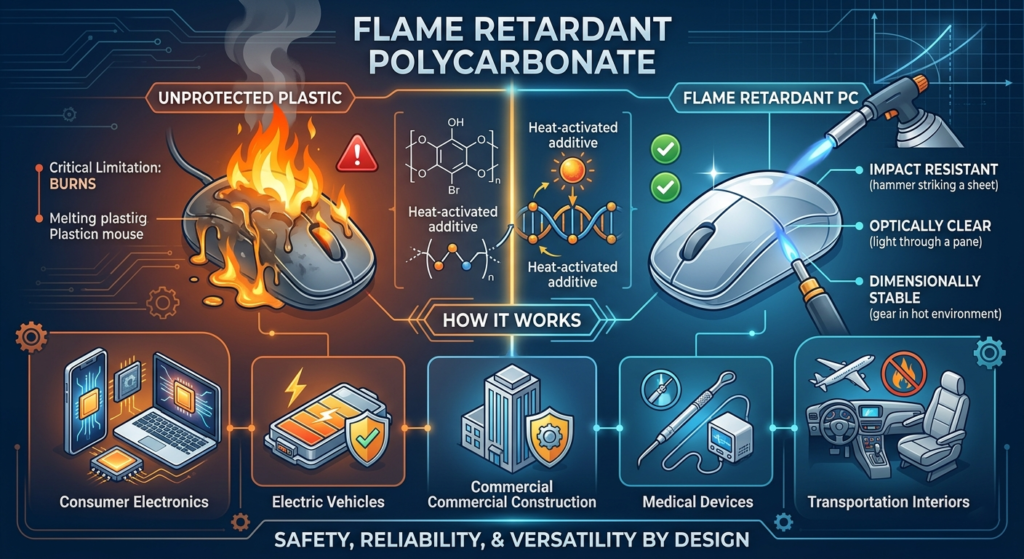
A plastic is classified as flame retardant when it has been formulated or modified to resist ignition, self-extinguish after a flame source is removed, and limit the spread of fire. Flame retardancy in engineering thermoplastics is achieved through two primary mechanisms:
- Additive flame retardants: Chemical compounds blended into the base resin — including phosphorus-based, nitrogen-based, or halogenated (brominated/chlorinated) compounds — that interrupt the combustion chain reaction.
- Reactive flame retardants: Chemically incorporated into the polymer backbone during synthesis, providing more durable and stable FR performance without migration.
- Char-forming mechanisms: Some FR systems promote the formation of a protective carbonaceous char layer on the material surface, physically blocking heat transfer and fuel gases from reaching the flame.
The performance of any flame retardant plastic is evaluated and classified using standardized test methods, with UL 94 (Underwriters Laboratories Standard for Safety of Flammability of Plastic Materials) being the most widely recognized globally.
UL 94 Ratings Explained
UL 94 is a critical rating system that directly impacts whether your product can be used in electrical, electronic, and industrial applications. Here is what each rating means in practice:
- HB (Horizontal Burn): The lowest FR rating. Material burns slowly or self-extinguishes when tested horizontally. Unsuitable for most fire-sensitive applications.
- V-2: Material self-extinguishes within 30 seconds of vertical flame test; burning drips are allowed.
- V-1: Self-extinguishes within 30 seconds vertically; no burning drips permitted.
- V-0: Self-extinguishes within 10 seconds vertically; no burning drips. The most common commercial FR rating for enclosures and electrical components.
- 5VB: Plaques self-extinguish within 60 seconds after five 5-second flame applications; no burn-through.
- 5VA: The highest rating. Plaques and molded parts self-extinguish within 60 seconds; no burn-through of 3mm plaques. Required for high-risk electrical enclosures.
Both flame retardant polycarbonate and FR ABS are commercially available in V-0 grades, and select formulations of each can achieve 5VA certification — but the wall thickness at which they achieve these ratings differs, a detail that significantly affects part design.
2. Material Overview: FR Polycarbonate vs FR ABS
Flame Retardant Polycarbonate (FR PC)
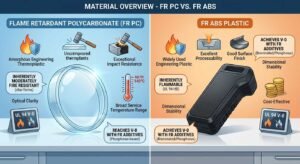
Polycarbonate is an amorphous engineering thermoplastic known for its exceptional impact resistance, optical clarity, and broad service temperature range. In its standard form, PC is inherently moderately fire-resistant due to its bisphenol A (BPA) based chemistry — it forms char when burned and has a limiting oxygen index (LOI) of approximately 25–27%. However, standard PC typically achieves only a V-2 rating without FR additives.
Flame retardant polycarbonate grades incorporate phosphorus-based FR systems (such as organophosphates or phosphazenes) or specialized halogen-free additives that elevate fire performance to V-0 at 1.5mm or even 0.8mm wall thickness — a significant advantage for thin-wall molding. Key commercial FR PC grades include products from Covestro (Makrolon), SABIC (Lexan), and Trinseo (Calibre).
FR ABS Plastic
Acrylonitrile Butadiene Styrene (ABS) is one of the most widely used engineering plastics in the world, valued for its excellent processability, good surface finish, dimensional stability, and cost-effectiveness. Standard ABS is inherently flammable (UL 94 HB rating) with a low LOI of approximately 18–20%.
FR ABS grades achieve V-0 or higher performance through the addition of brominated flame retardants (typically tetrabromobisphenol A or decabromodiphenyl ethane), phosphorus-based systems, or intumescent additives. FR ABS is commercially available from LG Chem, BASF, Ineos Styrolution, and Toray. It achieves V-0 at 1.5mm in most commercial grades, with select formulations achieving 5VA certification.
3. Flame Retardant Polycarbonate vs FR ABS: Full Property Comparison
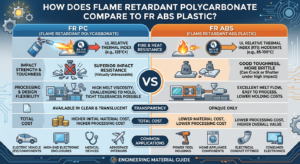
The following table provides a comprehensive side-by-side comparison across 12 key engineering properties. This is the core data you need for material selection decisions:
| Property | Flame Retardant Polycarbonate | FR ABS Plastic |
| UL 94 Rating | V-0 (standard), 5VA achievable | V-0 (standard), 5VA achievable |
| Impact Resistance | Excellent (15–20 ft-lb/in notched Izod) | Good (5–10 ft-lb/in notched Izod) |
| Heat Deflection Temp | 130–140°C (HDT @ 0.45 MPa) | 85–100°C (HDT @ 0.45 MPa) |
| Tensile Strength | 55–65 MPa | 40–50 MPa |
| Optical Clarity | Transparent grades available | Opaque only |
| Processing Temp | 280–320°C | 220–260°C |
| Density | 1.20–1.22 g/cm³ | 1.05–1.10 g/cm³ |
| Chemical Resistance | Moderate (attacked by solvents) | Good (broader chemical resistance) |
| Cost (relative) | Higher (~20–40% premium) | Lower (cost-effective) |
| Dimensional Stability | Good (low shrinkage) | Very Good (excellent stability) |
| UV Resistance | Good (stabilized grades) | Moderate (yellowing risk) |
| Regulatory Compliance | REACH, RoHS, halogen-free options | REACH, RoHS, halogen-free options |
4. Deep-Dive: Key Performance Differences
4.1 Impact Resistance: A Clear Advantage for FR PC
Impact resistance is arguably the most important differentiator between flame retardant polycarbonate and FR ABS. FR PC delivers notched Izod impact values of 15–20 ft-lb/in (approximately 800–1000 J/m), making it among the toughest engineering thermoplastics available. This performance is maintained across a wide temperature range, including sub-zero conditions down to -40°C.
FR ABS, while delivering acceptable impact resistance of 5–10 ft-lb/in (approximately 265–530 J/m), is significantly less tough. It also shows greater performance degradation at low temperatures, as the butadiene rubber phase, which provides toughness, becomes brittle below approximately -20°C.
Verdict: For applications requiring high-impact loading, drop resistance, or operation in cold environments, flame retardant polycarbonate is the superior choice.
4.2 Thermal Performance: FR PC Operates at Higher Temperatures
Heat deflection temperature (HDT) is a critical parameter for electrical enclosures and components that must operate near heat-generating electronics. Flame retardant polycarbonate delivers HDT values of 130–140°C at 0.45 MPa — comfortably above most electronic operating environments.
FR ABS typically delivers HDT values of 85–100°C at 0.45 MPa. While adequate for many applications, this lower thermal ceiling can be problematic in enclosed electronics where internal temperatures may exceed 80°C during peak operation. FR ABS also shows greater heat aging effects over time at elevated temperatures.
Verdict: For high-temperature electrical environments, server rooms, automotive underhood-adjacent applications, or lighting fixtures with significant heat generation, FR PC is strongly preferred.
4.3 Optical Clarity: FR PC’s Unique Advantage
One of the most significant and often decisive advantages of flame retardant polycarbonate over FR ABS is optical transparency. FR PC is available in transparent grades with light transmission values of 85–89%, making it the only fire-rated engineering plastic suitable for applications requiring visibility through the material.
FR ABS is inherently opaque due to the two-phase polymer morphology created by the dispersed butadiene rubber particles. No transparent grades of FR ABS are commercially available. This is a fundamental limitation that eliminates FR ABS from consideration for transparent covers, inspection windows, light diffusers, or any application where visual access through the material is required.
Verdict: Any application requiring optical transparency must use flame retardant polycarbonate. FR ABS has no viable alternative for this requirement.
4.4 Chemical Resistance: FR ABS Has the Edge
Chemical resistance represents one area where FR ABS outperforms flame retardant polycarbonate. ABS demonstrates good resistance to dilute acids, alkalis, alcohols, and many aqueous solutions. It is also compatible with most lubricants and cutting fluids commonly encountered in industrial environments.
Polycarbonate, despite its other outstanding properties, has notable chemical weaknesses. It is attacked by many organic solvents — including acetone, dichloromethane, toluene, and strong alkaline cleaners. PC also undergoes stress cracking in the presence of certain chemicals, particularly when combined with residual molding stress. This can be a significant concern in applications where chemical exposure is likely.
Verdict: For applications in chemical processing environments, industrial machinery with lubricant exposure, or where regular solvent-based cleaning is required, FR ABS offers better chemical compatibility.
4.5 Cost Considerations: FR ABS Offers Better Economics
From a pure material cost perspective, FR ABS is typically 20–40% less expensive than comparable flame retardant polycarbonate grades. This cost difference compounds significantly at high production volumes — for consumer products manufactured in the millions of units, material cost differences of even a few cents per kilogram translate into substantial budget impacts.
However, total cost of ownership (TCO) analysis should consider more than raw material price. FR PC’s superior impact resistance may eliminate the need for additional structural reinforcement or protective features. Its higher processing temperature means higher energy consumption during molding. FR ABS’s better dimensional stability and shorter cycle times (due to lower processing temperatures) can reduce per-part manufacturing costs.
Verdict: FR ABS delivers better cost economics for high-volume, cost-sensitive applications. FR PC justifies its premium when performance requirements — particularly impact resistance and heat deflection — cannot be met by FR ABS.
5. Application-Specific Selection Guide
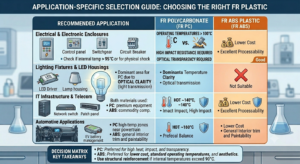
The best flame retardant plastic is always the one that meets your specific application requirements at the lowest total cost. Use the following table as a starting framework:
| Application | FR Polycarbonate | FR ABS |
| Electrical/Electronic Enclosures | ✅ Preferred (impact + heat) | ✅ Good (cost-effective) |
| Lighting Fixtures | ✅ Preferred (optical clarity) | ⚠️ Limited (opaque only) |
| Automotive Interior | ✅ Excellent (high temp) | ✅ Good (lower temp zones) |
| IT & Telecom Hardware | ✅ Preferred (thin walls) | ✅ Common (standard parts) |
| Medical Devices | ✅ Preferred (sterilizable) | ⚠️ Limited (lower temp) |
| Consumer Electronics | ✅ High-end devices | ✅ Budget devices |
| Industrial Safety Guards | ✅ Preferred (transparency) | ✅ Good (cost-driven) |
Electrical and Electronic Enclosures
This is the largest application category for both FR PC and FR ABS. For control panels, switchgear, circuit breaker housings, and industrial equipment enclosures, the choice depends primarily on operating temperature and impact requirements. If internal temperatures can exceed 95°C or if enclosures are subject to physical shock, FR PC is the preferred choice. For standard office or light industrial environments with moderate temperatures and budgets, FR ABS provides excellent value.
Lighting Fixtures and LED Housings
LED drivers and lamp housings represent one of FR PC’s dominant application areas. The ability to mold transparent FR PC allows designers to combine light transmission with fire safety compliance in a single material — eliminating the need for separate clear glazing elements. The high HDT of FR PC also manages the thermal loads inherent in enclosed LED systems. FR ABS is simply not suitable for applications requiring optical performance in lighting.
IT Infrastructure and Telecommunications
Server racks, network switches, patch panels, and data center equipment demand consistent fire protection combined with good dimensional accuracy for cable management and component integration. Both materials are used widely in this sector. FR ABS is particularly common for commodity server components, while FR PC dominates in premium equipment, where its superior impact resistance protects expensive electronics during handling and installation.
Automotive Applications
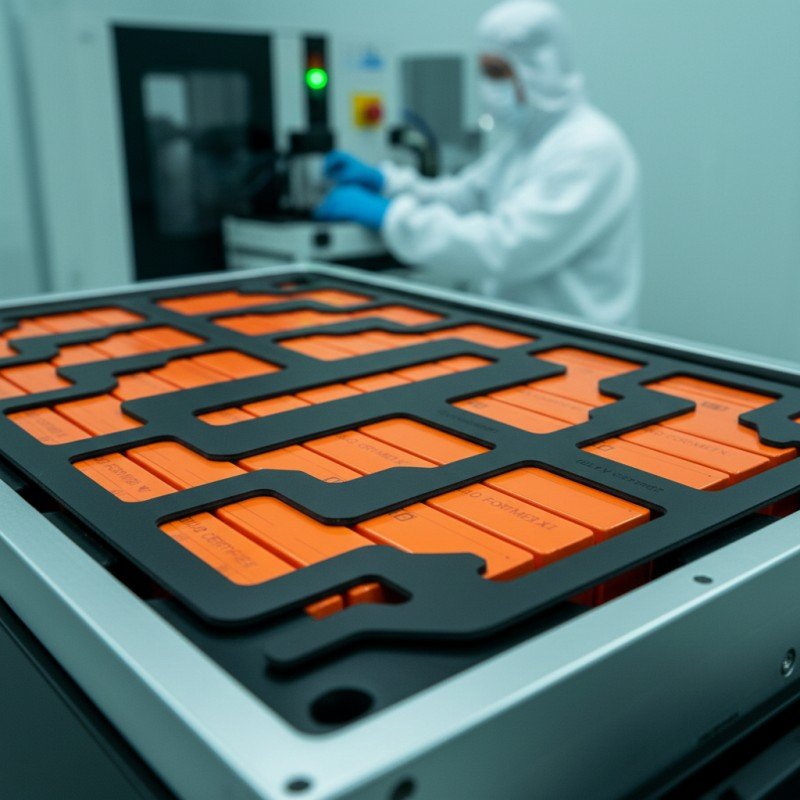
Automotive interior applications — instrument panels, center consoles, interior trim, and EV battery management components — use both materials extensively. FR PC handles higher-temperature zones closer to powertrain heat, while FR ABS is preferred for broader interior trim applications where its excellent surface finish and paintability deliver superior aesthetics at lower cost.
6. Processing and Manufacturing Considerations
Injection Molding: Key Differences
Both FR PC and FR ABS are processed primarily by injection molding, but their processing windows differ significantly in ways that affect tooling, cycle time, and production economics.
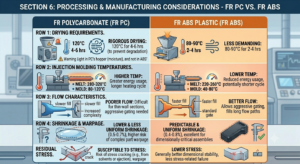
- Processing temperature: FR PC requires melt temperatures of 280–320°C and mold temperatures of 80–120°C. FR ABS processes at 220–260°C with mold temperatures of 40–80°C. Lower processing temperatures for FR ABS mean reduced energy consumption per cycle and potentially shorter heat-up/cool-down times.
- Drying requirements: FR PC is highly hygroscopic and requires rigorous drying at 120°C for 4–6 hours before processing to prevent hydrolytic degradation and surface defects (splay, silver streaking). FR ABS requires drying at 80–90°C for 2–4 hours — a less demanding pre-processing step.
- Flow characteristics: FR ABS generally offers better flow in thin-wall sections than FR PC, allowing more aggressive gating strategies and filling longer flow paths. This can reduce tooling complexity and improve part fill consistency.
- Shrinkage and warpage: FR ABS has very predictable and uniform shrinkage (0.4–0.8%), making it a preferred choice for dimensionally critical assemblies. FR PC exhibits lower but less uniform shrinkage (0.5–0.7%), which can be more difficult to optimize in complex geometries.
- Residual stress: FR PC is more susceptible to residual stress-related issues — including stress cracking and warpage — particularly in parts with sharp corners, abrupt wall thickness changes, or aggressive ejection features.
Secondary Operations
FR ABS’s excellent machinability, paintability, and electroplatability (using conventional etching-based adhesion promotion processes) give it a practical advantage in applications requiring extensive secondary processing. PC can be painted and printed but requires careful primer selection to avoid solvent attack. Both materials can be ultrasonically welded, though PC requires higher energy settings due to its higher processing temperature.
| ⚙️ Processing Quick Reference
FR PC: Dry at 120°C for 4–6 hrs | Melt: 280–320°C | Mold: 80–120°C | Careful solvent cleaning only FR ABS: Dry at 80–90°C for 2–4 hrs | Melt: 220–260°C | Mold: 40–80°C | Broad secondary processing compatibility |
7. Regulatory Compliance and Environmental Considerations
Halogen-Free Formulations
Growing regulatory pressure, particularly in the European Union, has driven significant demand for halogen-free flame retardant plastics. Both FR PC and FR ABS are now widely available in halogen-free formulations that comply with the EU RoHS Directive (2011/65/EU) and REACH Regulation (EC No 1907/2006).
Halogen-free FR PC grades typically use phosphorus-based systems (organophosphates, phosphazenes) or sulfonate-based FR additives. Halogen-free FR ABS grades most commonly use phosphorus-based systems (e.g., red phosphorus, metal hydroxides, or melamine-based compounds). These formulations generally maintain V-0 performance while meeting the substance restrictions of major global environmental regulations.
Key Regulatory Frameworks
- RoHS Directive (EU): Restricts use of certain hazardous substances including specific halogenated flame retardants. Both materials available in compliant grades.
- REACH Regulation (EU): Governs registration, evaluation, and authorization of chemicals. Compliant grades must document substances of very high concern (SVHCs).
- UL 94 Certification: Required for most electrical and electronic applications in North America and broadly adopted globally.
- IEC 62368-1 / IEC 60950-1: International standards for audio/video, IT, and communications equipment that reference UL 94 ratings for enclosure materials.
- WEEE Directive (EU): Impacts end-of-life recycling. Halogen-free grades are preferred for recycling stream compatibility.
- California Proposition 65: Requires warnings for products containing listed chemicals. Some brominated FR additives appear on the Prop 65 list.
8. Decision Framework: How to Choose Between FR PC and FR ABS
Use this structured decision process to select the right flame retardant plastic for your application:
| ✅ Choose Flame Retardant Polycarbonate (FR PC) When:
• Operating temperatures exceed 100°C or approach 130°C • High impact loading, drop resistance, or physical shock is expected • Optical transparency or light transmission is required • Thin-wall sections (< 1.5mm) must achieve V-0 rating • Long-term UV stability without yellowing is important • The application involves electrical arcing or sparking risks • Part cost is secondary to performance reliability |
| ✅ Choose FR ABS Plastic When:
• Operating temperatures stay below 90°C • Cost optimization is a primary design driver • Chemical resistance to solvents, lubricants, or cleaners is needed • Excellent dimensional stability and tight tolerances are required • Extensive painting, plating, or surface decoration is planned • High production volumes make material cost differences significant • Processing simplicity and lower energy consumption are priorities |
| 🔄 Consider FR PC/ABS Alloy When:
• You need better impact than FR ABS but cannot justify full FR PC cost • Both thermal performance (HDT ~115°C) and processability matter • Broad chemical resistance combined with toughness is required • A middle-ground solution balances your competing requirements Note: FR PC/ABS alloys achieve V-0 and offer a compelling performance-cost compromise |
9. Frequently Asked Questions
Is flame retardant polycarbonate stronger than FR ABS?
Yes, in terms of impact resistance and tensile strength, flame retardant polycarbonate is significantly stronger than FR ABS. FR PC delivers notched Izod impact values 2–3 times higher than FR ABS. However, FR ABS has superior dimensional stability and can outperform FR PC in applications where consistent dimensional accuracy under load is more important than peak impact resistance.
Can FR ABS replace flame retardant polycarbonate?
In many applications, yes — but not all. FR ABS can replace FR PC in applications with operating temperatures below 90°C, moderate impact requirements, good chemical compatibility needs, and cost sensitivity. FR ABS cannot replace FR PC where optical transparency is required, where operating temperatures exceed 100°C, or where very high impact resistance is essential.
Which is better for electrical enclosures: FR PC or FR ABS?
Both are widely used for electrical enclosures and both can achieve the required UL 94 V-0 or 5VA ratings. The choice depends on the specific enclosure requirements. For industrial control panels with significant heat generation or physical abuse risk, FR PC is preferred. For lighter-duty commercial electronic enclosures in temperature-controlled environments, FR ABS provides excellent performance at lower cost.
Are halogen-free versions of both materials available?
Yes. Both flame retardant polycarbonate and FR ABS are commercially available in halogen-free formulations that comply with RoHS and REACH regulations. Halogen-free grades are increasingly specified in European markets and are becoming standard in consumer electronics globally. Performance properties are largely equivalent to halogenated grades, though some halogen-free FR systems require slightly thicker wall sections to achieve the same V-0 rating.
What is the price difference between FR PC and FR ABS?
FR ABS is typically 20–40% less expensive than comparable FR PC grades on a per-kilogram basis. The exact difference varies by formulation, FR system, grade specification, and supplier. At current market pricing, FR PC typically ranges from $3.50–$6.00/kg while FR ABS ranges from $2.50–$4.00/kg, though prices fluctuate with petrochemical markets. The density difference (PC is ~10% denser than ABS) slightly reduces the per-part cost advantage of FR ABS.
Conclusion: Making the Right FR Plastic Choice
The flame retardant polycarbonate vs FR ABS decision ultimately comes down to your specific application’s performance envelope and economic constraints. Neither material is universally superior — each excels in different use cases defined by temperature, mechanical loading, optical requirements, chemical environment, and production economics.
Flame retardant polycarbonate is the right choice when you need maximum impact resistance, high thermal performance, optical transparency, or reliable performance in demanding environments. Its premium price is well justified in high-stakes applications where material failure carries significant safety or financial consequences.
FR ABS plastic is the right choice for cost-sensitive applications with moderate performance requirements — particularly where excellent dimensional stability, processability, surface finish quality, and chemical