Table of Contents
The electric vehicle revolution is reshaping the automotive industry, but with innovation comes new challenges—especially regarding battery safety. As EV adoption accelerates globally, manufacturers face increasing pressure to protect lithium-ion batteries from thermal runaway, fire hazards, and structural failure. Enter flame retardant polycarbonate: a material that’s becoming indispensable in modern EV battery design.
This advanced polymer offers a unique combination of fire resistance, mechanical strength, and thermal stability that addresses the most critical safety concerns in electric vehicle battery systems. But what exactly makes flame retardant polycarbonate the material of choice for leading EV manufacturers? Let’s explore the science, benefits, and real-world applications that are making this material essential for the future of electric mobility.
Understanding the Critical Role of Materials in EV Battery Safety
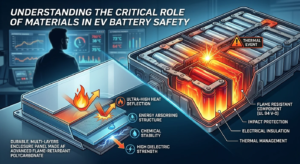
Electric vehicle batteries operate under demanding conditions that require exceptional material performance. Lithium-ion battery packs generate significant heat during charging and discharging cycles, and any malfunction can trigger catastrophic thermal events. The National Highway Traffic Safety Administration reports that while EV fires are statistically rare, when they occur, they can burn longer and hotter than conventional vehicle fires, reaching temperatures exceeding 1,000°C.
This reality has pushed automotive engineers to seek materials that don’t just meet minimum safety standards but exceed them significantly. Traditional plastics and standard polycarbonates, while useful in many applications, simply cannot provide the multi-layered protection required for modern EV battery enclosures, module separators, and thermal barriers.
The ideal battery safety material must simultaneously offer flame resistance, impact protection, electrical insulation, chemical stability, and thermal management—a combination that few materials can deliver effectively.
The Science Behind Flame Retardant Polycarbonate
Flame retardant polycarbonate represents a significant evolution from standard polycarbonate resins. While regular polycarbonate already offers excellent impact resistance and transparency, the addition of flame retardant compounds transforms it into a safety-critical material suitable for high-risk applications.
How Flame Retardancy Works
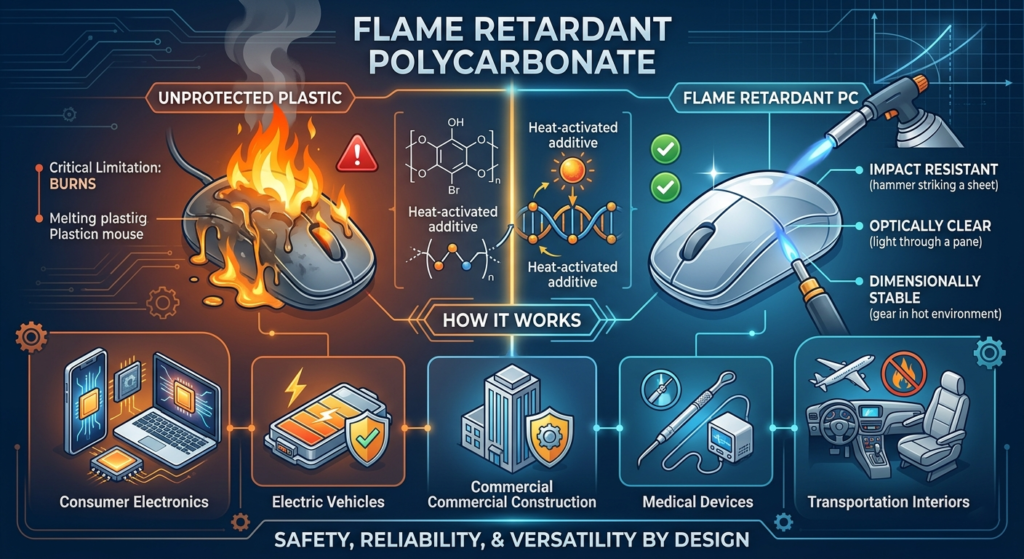
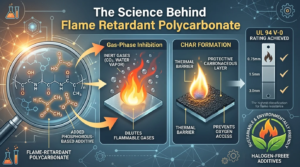
The flame retardant properties are achieved through several mechanisms. Most formulations incorporate halogen-free additives that work through char formation and gas-phase inhibition. When exposed to flame or extreme heat, these additives create a protective carbonaceous layer on the material surface, which acts as a thermal barrier and prevents oxygen from reaching the underlying polymer.
Additionally, the flame retardant compounds release inert gases during decomposition, diluting flammable gases and starving the combustion process of oxygen. This dual-action approach provides superior fire protection compared to single-mechanism flame retardants.
Modern formulations achieve UL 94 V-0 ratings—the highest classification for flame resistance—at wall thicknesses as low as 0.75mm, making them ideal for lightweight automotive applications where every gram matters for overall vehicle efficiency.
Chemical Composition and Performance
Advanced flame retardant polycarbonates typically use phosphorus-based additives rather than halogenated compounds, addressing environmental and health concerns while maintaining excellent performance. These formulations offer improved sustainability profiles without compromising safety characteristics.
The molecular structure of polycarbonate itself contributes to flame resistance. The carbonate groups in the polymer chain decompose at high temperatures to release carbon dioxide, a non-flammable gas that helps suppress combustion. When combined with specialized flame retardant additives, this creates a synergistic effect that dramatically enhances fire safety.
Key Properties That Make Flame Retardant Polycarbonate Essential for EV Batteries
Superior Flame Resistance and Self-Extinguishing Behavior
The primary advantage is obvious but worth emphasizing: flame retardant polycarbonate is designed to resist ignition and self-extinguish when the flame source is removed. This critical property can prevent a minor incident from escalating into a full battery pack fire.
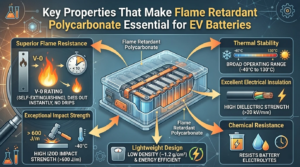
In standardized testing, high-quality flame retardant polycarbonates achieve V-0 ratings, meaning they extinguish within 10 seconds after flame exposure with no flaming drips. For EV battery applications, this can provide crucial time for automatic fire suppression systems to activate or for occupants to evacuate safely.
Exceptional Impact Strength and Durability
Electric vehicles encounter numerous mechanical stresses—from road vibrations and impacts to crash scenarios. Flame retardant polycarbonate maintains the outstanding impact resistance that standard polycarbonate is known for, with Izod impact strengths often exceeding 600 J/m even at low temperatures.
This toughness is essential for battery enclosures that must protect cells from external impacts while maintaining structural integrity during thermal events. Unlike brittle materials that may crack or shatter under stress, flame retardant polycarbonate can absorb significant energy without failure.
Thermal Stability Across Wide Temperature Ranges
EV batteries operate across a broad temperature spectrum, from sub-zero conditions in winter climates to elevated temperatures during fast charging or high-performance driving. Flame retardant polycarbonate maintains dimensional stability and mechanical properties across a temperature range typically from -40°C to 130°C, with some specialized grades performing even beyond these extremes.
This thermal stability ensures that battery components maintain their protective functions regardless of operating conditions or geographic location. The material won’t become brittle in cold weather or soften excessively in heat, providing consistent performance throughout the vehicle’s lifetime.
Excellent Electrical Insulation Properties
Battery safety requires reliable electrical insulation to prevent short circuits and electrical failures. Flame retardant polycarbonate offers excellent dielectric strength, typically exceeding 20 kV/mm, and high volume resistivity that effectively isolates electrical components.
This electrical performance is maintained even in humid conditions or after extended exposure to battery electrolytes, providing long-term reliability that’s essential for vehicles designed to last 10-15 years or longer.
Chemical Resistance to Battery Materials
Lithium-ion batteries contain aggressive chemicals including electrolytes, solvents, and various ionic compounds. Flame retardant polycarbonate demonstrates good resistance to these substances, maintaining structural integrity even after prolonged exposure.
This chemical compatibility prevents degradation that could compromise safety over time, ensuring that protective barriers and enclosures remain effective throughout the battery’s service life. Material testing shows minimal dimensional changes or property loss after immersion in common battery electrolytes for extended periods.
Lightweight Design for Energy Efficiency
Every kilogram added to an electric vehicle directly impacts its range and efficiency. Flame retardant polycarbonate offers an exceptional strength-to-weight ratio, with densities around 1.2 g/cm³—significantly lighter than metals while providing comparable or superior protective performance in many applications.
This weight advantage translates directly to extended driving range, improved acceleration, and better overall vehicle dynamics. For manufacturers striving to maximize EV performance and consumer appeal, the material’s lightweight nature is a significant competitive advantage.
Critical Applications in EV Battery Systems
Battery Pack Enclosures and Housings
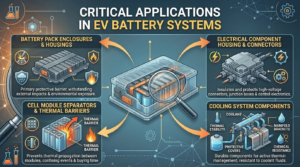
The battery pack enclosure represents the primary protective barrier between high-voltage cells and the external environment. Flame retardant polycarbonate is increasingly used for these critical components, either as complete housings or as integrated panels within metal frameworks.
These enclosures must withstand road debris impacts, corrosion from environmental exposure, and potential thermal events from within the battery pack. The material’s combination of flame resistance, impact strength, and weather resistance makes it ideal for this demanding application.
Cell Module Separators and Thermal Barriers
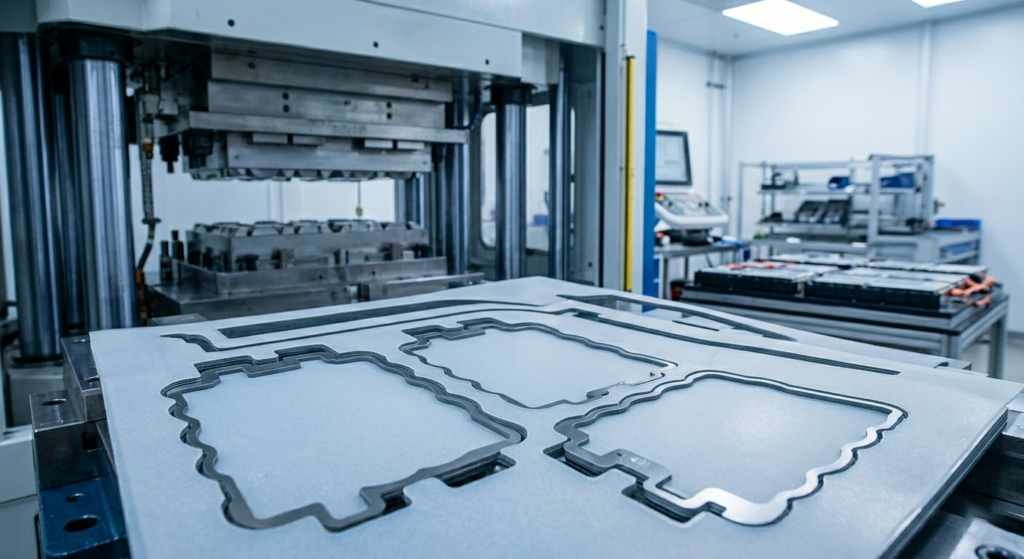
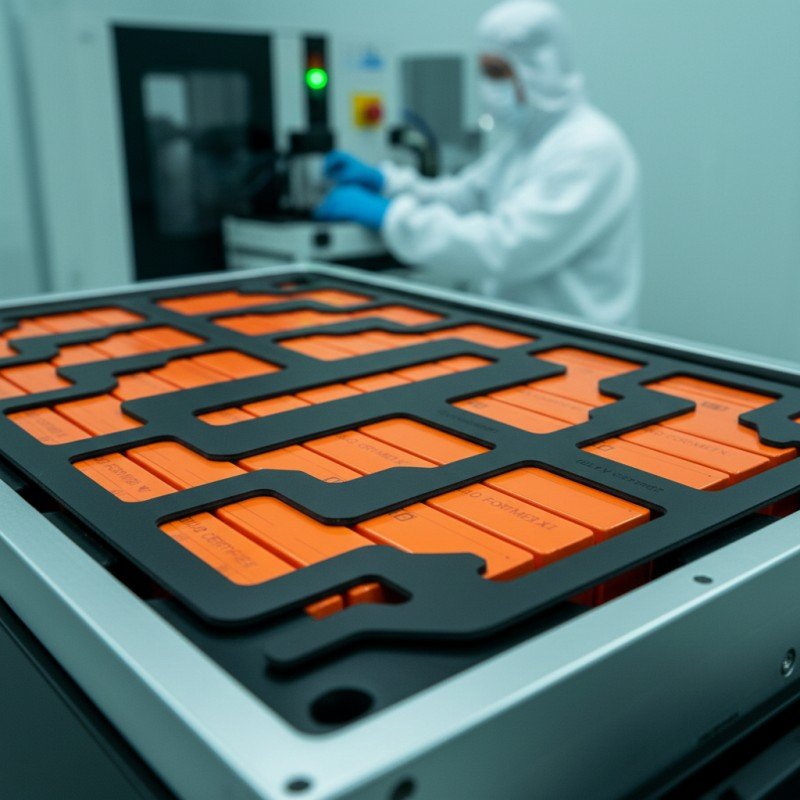
Within battery packs, individual cell modules require separation to prevent thermal propagation—where a thermal runaway event in one cell cascades to neighboring cells. Flame retardant polycarbonate sheets and molded components create effective thermal and electrical barriers between modules.
These separators can withstand direct flame exposure from a failing cell while maintaining structural integrity, providing precious time for cooling systems to activate and preventing catastrophic pack-wide failures. Real-world testing has demonstrated that properly designed barriers can limit thermal events to single modules rather than entire packs.
Electrical Component Housing and Connectors
High-voltage electrical systems within EVs require robust protection for connectors, junction boxes, and control electronics. Flame retardant polycarbonate provides the necessary electrical insulation, flame resistance, and mechanical protection for these critical components.
The material’s moldability allows for complex geometries that integrate multiple functions—strain relief, sealing features, and mounting points—into single components, reducing assembly complexity and potential failure points.
Cooling System Components
Active thermal management systems in modern EV batteries often incorporate plastic components for coolant distribution, mounting brackets, and protective covers. Flame retardant polycarbonate’s thermal stability and chemical resistance to coolants make it suitable for these applications where materials must perform reliably in direct contact with thermal management fluids.
Regulatory Compliance and Industry Standards
The automotive industry operates under stringent safety regulations that directly influence material selection. Flame retardant polycarbonate helps manufacturers meet or exceed requirements from organizations including:
UL (Underwriters Laboratories): UL 94 flame class ratings, with V-0 being the most stringent classification that many EV battery applications require.
FMVSS (Federal Motor Vehicle Safety Standards): Particularly FMVSS 302, which specifies burn resistance requirements for automotive interior materials.
ECE Regulations: European standards for vehicle safety that include specific requirements for high-voltage battery protection.
ISO Standards: International standards for road vehicles, particularly ISO 6469 series focusing on electric vehicle safety specifications.
Leading material suppliers provide comprehensive documentation demonstrating compliance with these standards, streamlining the qualification process for automotive manufacturers and reducing time-to-market for new vehicle platforms.
Environmental Considerations and Sustainability
As the automotive industry pursues sustainability goals, material environmental profiles have become increasingly important. Modern flame retardant polycarbonates offer several sustainability advantages:
Halogen-Free Formulations: Avoiding brominated and chlorinated flame retardants addresses concerns about toxic combustion byproducts and environmental persistence.
Recyclability: Polycarbonate can be mechanically recycled or chemically depolymerized back to raw materials, supporting circular economy initiatives.
Reduced Lifecycle Emissions: The lightweight nature of polycarbonate components contributes to improved vehicle energy efficiency, reducing emissions over the vehicle’s lifetime—a benefit that far outweighs the material’s production footprint.
Long Service Life: Excellent durability means components don’t require premature replacement, reducing waste and resource consumption.
Leading material manufacturers are also implementing renewable energy in production facilities and exploring bio-based polycarbonate formulations that could further improve sustainability profiles in future generations.
Comparison with Alternative Materials
While flame retardant polycarbonate excels in many areas, understanding how it compares to alternatives provides context for material selection decisions.
Versus Metal Enclosures: While metals offer excellent thermal conductivity and structural strength, they add significant weight, are susceptible to corrosion, and require more complex manufacturing processes. Polycarbonate offers better electrical insulation and design flexibility with lower mass.
Versus Composite Materials: Advanced composites like carbon fiber reinforced polymers provide exceptional strength-to-weight ratios but at substantially higher costs and with more complex processing requirements. For most battery applications, flame retardant polycarbonate offers a better balance of performance and economics.
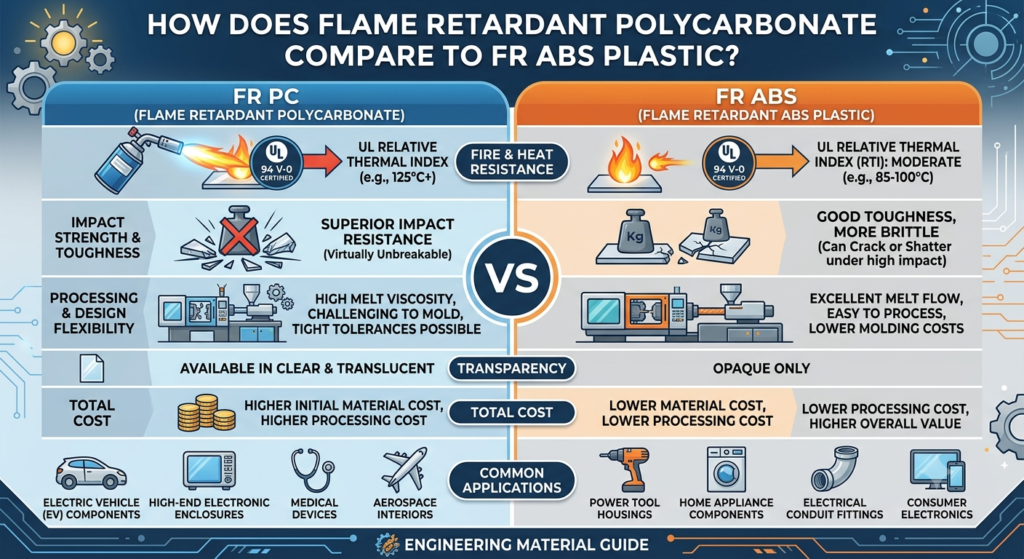
Versus Standard Engineering Plastics: Materials like ABS or standard nylon lack the flame resistance and high-temperature performance required for critical battery safety applications, making them unsuitable despite lower costs.
Versus Other Flame Retardant Polymers: While materials like flame retardant polyamides or PBT offer good performance, polycarbonate generally provides superior impact resistance and better low-temperature performance—critical factors for automotive applications.
Real-World Performance and Industry Adoption
Major automotive manufacturers have embraced flame retardant polycarbonate in their EV battery systems. While specific supplier relationships are often confidential, industry analysis reveals widespread adoption across brands from Tesla and General Motors to European and Asian manufacturers.
Case studies from the field demonstrate the material’s effectiveness. During controlled thermal runaway testing, battery packs incorporating polycarbonate thermal barriers successfully contained thermal events to individual modules, preventing pack-wide failures that could lead to vehicle fires.
Crash testing programs have also validated the material’s performance under extreme mechanical stress, with battery enclosures maintaining structural integrity and protective functions even after severe impact scenarios that would disable the vehicle.
Future Developments and Innovation Trends
The evolution of flame retardant polycarbonate for EV applications continues with several exciting developments on the horizon:
Enhanced Thermal Conductivity: Researchers are developing formulations with improved thermal conductivity to help dissipate heat more effectively while maintaining flame resistance and electrical insulation.
Smart Materials Integration: Future versions may incorporate temperature-sensing capabilities or self-healing properties that could provide early warning of thermal events or repair minor damage autonomously.
Improved Sustainability: Bio-based polycarbonate formulations using renewable feedstocks are advancing toward commercial viability, potentially reducing carbon footprints significantly.
Multifunctional Designs: Integration of structural, thermal management, and electrical functions into single components will continue, enabled by advanced molding technologies and material formulations.
Conclusion: The Material of Choice for Safer EVs
As electric vehicles become mainstream transportation, the materials protecting their battery systems must meet unprecedented demands. Flame retardant polycarbonate has emerged as the ideal solution, offering a unique combination of fire safety, mechanical performance, thermal stability, and practical manufacturability that few alternatives can match.
Its ability to resist ignition, self-extinguish, withstand impacts, and maintain properties across wide temperature ranges makes it indispensable for protecting the heart of modern electric vehicles. As battery energy densities increase and fast-charging becomes standard, the safety margins provided by advanced materials become even more critical.
For automotive engineers, material scientists, and manufacturers committed to producing the safest possible electric vehicles, flame retardant polycarbonate isn’t just an option—it’s becoming the standard. As technology advances and sustainability requirements evolve, this versatile material will continue adapting to meet the challenges of next-generation electric mobility.
The road to widespread EV adoption depends not just on battery capacity and charging infrastructure, but on public confidence in vehicle safety. Flame retardant polycarbonate plays a vital role in building that confidence, one protected battery pack at a time.