How Does Mica Insulation Compare With Polycarbonate?
Table of Contents
Your polycarbonate barrier passed every test on the bench, shipped for two years, and now the returns are coming back cracked, yellowed and slightly warped. Nobody changed the design. What changed is that the assembly runs a little hotter than the datasheet number somebody read in a hurry. It is one of the most common insulation failures in electrical equipment, and it happens because polycarbonate and mica insulation look interchangeable on a specification sheet and behave nothing alike after eighteen months at temperature.
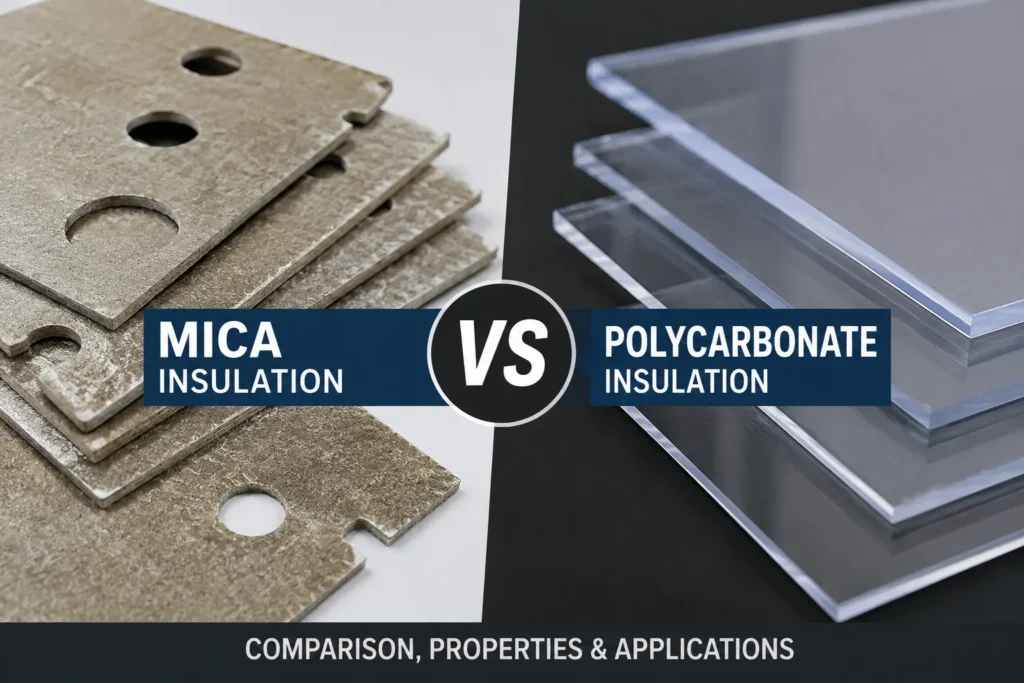
Mica insulation and polycarbonate are not really competitors. Polycarbonate is the better choice below roughly 120 C, where toughness, transparency, foldability and low part cost matter most, which covers low-voltage barriers, panel liners and folded 3D insulators. Mica insulation is the better choice above that, because it is a non-combustible mineral that holds its dielectric strength from 500 C to 1000 C and does not soften, creep or drip. Room-temperature dielectric strength is similar for both. Temperature, flammability and ageing decide the part.
Mica Insulation vs Polycarbonate: What You Are Actually Comparing
Both names cover a family of products, and much of the confusion between engineering and purchasing comes from two people comparing two grades that happen to share a name.
Mica insulation is built from natural mica, split into flakes, bonded with a resin system and calendared into flexible sheet or pressed into rigid board. Muscovite gives the higher dielectric strength and is normally used for continuous service around 500 to 600 C. Phlogopite is the more heat-tolerant mineral and takes over when service temperature climbs toward 800 to 1000 C. The binder sets the practical ceiling more often than the mineral does: silicone binders tolerate more heat and generate less smoke, epoxy binders are cheaper and stiffer, and glass-bonded grades push higher again at the cost of brittleness. Usable thickness runs from about 0.15 mm in flexible sheet to 3 mm and beyond in rigid board.
Polycarbonate is an amorphous engineering thermoplastic supplied as film from about 0.05 mm and as sheet from 0.25 mm upward, in general purpose, flame-retardant, UV-stabilized and glass-filled grades. It is transparent, extremely tough, easy to print and easy to score and fold, which is why it dominates low-voltage insulation. The trade-off is that every one of those properties is a property of a polymer chain, and polymer chains respond to heat, humidity, ultraviolet light and solvents in ways a mineral does not.
So the two materials answer different questions. Polycarbonate answers whether a part can be tough, transparent, formable and cheap while insulating. Mica insulation answers whether a part will still be insulating after the equipment gets hot, and whether it will add fuel to a fire if things go wrong.
Mica Insulation and Polycarbonate Compared on the Properties That Decide the Part
The ranges below are indicative and intended for shortlisting. Grade-to-grade variation inside each family is wide, so confirm against the specific datasheet before you release a drawing.
| Property that decides the part | Mica insulation | Polycarbonate |
| Material type | Natural mineral, muscovite or phlogopite, resin bonded | Amorphous engineering thermoplastic |
| Continuous service temperature | 500 to 600 C muscovite, 800 to 1000 C phlogopite | 115 to 125 C typical electrical RTI |
| Softening or failure mode in heat | None below the mineral limit, no melting | Softens near 145 to 150 C, creeps and distorts well before that |
| Behaviour in flame | Non-combustible, contributes no fuel | Burns and drips, flame-retardant grades reach V-0 only at qualifying thickness |
| Dielectric strength | 15 to 25 kV/mm | 15 to 25 kV/mm at typical sheet gauges, higher in thin film |
| Comparative tracking index | Inorganic and highly tracking resistant, normally the top material group | Commonly 125 to 250 V, usually material group IIIa or IIIb |
| Thermal conductivity | 0.20 to 0.40 W/m.K | About 0.20 W/m.K |
| Coefficient of thermal expansion | 8 to 15 x 10-6 per K | 65 to 70 x 10-6 per K |
| Density | 1.6 to 2.3 g/cm3 | 1.20 g/cm3 |
| Mechanical character | Rigid and brittle, cannot be folded | Tough and ductile, high impact strength, scores and folds |
| Optical | Opaque | Transparent, roughly 88 percent light transmission |
| Chemical resistance | Chemically inert | Attacked by alkalis, amines and many solvents, prone to stress cracking |
| Water and humidity ageing | Low absorption, stable | Hydrolysis at high temperature and humidity reduces molecular weight and toughness |
| Formability | Flat parts only, limited flexibility in thin sheet | Die-cut, scored, folded, thermoformed, printed |
Two rows in that table surprise people. Thermal conductivity is almost identical, near 0.20 W/m.K for both, so if you are choosing between them purely as thermal insulation per millimeter there is essentially nothing to choose. And dielectric strength at room temperature is comparable as well, in the 15 to 25 kV/mm range for both. Those two facts are exactly why polycarbonate keeps getting specified into applications it cannot survive. On paper it matches. The difference is not in the properties, it is in how long the properties last.
Temperature Is the Dividing Line Between Mica Insulation and Polycarbonate
If you take one number away from this comparison, make it this one. Polycarbonate has a glass transition around 145 to 150 C, and a heat deflection temperature commonly quoted near 130 to 140 C, but its useful electrical service temperature is lower again, typically a relative thermal index of 115 to 125 C. Mica insulation starts where polycarbonate has already left the room.
The mistake that causes most field failures is using heat deflection temperature as the design limit. Heat deflection temperature is a short-term test of when a loaded bar bends a defined amount. It says nothing about what twenty thousand hours at 110 C does to the polymer. Over that kind of exposure polycarbonate creeps under load, and it embrittles as hydrolysis and thermal ageing reduce molecular weight. The part that failed on the bench never failed. It got tired.
There is a second temperature trap in the flammability rating. A flame-retardant polycarbonate grade rated UL 94 V-0 is rated V-0 at a stated thickness, often 1.5 mm or 3.0 mm. Take the same grade down to 0.5 mm for a die-cut barrier and the rating can drop to V-2, which permits flaming drips. Designers copy the V-0 line out of a datasheet and lose it in the thickness reduction without ever knowing. Mica insulation does not have this problem, because it is a mineral and it does not burn at all.
Dielectric Strength, CTI and Creepage: Where Mica Insulation Quietly Wins Space
Dielectric strength gets all the attention in insulation specifications, and for these two materials it is close to a tie at room temperature. The property that actually differentiates them electrically is tracking resistance, and it changes the size of your assembly.
Comparative tracking index, measured to IEC 60112, describes how well an insulating surface resists forming a conductive carbon track when it is contaminated and energized. Unfilled polycarbonate typically lands somewhere between 125 V and 250 V, which puts it in material group IIIa or IIIc under IEC 60664-1. Mica-based inorganic insulation is highly tracking resistant and normally sits in the top material group. Because creepage distance requirements in IEC 60664-1 depend on material group as well as working voltage and pollution degree, that difference translates directly into millimeters of required spacing.
The practical consequence is worth stating plainly. In a polluted environment at a given working voltage, a polycarbonate barrier can require noticeably more creepage than an inorganic one, and that spacing has to come out of the enclosure. Teams fighting for space inside a compact assembly sometimes solve a packaging problem by changing the insulation material rather than the layout, and they usually discover the option late. Confirm the material group of the specific grade you are buying rather than assuming, because filled and modified grades behave differently, but do include it in the trade study.
Coefficient of thermal expansion is the other electrical property in disguise. Polycarbonate expands at 65 to 70 x 10-6 per K against roughly 8 to 15 x 10-6 per K for mica insulation. A 300 mm polycarbonate barrier through an 80 C temperature swing moves more than 1.5 mm. Constrain both ends with bolts through tight holes and the part bows, the clearance you designed disappears, and the stress concentrates at the fixing holes where the cracks eventually start. This is why long polycarbonate insulators need slotted holes and why the same drawing detail is unnecessary in mica.
Why Polycarbonate Insulation Fails Before It Melts
Melting is not the failure mode you should design against, because you will almost never see it. Four slower mechanisms take the part out first, and all four are absent in mica insulation:
- Thermal and hydrolytic ageing. Prolonged heat with humidity present breaks polycarbonate chains, molecular weight falls, and a tough ductile part becomes a brittle one that cracks at the first mechanical shock or assembly torque.
- Creep under load. A barrier that is clamped, bolted or spring loaded slowly deforms at temperatures far below its heat deflection number, so clearances close and parts loosen.
- Environmental stress cracking. Contact with alkaline cleaners, amines, certain greases, thread lockers, some adhesives and many solvents produces crazing and cracking, usually weeks or months after assembly rather than during it. Combined with residual stress from cutting, this is a leading cause of returns.
- Ultraviolet degradation. Unsterilized polycarbonate yellows and surface embrittles, which matters for any part visible through a vent or used outdoors.
None of this makes polycarbonate a bad material. It makes polycarbonate a material with a service envelope, and the envelope is narrower than the headline properties suggest. The engineering question is not whether polycarbonate is good, it is whether your application stays inside the envelope for the life of the product.
Where Polycarbonate Beats Mica Insulation
Inside its envelope, polycarbonate is hard to beat and mica insulation is the wrong answer:
- Low-voltage switchgear, distribution board and control panel barriers running well under 120 C, where impact resistance and formability matter more than heat.
- Folded three-dimensional insulators. A scored polycarbonate blank folds into a box, shroud or channel in one operation. Mica insulation is a flat-part material and cannot do this at all, which is often the single fact that decides the job.
- Transparent guards and insulating windows, where an operator or an inspection camera has to see through the barrier.
- Printed insulators carrying warning legends, part numbers or wiring diagrams directly on the insulating surface.
- Impact-exposed parts, where a brittle mineral sheet would crack in handling, shipping or service.
- High-volume, cost-driven parts at thin gauges, where polycarbonate film converts fast, nests well and needs no dust control.
Where Mica Insulation Is the Only Answer
Above the polycarbonate envelope, or anywhere flame is a design condition rather than an accident, mica insulation stops being an alternative and becomes the requirement:
- Heating appliances and elements. Toasters, hair dryers, heat guns, water heaters, coffee machines and industrial heaters all run element supports and shields at temperatures where no thermoplastic survives.
- Arc barriers and arc chutes in switchgear, contactors, circuit breakers and battery disconnect units, where the part has to take an arc event and still hold voltage afterwards.
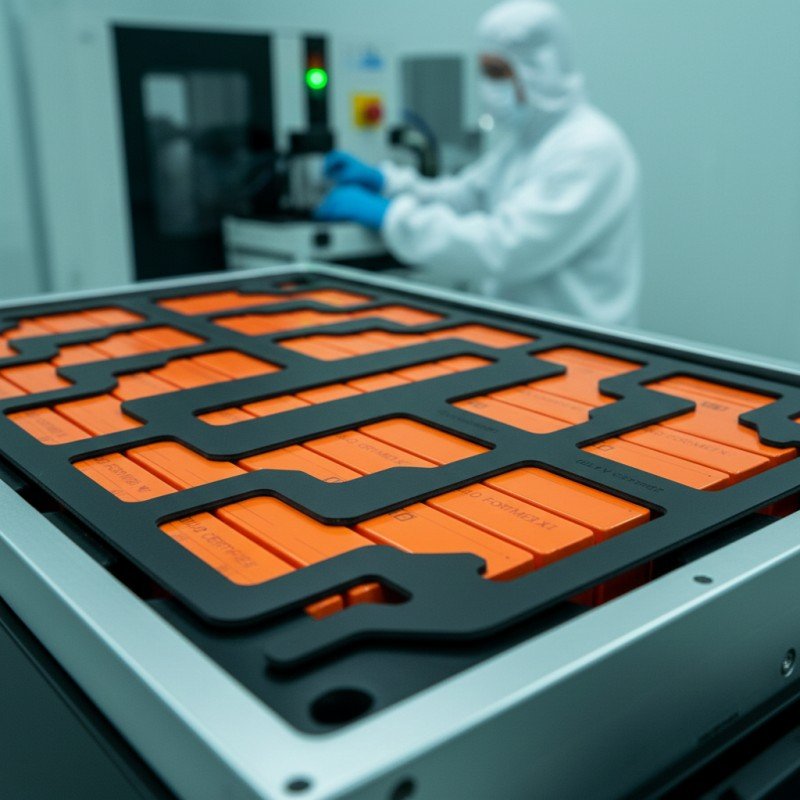
- EV battery thermal runaway barriers and busbar isolation, where a non-combustible dielectric that resists vent gas is now a regulatory requirement rather than a design preference.
- Motors, transformers and induction heating equipment operating above the reach of organic films.
- Furnace, kiln, glass and metal processing equipment, plus soldering and reflow fixtures that see repeated thermal cycling.
- Any part where the fire load of the insulation itself is a compliance issue, because mica insulation contributes no fuel and produces no flaming drips.
The 100 to 150 C Band Where Mica Insulation and Polycarbonate Both Look Right
Almost every bad decision in this comparison happens in one narrow band. Below 100 C polycarbonate is obviously fine. Above 200 C it is obviously impossible. Between roughly 100 C and 150 C both materials appear acceptable on a datasheet, and that is where the expensive mistakes live.
Three questions resolve the band, and they are the questions a good supplier will ask before quoting:
- What is the real hot-spot temperature, not the ambient temperature? Local temperatures next to a busbar, a resistor bank or a power semiconductor routinely run 20 to 40 C above the figure written on the specification, and that gap is exactly the width of the risk band.
- For how long, and with what humidity? Two thousand hours and twenty thousand hours are different materials problems. Polycarbonate ageing is cumulative and accelerates with moisture.
- Is the part loaded while hot? A clamped or bolted polycarbonate part creeps at temperatures where an unloaded one is stable, so the load case can move the ceiling down by tens of degrees.
There is also a design trend pushing more and more parts into this band from below. Power density is rising everywhere, from 800 V EV architectures and fast charging to compact inverters, dense server power shelves and smaller appliance motors. Assemblies that ran at 90 C five years ago run at 120 C today with the same enclosure volume. A polycarbonate insulator that was correctly specified for the previous generation is quietly out of envelope in the new one, and because nothing about the drawing changed, nobody re-runs the material decision. If you are carrying a legacy insulator into a higher power version of the same product, that part deserves a fresh look.
The Insulation Material Ladder: Mica Insulation, Polycarbonate and What Sits Between Them
Framing this as mica insulation versus polycarbonate makes the decision look binary when it is not. There is a ladder of materials between them, and if polycarbonate is marginal for your application, the next rung up is often a better answer than jumping straight to a mineral.
| Insulation material | Practical temperature ceiling | Where it belongs |
| Polycarbonate | 115 to 125 C | Low-voltage barriers, folded 3D insulators, transparent guards, printed insulation liners |
| PET polyester film | 105 to 130 C | Thin, low-cost flexible dielectric, slot liners, wraps, laminate cores |
| GPO-3 and FR-4 laminate | 130 to 180 C | Structural insulating panels, arc barriers, mounting plates |
| Aramid paper | 180 to 220 C | Motor and transformer insulation, flexible high-temperature dielectric |
| Polyimide film | 250 to 300 C | Thinnest reliable high-temperature dielectric, flexible circuits, cell wraps |
| Mica insulation | 500 to 1000 C | Heating elements, arc barriers, thermal runaway barriers, furnace and process equipment |
| Ceramic paper and aerogel | Above 1000 C | Thermal barriers where dielectric duty is handled by another layer |
Used properly the ladder saves money in both directions. A team about to over-specify mica insulation for a 140 C part usually finds that aramid paper or polyimide film does the job at lower cost and with better formability. A team trying to stretch polycarbonate to 160 C is on the wrong rung entirely. And a laminated construction, for example mica bonded to PET film, can put the heat resistance and the handling strength in the same part.
Die-Cutting Mica Insulation and Polycarbonate: Two Different Problems
This is the part of the comparison that never appears in a datasheet, and it is where a good specification most often fails quietly. Both materials are converted into parts, and each one punishes the wrong process differently.
Converting polycarbonate without building in cracks
- Polycarbonate is notch sensitive, so every cut edge is a potential crack initiation site. Blunt knives, incorrect bevel angles and cold material produce micro-cracks that survive inspection and fail months later in the field.
- Keep material and tooling above roughly 18 C. Cold polycarbonate fractures instead of shearing, and winter production is a recognizable defect signature.
- Laser cutting gives a clean-looking edge but leaves residual stress and a heat-affected zone that crazes later, particularly if the part is then folded or bolted. Knife or die cutting is safer for structural insulators.
- Score-and-fold work needs the right score depth, usually a defined fraction of the thickness, and the fold has to respect the extrusion orientation of the sheet. Folding across the wrong axis cracks the hinge.
- Keep protective masking on until final assembly, and specify a cleaning agent that is compatible with polycarbonate. Most stress-cracking complaints trace back to a solvent wipe nobody documented.
Converting mica insulation without delamination or dust
- Mica is layered, so small radii, narrow webs and sharp internal corners start delamination. Keep minimum hole diameter at or above the sheet thickness.
- Expect edge dust and design the process around removing it before packing, because loose mineral dust inside an electrical assembly is a contamination issue and not just housekeeping.
- There are no folds. A three-dimensional part becomes two or more flat parts, or a different material. Discovering this after the enclosure is tooled is a costly way to learn it.
- Pressure-sensitive adhesive needs to match the service temperature. Standard acrylic adhesive fails long before mica does, so high-temperature applications use silicone adhesive or mechanical capture with tabs and slots.
What good die-cut insulation parts share
Regardless of material, the converting details that prevent assembly complaints are the same: realistic outline tolerances, commonly around plus or minus 0.1 to 0.2 mm on a die-cut part; kiss-cut liners so parts release one at a time; pull tabs so operators never touch the functional surface; asymmetric outlines or index notches so a part cannot be fitted the wrong way round; and matched-set packaging so an assembly kit arrives complete. None of these appear in a material comparison, and all of them decide whether the material you chose works in production.
Cost: Why Polycarbonate Looks Cheaper Than Mica Insulation Until It Is Not
At thin gauges polycarbonate film is inexpensive, converts fast, needs no dust extraction and produces very little scrap, so the first quotation almost always favors it. That comparison is fair only when the application sits safely inside the polycarbonate envelope. Three costs sit outside the quotation and decide the real answer.
Rework and warranty cost. A cracked barrier discovered in the field is not a material cost, it is a field service visit, a returned unit and in the worst case a safety report. The price difference between a polycarbonate part and a mica part is usually a small fraction of one warranty claim.
Requalification cost. Substituting an insulator in a certified product can mean retesting to the relevant safety standard. Choosing correctly the first time is cheaper than choosing cheaply twice, and this is the argument that most often persuades a cost-focused stakeholder.
Conversion and assembly cost. For small parts the conversion cost frequently exceeds the material cost, and nesting yield can swing the material consumed per good part by twenty percent or more. On the other hand, one folded polycarbonate part can replace three flat mica parts and two assembly operations, and that is a genuine saving where the temperature allows it. Ask your converter to quote both constructions with tooling and yield shown separately, then compare landed cost per assembly rather than price per square meter.
Five Specification Mistakes With Mica Insulation and Polycarbonate
- Using heat deflection temperature as the service limit for polycarbonate. Use the relative thermal index, and derate for load and humidity.
- Carrying a UL 94 V-0 rating across a thickness change. The rating belongs to the tested thickness, and thinning a die-cut part can move it to V-2 with flaming drips permitted.
- Bolting a long polycarbonate barrier through tight holes at both ends. Its expansion is roughly five times that of mica insulation, so it needs slotted holes or it will bow and crack.
- Leaving comparative tracking index and material group out of the creepage calculation. This either wastes space with a polymer or misses an opportunity to shrink the assembly with an inorganic insulator.
- Designing a folded three-dimensional part and then trying to make it in mica insulation. Mica does not fold. Decide the material before the enclosure geometry is frozen, not after.
A Ten-Minute Framework for Choosing Mica Insulation or Polycarbonate
Answer these seven questions and the material usually chooses itself:
- What is the peak local temperature at the part, and for how many hours over the product life?
- Is the part mechanically loaded while it is hot? If yes, creep governs and the temperature limit drops.
- Is flame or arc exposure a design condition? If yes, a non-combustible mineral is the starting point, not the fallback.
- What is the working voltage, pollution degree and available creepage? This is where material group changes the packaging.
- Is the part flat or does it need to be folded, formed or transparent? Formability rules out mica insulation immediately.
- What chemicals, cleaning agents, adhesives and greases will touch the part, in production and in service?
- What is the annual volume, and does the geometry favors steel-rule tooling, rotary tooling or knife cutting?
FAQ: Mica Insulation vs Polycarbonate
Is mica insulation better than polycarbonate?
Only above the polycarbonate service envelope. Below roughly 120 C, polycarbonate is usually the better engineering and commercial choice because it is tough, formable, transparent and cheap to convert. Above that, or wherever flame and arc exposure are design conditions, mica insulation is better because it does not soften, creep, burn or drip.
What temperature can polycarbonate insulation withstand?
Plan around a relative thermal index of roughly 115 to 125 C for electrical service rather than the heat deflection temperature of 130 to 140 C that appears in most datasheets. Derate further if the part is mechanically loaded, exposed to humidity or expected to last more than a few thousand hours at temperature.
Can polycarbonate be used near a heating element?
No. Element supports, shields and adjacent barriers see temperatures far outside any thermoplastic envelope, and the flammability behavior is unacceptable in that location. Mica insulation is the standard material for this application across appliances and industrial heating equipment.
Is mica insulation a better electrical insulator than polycarbonate?
At room temperature the two are comparable on dielectric strength, both broadly in the 15 to 25 kV/mm range. Mica insulation is clearly better on tracking resistance and it is far better at retaining its dielectric performance after heat exposure, which is what matters in service rather than on day one.
Can mica sheet be folded or formed like polycarbonate?
No. Thin flexible mica sheet accepts gentle curvature, but mica is a layered mineral and a sharp fold delaminates or fractures it. Three-dimensional insulators in mica are built from multiple flat die-cut parts, or the geometry is redesigned. If a single folded part is essential and the temperature allows it, polycarbonate or a high-temperature film is the right route.
Which is cheaper for die-cut insulation parts?
Polycarbonate almost always wins the first quotation at thin gauges, because it converts quickly and cleanly. The comparison changes once you include requalification risk, warranty exposure and the possibility of consolidating several flat parts into one folded part. Compare landed cost per assembly with tooling and yield shown separately rather than price per square meter.
Can mica insulation and polycarbonate be combined in one part?
Directly bonding the two is rarely useful, because the polycarbonate layer sets the temperature limit of the whole assembly. What does work is a division of labor: a mica shield local to the heat source, with a polycarbonate or film part handling the rest of the barrier where the temperature is lower. Laminating mica to PET or polyimide is the more common composite approach when handling strength is needed at temperature.
Get Mica Insulation and Polycarbonate Samples Cut to Your Drawing
The comparison in this article gets you to a shortlist. Closing it out takes parts in hand, because ageing behavior, creepage in your actual layout and fit inside your enclosure are measured, not argued. Boost Insulation die-cuts and laminates mica sheet, polycarbonate, PET, polyimide, aramid paper and composite constructions for electrical, appliance, EV and industrial equipment, and the fastest route to a decision is usually two candidate materials cut to your real geometry.
To get a useful quotation on the first exchange, send the following:
- A 2D drawing in DXF or PDF, or a STEP file of the surrounding parts if the geometry is not settled.
- Peak local temperature at the part, expected service hours and whether the part is loaded while hot.
- Working voltage, any dielectric or hippo test requirement, and the applicable flammability rating with its thickness.
- Whether the part must be folded, printed, transparent or adhesive backed.
- Annual volume, target sample date and any standard the finished assembly is certified to.
Send the package through boostinsulation.com and we will come back with candidate materials, indicative pricing with tooling shown separately, and die-cut samples for your own testing. If polycarbonate is the right answer for your part, we will tell you so, even though mica is the more expensive sale. An insulator that fails in the field costs everyone more than the part it saved.
Appendix: SEO Notes for the Editor
Primary keyword: mica insulation. Secondary: mica insulation vs polycarbonate, polycarbonate insulation, mica sheet, die-cut insulation parts, high temperature electrical insulation, comparative tracking index, UL 94 V-0 insulation.
Keyword placement in headings: the primary keyword appears in the H1 and in fourteen of the fifteen H2 headings, paired each time with a different secondary term so each heading reads as a natural comparison rather than as repetition. The remaining H2 and every H3 carries a secondary keyword instead, which keeps the page from reading as over-optimized while still covering the term set.
Meta description: 149 characters, primary keyword in the opening two words, comparison intent, and a specify-stage call to action.
Snippet target: the second paragraph is a stand-alone direct answer to the title question, written to be lifted whole into a featured snippet. Keep it as the second paragraph and do not insert a subheading before it.
Suggested internal links: mica sheet product page from the first mention in paragraph two, polycarbonate product page from the Where Polycarbonate Beats Mica Insulation section, PET, polyimide and aramid pages from the material ladder table, die-cutting capability page from the converting section, and the RFQ page from the closing section. The ladder table is the strongest internal linking opportunity on the page.
Schema: mark the seven FAQ entries up as FAQ Page, and give both tables a caption naming the compared materials.
Image suggestions: a die-cut mica barrier beside a scored and folded polycarbonate insulator, a photograph of a heat-aged cracked polycarbonate part next to an unaged one, and a labelled diagram of creepage distance across a contaminated surface. Use the primary keyword in the alt text of one image only.
Related Posts:
Is Flame Retardant Polycarbonate Better Than Acrylic?
What Properties Make a Mica Insulation Sheet Effective?
What Temperature Can a Mica Insulation Sheet Withstand?
What Affects the Price of Flame Retardant Polycarbonate?
What is UL94 V0? Guide to Flame Retardant PC Film Testing
Should EV Battery Aerogel Pads Wrap or Split at Corners?
 betty wong