
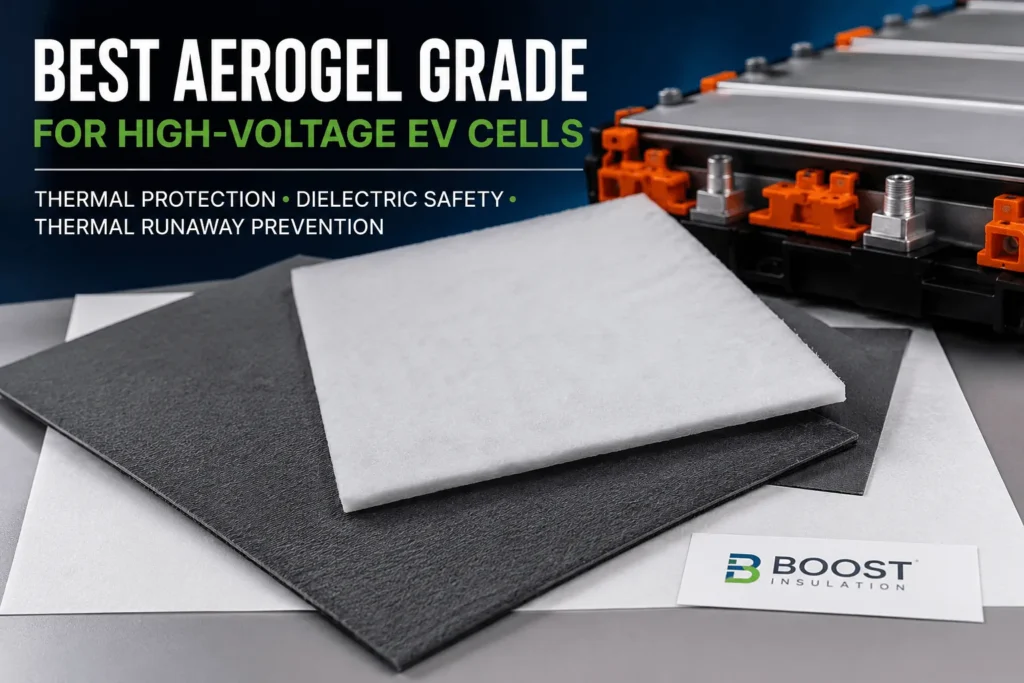
Which Aerogel Grade Is Best for High-Voltage EV Cells?
Table of Contents
If an EV platform operates at 400 V or 800 V, does that automatically mean the battery needs a different aerogel grade—or is the real selection driven by cell energy, thermal-runaway severity, stack pressure, vent direction, and dielectric design? This distinction matters because an aerogel blanket can look suitable on a datasheet yet fail after it is compressed, laminated, die-cut, exposed to hot vent gas, or installed beside a metallic heat bridge.
| The best aerogel grade for high-voltage EV cells is usually a reinforced, low-dust, battery-grade silica aerogel composite with validated thermal performance at the installed thickness and compression. Use film encapsulation, dielectric skins, adhesive zoning, or mica reinforcement when the location also requires electrical isolation, clean assembly, or direct flame protection. Pack voltage alone does not determine the grade; cell format, chemistry, energy, venting, and module-level test targets do. |
Aerogel Grade for High-Voltage EV Cells: Quick Selection Matrix
| Application | Preferred Construction | Main Reason | Key Validation |
| Prismatic cell-to-cell | Reinforced or film-encapsulated silica aerogel | Broad-face thermal resistance and controlled compression | Installed-thickness module test |
| Pouch-cell stack | Smooth encapsulated aerogel plus compliant pressure layer | Low dust and uniform stack pressure | Swelling, aging, and surface-pressure test |
| Cylindrical row barrier | Mechanically reinforced shaped aerogel laminate | Stable geometry around holders and gas channels | Vent-flow and module-propagation test |
| Direct vent or flame zone | Aerogel with mica or high-temperature facing | Jet, flame, and particle protection | Impingement and cell-vent test |
| High-voltage metal area | Aerogel plus dielectric PC or qualified film | Thermal resistance plus puncture-safe isolation | Dielectric, creepage, and aging test |
Which Aerogel Grade Is Best for High-Voltage EV Cells?
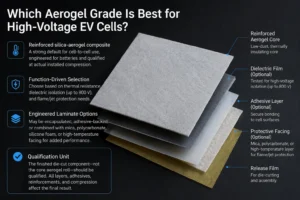
There is no single universal aerogel grade that is best for every high-voltage EV platform. A strong default for cell-to-cell use is a reinforced silica-aerogel composite engineered for batteries, converted into a low-dust, dimensionally controlled pad and qualified at the actual installed compression. The construction may be left breathable, film-encapsulated, adhesive-backed, or combined with mica, polycarbonate, silicone foam, or a high-temperature facing depending on the application.
The selection must begin with the required function. If the part only needs to slow heat through a broad cell face, a reinforced aerogel composite may be sufficient. If it must also provide dielectric isolation in an 800 V pack, the complete laminate may need a tested dielectric film or flame-retardant polycarbonate skin. If it faces a vent jet or direct flame, a mica or ceramic-facing layer may be necessary because the aerogel core alone is not a complete jet-shielding system.
The finished die-cut component—not the core aerogel roll—should be the qualification unit. Films, adhesives, carrier fibers, reinforcement, edge seals, inks, pull tabs, and compression all change the installed result.
What “High-Voltage EV Cells” Really Means
Most lithium-ion cells used in 400 V and 800 V EV packs still operate within broadly similar single-cell voltage ranges. The higher vehicle-system voltage is achieved mainly by placing more cells in series or by changing the pack architecture, not by turning each cell into an 800 V device.
Therefore, nominal pack voltage does not directly determine aerogel thermal performance. An 800 V platform may create stricter dielectric-clearance, creepage, isolation-monitoring, busbar, connector, and service-safety requirements, but the thermal barrier between two adjacent cells is still selected primarily from the local failure energy and heat-transfer paths.
A large-format 3.2 V LFP prismatic cell can release a severe amount of energy despite its lower nominal cell voltage. A high-nickel NMC pouch cell may present a different heat-release rate, vent behavior, and propagation risk. Cell capacity, chemistry, state of charge, packaging, and electrical configuration are more useful selection inputs than the pack-voltage label alone.
This is an important procurement insight: do not ask a supplier for an “800 V aerogel” without defining the local dielectric and thermal requirements. Ask for a finished barrier that meets the module’s installed thermal, mechanical, electrical, and flame-performance targets.
How to Define an Aerogel Grade for High-Voltage EV Cells
In battery engineering, “grade” should describe a complete and traceable material construction. It should include the aerogel chemistry, carrier fiber, density or areal weight, nominal thickness, thermal conductivity test condition, compression behavior, high-temperature stability, reinforcement, encapsulation, adhesive, liner, flame classification, dielectric properties, and manufacturing source.
Two products sold as 2 mm silica aerogel may perform differently because one uses a weak carrier felt, one contains radiation-blocking additives, one is hydrophobic, one is heavily compressed, and one is laminated with a full-face adhesive. A meaningful grade designation must distinguish these variants.
The drawing and bill of materials should identify the exact raw-material manufacturer and grade, approved alternates, film type, adhesive type, finished thickness, critical dimensions, edge-seal construction, and change-control requirements. Supplier substitution without revalidation can change propagation behavior.
For automotive programs, the grade should be connected to incoming inspection, lot traceability, certificate data, storage conditions, shelf life, process controls, and PPAP documentation. A commercial product name alone is not enough.
Thermal Conductivity Requirements for an Aerogel Grade
Low thermal conductivity is the main reason to select aerogel, but the reported number must be interpreted correctly. Ask whether the value is measured through-plane or in-plane, at what mean temperature, using which test method, at what density, and under what compression.
A room-temperature value is useful for initial comparison, but thermal-runaway protection occurs at much higher temperatures. As temperature rises, radiative transfer can become more significant, and the carrier, opacifier, facing, adhesive, and film can influence the cold-side temperature.
Compare candidate grades using the same test method and the same finished construction. A bare aerogel core may show an excellent value but perform differently after film encapsulation and full-face adhesive lamination. The best supplier data includes cold-side temperature curves, time to defined thresholds, heat-flux exposure, and post-test structural integrity.
For cell-to-cell barriers, through-plane thermal resistance at installed thickness is often more useful than nominal conductivity alone. The design team should also instrument edges, shoulders, busbars, and cooling structures because these areas may bypass the central aerogel layer.
Installed Thickness and Compression for High-Voltage EV Cells
The correct thickness is the thickness that remains in the assembled module throughout life. Incoming free-state thickness can be misleading because stack preload, cell tolerance, temperature, aging, and swelling may compress the barrier substantially.
Thicker aerogel generally increases thermal resistance and can increase propagation delay. Published battery studies have demonstrated that increasing aerogel-felt thickness can delay downstream-cell thermal runaway. Those results support the trend but do not establish a universal thickness for large-format EV cells.
Request compressive stress-strain data, compression set, recovery, and thermal performance at representative pressure. Define the beginning-of-life and end-of-life compression window. Excessive pressure can reduce thermal path length and damage the porous structure; insufficient pressure can allow gaps, movement, wrinkles, or poor assembly control.
Local compression is critical. Thick edge seals, adhesive overlaps, liner tabs, locating features, module ribs, and uneven cell swelling can create thin zones that become hot spots. Prototype assemblies should use pressure film, thickness mapping, or dimensional inspection to confirm uniform loading.
Which Aerogel Grade Is Best for NMC and NCA EV Cells?
High-nickel NMC and NCA cells are often selected for high energy density, and severe thermal-runaway events can produce rapid heat release, flammable gases, flame, and ejecta. The barrier grade should prioritize high thermal resistance, high-temperature dimensional stability, low shrinkage, robust reinforcement, and protection against vent exposure.
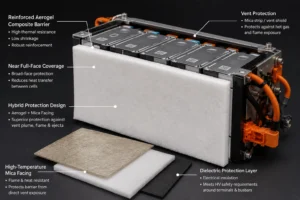
For broad-face prismatic or pouch cells, a reinforced aerogel composite with near-full-face coverage is a strong baseline. If the upper edge is exposed to a vent plume, add a high-temperature facing, mica strip, or dedicated vent shield rather than extending a soft pad over the safety vent.
The grade should be tested at the worst credible state of charge and installed compression. High-energy cells can overwhelm a barrier through radiation, metal structures, or hot gas even when the central pad remains intact. A hybrid system is frequently more robust than relying on conductivity alone.
For high-voltage architectures, confirm that the complete laminate also meets the project’s dielectric and contamination requirements around terminals, busbars, sensing circuits, and metallic frames.
Which Aerogel Grade Is Best for LFP EV Cells?
LFP chemistry is generally considered more thermally stable than high-nickel chemistries, but large-format LFP cells can still release substantial heat and gas during severe failure. The large facing area of blade and prismatic LFP cells can create a broad conduction and radiation path.
A thinner or lower-cost aerogel construction may be sufficient in some validated LFP modules, but chemistry alone should not justify reducing the barrier. Cell capacity, state of charge, pack integration, vent direction, structural compression, electrical connection, and acceptance criteria determine the required grade.
Large cell-to-pack LFP architectures may use long cells with direct structural contact to trays, cooling plates, and pack members. The aerogel grade must be coordinated with these heat paths. Full-length dimensional stability and flatness can be as important as nominal conductivity.
Because high-volume LFP platforms are cost sensitive, design-to-cost should focus on the minimum validated installed thickness, optimized coverage, automated die cutting, selective adhesive, and reduced part count rather than switching to an unqualified commodity blanket.
Choose the Aerogel Grade by Cell Format
Prismatic cells usually need a flat, reinforced barrier across the broad facing area. The grade should maintain flatness, tolerate compression, and support precise cutouts around shoulders, vents, terminals, rails, and cooling contacts.
Pouch cells need a smooth and compliant construction that avoids point loading. Low-dust encapsulation is valuable, and the layer stack may include silicone foam for pressure management. The aerogel should retain thermal resistance as the pouch stack swells.
Cylindrical cells may use row barriers, group partitions, sleeves, or module-boundary shields. The grade must work with cell holders, cooling channels, axial venting, and open gas-flow paths. A mechanically stable shaped laminate may be more useful than fragile loose felt.
Cell-to-pack and cell-to-chassis systems require early material involvement. Long continuous structures and reduced module walls can create new bypass routes. The best aerogel grade is the one that can be converted into the exact geometry required to interrupt those routes.
Bare Aerogel Blanket vs Reinforced Battery Grade
Bare or lightly reinforced aerogel blanket can provide strong thermal insulation at relatively low cost, but it may shed dust, fray at cut edges, deform during handling, or vary in thickness. It is more suitable for development work, protected cavities, or applications where separate encapsulation and support are provided.
A reinforced battery-grade aerogel composite uses a controlled fiber network, scrim, or carrier to improve tensile strength, flex durability, dimensional stability, and die-cut response. Reinforcement makes the material easier to convert into repeatable production parts.
The reinforcement should not create an excessive solid-conduction path. Compare the complete thermal and mechanical data. A stronger grade can sometimes use less thickness or reduce scrap, but a heavy carrier can raise conductivity.
For most high-volume EV intercell parts, reinforced battery grade is a safer starting point than an unprotected commodity blanket because it supports cleaner assembly, traceability, and dimensional control.
When Film-Encapsulated Aerogel Is the Best Grade
Film encapsulation is often preferred when the module requires low dust, clean automated assembly, dielectric surfaces, controlled edges, printed identification, or adhesive backing. The film protects the aerogel core from abrasion and operator handling.
PET is commonly used for handling and dielectric functions in moderate-temperature zones. PI offers higher temperature capability but adds cost. Coated glass fabric, ceramic paper, or mica-facing layers may be selected for direct flame or jet exposure.
Encapsulation changes the grade. Film shrinkage, puncture resistance, seam design, adhesive, edge-seal width, and overlap direction must be controlled. A film that retracts under heat can expose the core; a wide polymer seam can reduce the active thermal area or become a bypass path.
Qualify the complete encapsulated part, including edge construction. A certificate for the aerogel core does not automatically prove the performance of the final laminate.
When Adhesive-Backed Aerogel Is the Best Grade
Adhesive backing can reduce assembly time, improve positioning, support automation, and prevent the barrier from shifting before the module is compressed. It is useful when the cell or structural surface is clean, stable, and compatible with the selected pressure-sensitive adhesive.
Full-face adhesive is not automatically best. It creates continuous contact and adds a polymer layer across the thermal interface. Depending on the formulation and thickness, it may change thermal resistance, compression, flame behavior, and aging.
Selective adhesive zones, perimeter strips, or small registration areas can provide sufficient fixation while preserving more active aerogel area. Define keep-out zones around vents, terminals, welds, cooling contacts, and high-temperature edges.
Test peel strength after heat aging, humidity, vibration, compression cycling, and relevant chemical exposure. Review liner release, pull-tab geometry, repositionability, and adhesive squeeze-out. The adhesive grade should be approved as part of the finished aerogel construction.
High-Temperature and Flame-Faced Aerogel Grades
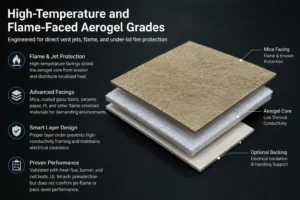
Locations exposed to direct vent jets, flame, glowing particles, or under-lid fire need more than a low-conductivity core. A high-temperature facing can protect the aerogel from erosion and distribute localized heat.
Mica, coated glass fabric, ceramic paper, PI, and other flame-resistant facings can be combined with aerogel. Mica is particularly useful where rigid electrical and flame protection is required. The aerogel behind it reduces heat transfer to the protected component.
The facing should not create a high-conductivity frame or sharp edge that damages the cell. Layer order depends on the hot side, protected side, compression direction, and electrical-clearance requirement.
Use application-relevant heat-flux, burner, impingement, or cell tests. UL 94 data is useful for polymer preselection but does not establish jet-flame resistance or pack-level thermal-propagation performance.
Dielectric Requirements for High-Voltage EV Packs
High-voltage packs require disciplined electrical isolation, but the aerogel core should not automatically be assumed to be the primary dielectric component. Some aerogel formulations may contain conductive additives or surface contamination, and edge quality can affect the result.
Define dielectric strength, insulation resistance, test voltage, dwell time, leakage-current limit, moisture conditioning, minimum thickness, surface condition, and post-aging requirements. Consider puncture, burrs, weld spatter, sharp busbar edges, and compression.
A film-encapsulated aerogel or aerogel-plus-polycarbonate construction can separate the thermal and electrical functions. Flame-retardant PC provides clean dielectric coverage, puncture resistance, and structural stability around high-voltage hardware.
Creepage and clearance are geometric properties of the complete design. A barrier material does not compensate for inadequate spacing around terminals and conductors. Review the full high-voltage path, not only the cell face.
UL94 V-0 and VTM-0: What They Do Not Tell You
UL 94 V-0 is a vertical-burning classification for defined plastic specimens. VTM-0 applies to thin flexible materials tested using a different method. Ratings depend on grade, thickness, color, and specimen construction.
These classifications help screen polymer films, polycarbonate skins, adhesives, and other layers, but they do not prove that an aerogel barrier will stop thermal runaway, resist a battery jet flame, or meet UN Regulation No. 100.
Verify the exact certified thickness and grade. A V-0 core, a VTM-0 film, and an adhesive do not automatically produce a certified V-0 finished laminate. Composite behavior may need separate evidence.
Use UL documentation honestly in marketing and technical specifications. State the rated material and thickness, then separately describe application-level thermal and flame testing.
How an Aerogel Grade Works With PC, Silicone Foam, and Mica
Aerogel is optimized for thermal resistance. Flame-retardant polycarbonate is optimized for dielectric structure, puncture resistance, large-area stability, and clean assembly. Silicone foam is optimized for gap filling, vibration, swelling, and preload. Mica is optimized for rigid high-temperature electrical and flame protection.
A high-voltage EV stack may use aerogel at the cell-to-cell interface, PC near busbars and structural metal, silicone foam to control pressure, and mica around vents or the pack cover. The arrangement should follow the thermal, electrical, and mechanical functions.
Avoid unnecessary complexity. Every added layer creates thickness, tolerance, adhesive interfaces, cost, and change-control risk. Use the simplest multilayer stack that meets the validated requirements.
The completed stack must be tested at the installed pressure. A soft foam can over compress the aerogel, a rigid skin can bridge heat at the edge, and a full-face adhesive can change the effective thermal resistance.
DFM for the Best Aerogel Grade for High-Voltage EV Cells
The best material grade can still fail if the converted part is poorly designed. The converter needs the cell outline, active area, vent keep-out, terminals, welds, busbars, frame features, cooling contacts, compression direction, assembly sequence, and protected surfaces.
Critical dimensions include overall profile, installed thickness, vent clearance, edge-seal width, adhesive registration, liner split, pull tabs, locating features, cutout radii, minimum web width, flatness, cleanliness, and packaging orientation.
Aerogel can be crushed or contaminated during slitting and die cutting. Tool clearance, blade condition, cutting pressure, support liner, web tension, dust extraction, part handling, and inspection must be controlled.
Prototype tooling should allow fast iteration after thermal and assembly tests. Digital cutting, flatbed tooling, rotary die cutting, or progressive conversion can be selected according to geometry, volume, laminate construction, and tolerance.
Five-Level Validation for an Aerogel Grade
Level 1 screens the raw material and finished laminate. Measure thickness, density or areal weight, thermal conductivity, high-temperature shrinkage, compression, dielectric behavior, flame response, adhesive peel, dust, moisture, and chemical compatibility.
Level 2 uses thermal coupons under representative compression. Compare cold-side temperature, time to threshold, heat-flux response, film damage, seam opening, and post-test integrity.
Level 3 tests the actual interface or two-cell geometry. Include the cell casing, pressure, vents, edges, busbars, cooling contacts, and assembly tolerances. Instrument the center, shoulders, terminals, and bypass paths.
Level 4 is representative module propagation testing at the project-defined state of charge and trigger method. Record trigger-cell runaway, adjacent-cell temperature and voltage, venting, flame, gas, pressure, warning, and propagation time.
Level 5 is pack or vehicle validation. Confirm enclosure response, warning strategy, vent management, external hazard criteria, electrical isolation, and post-event safety. UN Regulation No. 100 evaluates the complete REESS or vehicle, not an individual aerogel coupon.
How to Compare Aerogel Supplier Data
Compare the same property measured using the same test method. Reject comparisons that mix bare-core conductivity with finished-laminate data or room-temperature data with elevated-temperature claims.
Ask the supplier to identify which values are typical, minimum, maximum, guaranteed, or derived. Request raw curves and test conditions for critical properties. Confirm the sample thickness and compression.
Review traceability from raw aerogel to die-cut part. The supplier should control incoming material, storage, lamination, cutting, inspection, packaging, nonconformance, and engineering changes.
Automotive buyers should assess IATF 16949 or appropriate quality-system evidence, APQP, PPAP, PFMEA, control plans, measurement-system analysis, capability data, lot traceability, and documented change notification.
Industry Insight: The Best Grade Is Becoming a Finished System
The EV industry is moving away from buying aerogel only by thickness and conductivity. Modern barrier programs increasingly specify mechanical durability, installed-pressure behavior, cold-side temperature curves, dielectric evidence, low dust, automated handling, and module-test performance.
Research is also moving toward multifunctional aerogel composites with reinforced fiber networks, radiation-control additives, flame-resistant surfaces, phase-change layers, and mechanical pressure-management features. This reflects the reality that thermal runaway transfers energy through multiple routes.
High-integration 800 V platforms, cell-to-pack designs, and large-format cells increase the value of thin barriers but also increase the consequences of structural heat bypass. The best grade is therefore the construction that fits the complete architecture and can be manufactured repeatedly.
For suppliers, the commercial advantage is not simply offering an aerogel roll. It is converting the material into a test-ready, traceable component and supporting rapid engineering changes after module validation.
Cost and Sourcing Strategy for Aerogel Grades
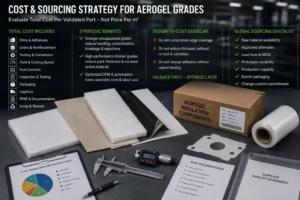
Compare cost per validated part, not price per square meter. Include films, adhesives, liners, reinforcement, tooling, yield, cutting speed, dust controls, inspection, packaging, logistics, PPAP, and scrap.
A stronger encapsulated grade may cost more as raw material but reduce manual handling, contamination, breakage, assembly time, and rejection. A thinner high-performance grade may reduce pack thickness or allow more active material.
Design-to-cost should occur after the safety target and main heat paths are understood. Removing edge coverage, reducing thickness, or changing adhesive without repeat testing can create a false saving.
For global sourcing, confirm raw-material availability, approved alternates, lead time, minimum order quantity, prototype capability, capacity, export packaging, and change-control commitments.
RFQ Checklist for an Aerogel Grade for High-Voltage EV Cells
Provide the pack voltage, cell chemistry, format, capacity, dimensions, nominal and worst-case state of charge, vent location, module layout, electrical connection, cooling method, available gap, installed thickness target, compression range, and end-of-life swelling allowance.
Define the thermal and electrical objectives: propagation delay, no-propagation period, protected-cell temperature limit, dielectric test voltage, insulation resistance, flame requirement, vent exposure, and validation method.
Send a 2D PDF or CAD file with critical dimensions, tolerances, keep-out zones, adhesive areas, edge seals, liner split, pull tabs, orientation, cleanliness, packaging, and expected annual volume.
Request documentation for the exact core, film, adhesive, reinforcement, and finished part. Include thermal, compression, high-temperature, dielectric, flame, aging, chemical, traceability, inspection, quality-system, and change-control evidence.
How Boost Insulation Supports High-Voltage EV Aerogel Projects
Boost Insulation supports EV and energy-storage programs with aerogel, flame-retardant polycarbonate, silicone foam, mica, dielectric films, pressure-sensitive adhesives, precision lamination, slitting, die cutting, and custom assembly.
Engineering support can include grade screening, multilayer stack design, installed-thickness review, compression analysis, vent keep-out, adhesive zoning, encapsulation, edge sealing, liner and pull-tab design, rapid prototypes, inspection plans, voltage testing, aging tests, APQP, PPAP, and lot traceability.
For a useful DFM review, upload the cell or module drawing and provide the installed gap, compression range, vent direction, thermal and dielectric targets, material restrictions, validation plan, expected volume, and any current test or assembly problem.
The objective is to recommend a manufacturable barrier for representative validation. No material supplier should promise pack-level compliance without testing the complete target configuration.
| Need an aerogel-grade and multilayer DFM review?
Send Boost Insulation your cell or module drawing, installed gap, compression range, vent direction, thermal target, dielectric test requirement, material restrictions, validation plan, and annual volume. The engineering team can review aerogel, PC insulation, silicone foam, mica, film, adhesive, and precision die-cut options. Visit boostinsulation.com to upload a drawing or request a quote |
Frequently Asked Questions
Is there an “800 V aerogel” grade?
Not in a technically meaningful sense. The pack voltage affects dielectric design, but thermal grade selection depends mainly on cell energy, chemistry, format, thermal-runaway severity, compression, venting, and the required system result.
Is silica aerogel the best chemistry for EV battery barriers?
Silica-based reinforced aerogel composites are widely used because they provide low thermal conductivity and high-temperature capability. The finished reinforcement, facing, and laminate design are as important as the core chemistry.
What thermal conductivity should battery aerogel have?
Use conductivity as a screening property and compare values at the same temperature, direction, thickness, density, and pressure. Final selection should use cold-side temperature or propagation data from the finished stack.
What is the best aerogel thickness for high-voltage EV cells?
There is no universal thickness. Select the minimum installed thickness that meets the module target with margin at worst-case compression, state of charge, cell energy, vents, and production tolerances.
Should the aerogel be PET or PI encapsulated?
PET is useful for clean handling and dielectric surfaces in moderate exposure areas. PI provides higher temperature capability. Direct flame zones may need mica, ceramic fabric, or another high-temperature facing.
Does the aerogel itself need UL94 V-0?
Project requirements vary. Verify the exact material and thickness. UL 94 classifications help screen flammability but do not prove thermal-runaway suppression or pack-level safety.
Can aerogel replace polycarbonate insulation or silicone foam?
Usually not. Aerogel provides thermal resistance; PC provides structural dielectric protection; silicone foam manages gaps and compression. They often work together.
What should be sent for a custom sample?
Send the cell or module drawing, installed thickness, compression range, vent location, dielectric target, flame requirement, adhesive and film needs, test plan, and expected volume.
Technical References
- United Nations Economic Commission for Europe. UN Regulation No. 100, Revision 3, and the 05 series thermal-propagation amendment documents. Source
- UNECE. Proposal for the 05 Series of Amendments to UN Regulation No. 100: improved thermal-propagation requirements. Source
- UL Solutions. Combustion (Fire) Tests for Plastics: UL 94 V and VTM classifications. Source
- Liu, Q. et al. “Influence of Aerogel Felt with Different Thickness on Thermal Runaway Propagation of 18650 Lithium-ion Battery.” Electrochemistry, 2022. Source
- Wong, S. K. et al. “Mitigating Thermal Runaway Propagation in High Specific Energy Lithium-Ion Battery Modules Using Nanofiber Aerogel.” Energy, 2024. Source
- Chen, M. et al. “Study on Thermal Runaway Propagation Inhibition of Battery Module by Flame-Retardant Phase Change Material Combined With Aerogel Felt.” Applied Energy, 2024. Source
- Boost Insulation. EV battery insulation, aerogel, flame-retardant PC, thermal management, precision die cutting, rapid prototyping, APQP, and PPAP capabilities. Source
Related Posts:
How Do You Measure Particle Shedding From Die-Cut Aerogel?
How to Choose EV Battery Cell Insulation Pads?
What Affects the Price of Flame Retardant Polycarbonate?
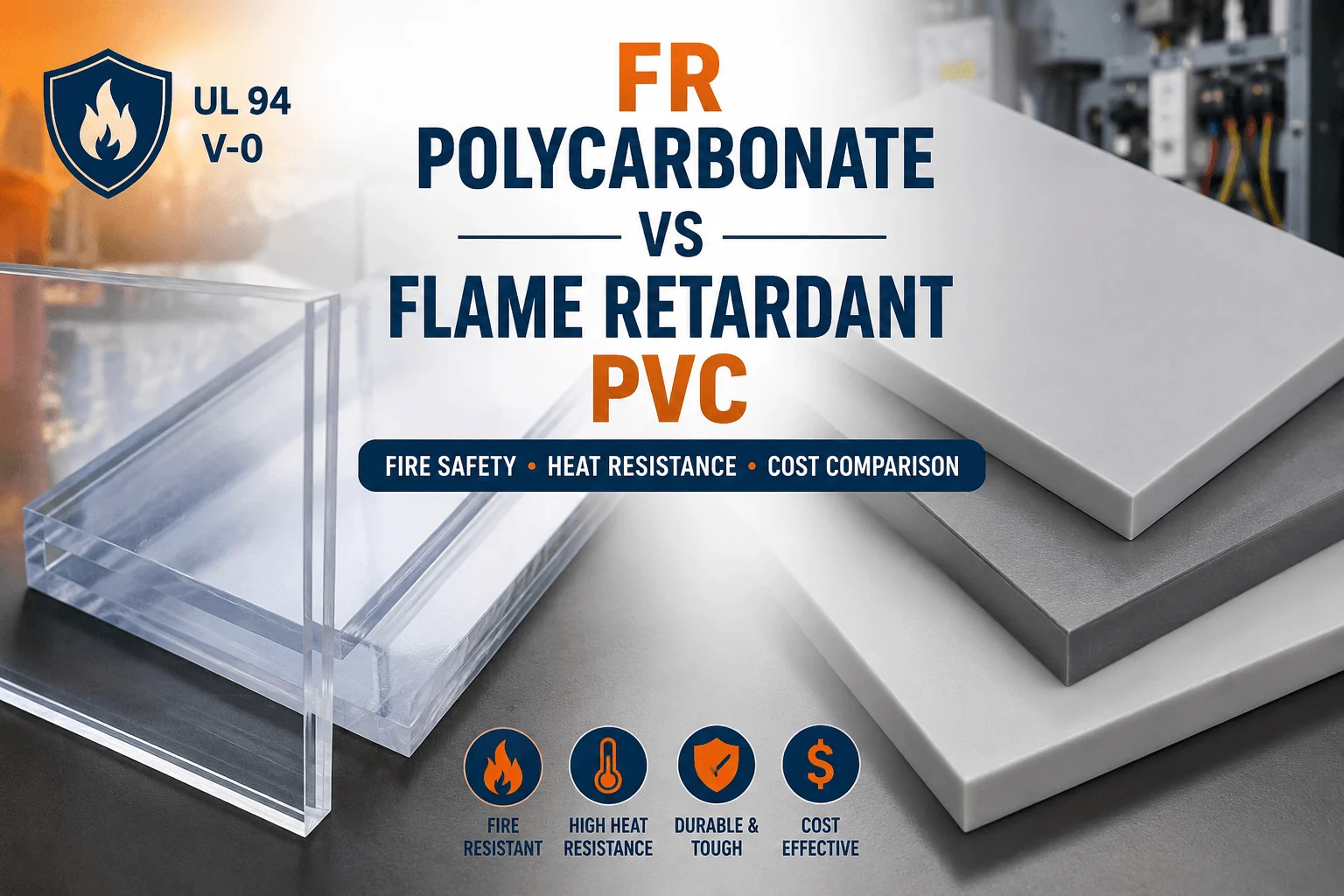
How Does FR Polycarbonate Compare to Flame Retardant PVC?
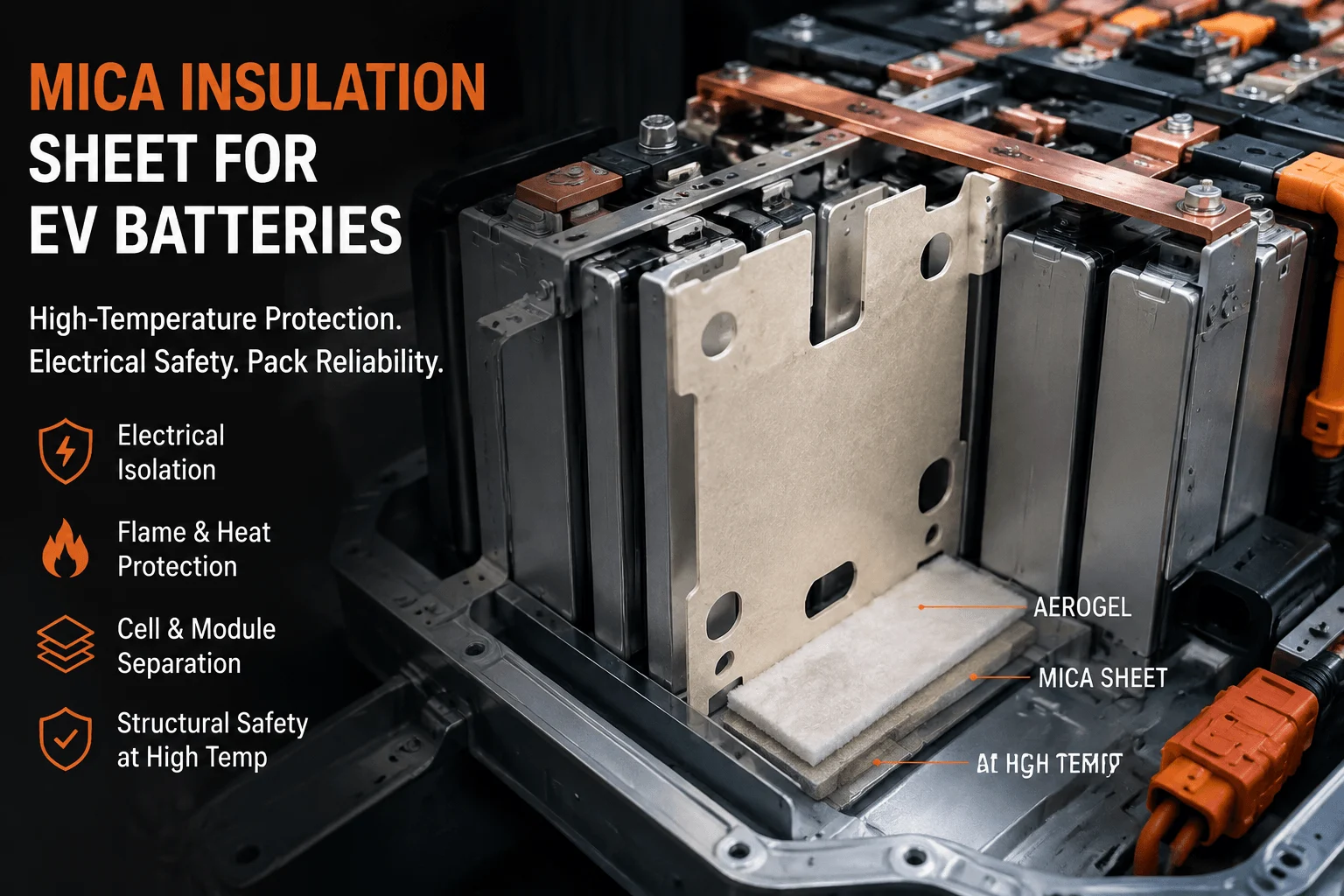
How Does a Mica Insulation Sheet Protect EV Batteries?
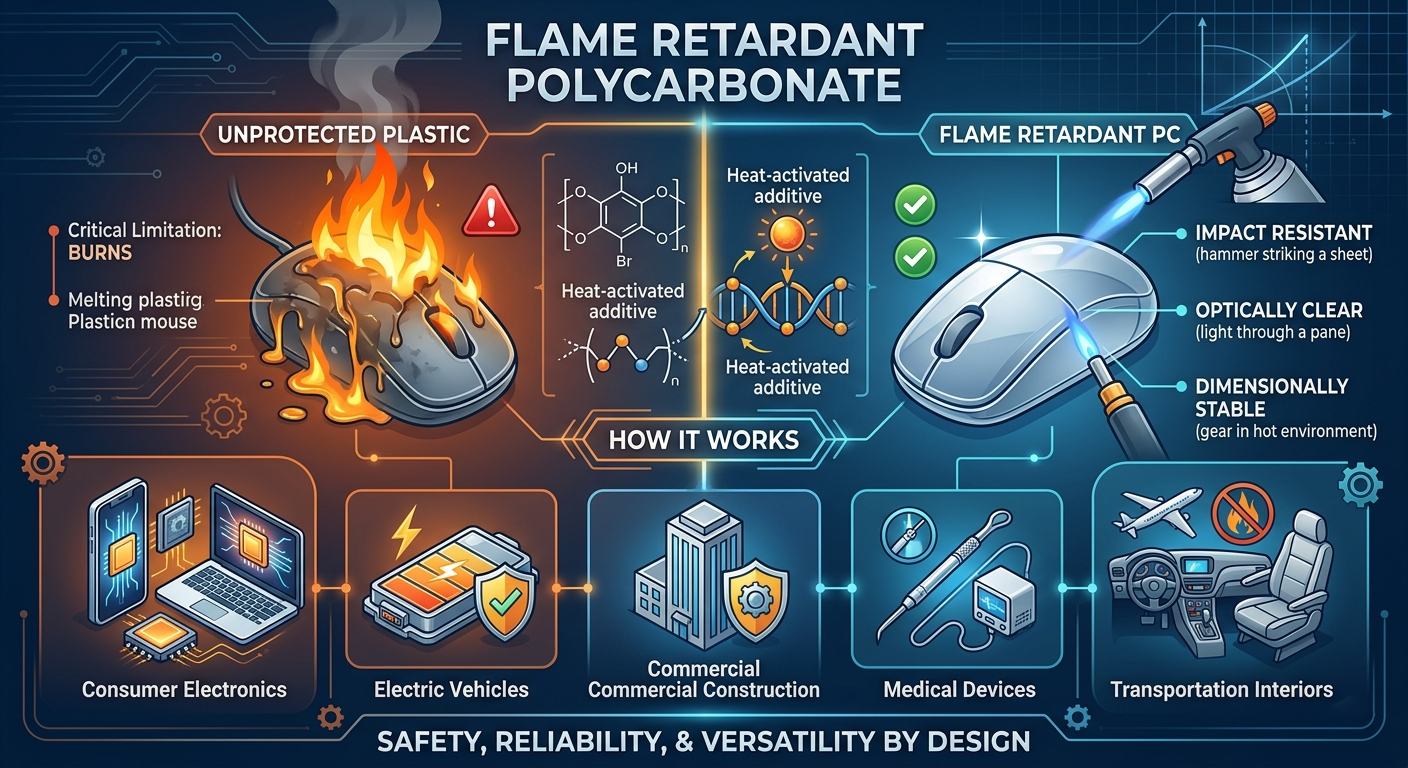
What Is Flame Retardant Polycarbonate and Why Does It Matter?
 betty wong