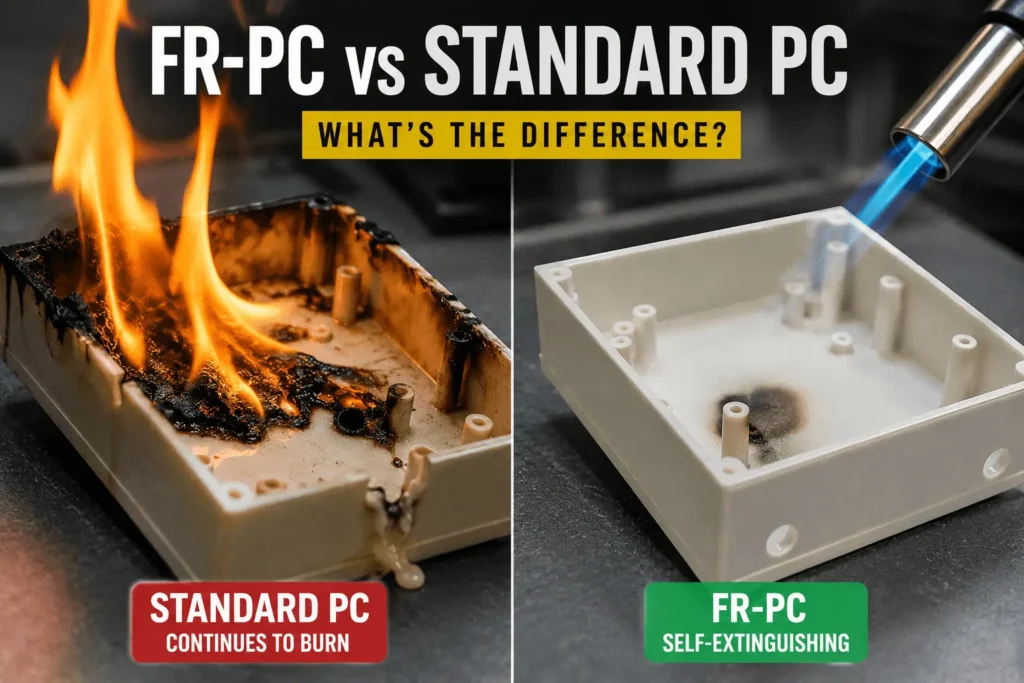
What’s the Difference Between FR-PC and Standard PC?
You’ve sourced the polycarbonate. Your prototype looks perfect. The mechanical tests pass. Then the UL certification lab calls: your enclosure failed the flame test. The part melted, dripped burning material, and kept burning for more than 30 seconds. Your product cannot ship. Now you’re six weeks behind schedule, facing a full material re-specification — and someone is asking why you didn’t specify flame retardant PC from the start.
If you’ve never had that conversation, you may not fully appreciate the gap between standard polycarbonate and its flame retardant counterpart. To the eye, FR-PC and standard PC can look identical — same pellet shape, similar color, comparable surface finish on a molded part. But in a fire test, or in a regulatory audit, or on a product liability claim, the difference between them is everything. One gives you a UL certification and market access. The other gives you a product recall.
This guide draws that line with precision. By the end, you’ll know exactly what separates FR-PC from standard PC, where each material belongs, and how to make the right choice for your application — before the certification lab does it for you.
⚑ QUICK ANSWER
These four differences ripple through every aspect of material selection, product design, manufacturing process, and market access strategy. The sections below unpack each one in detail — and introduce the nuances that determine which grade is right for your specific application.
1. What Is Standard Polycarbonate?
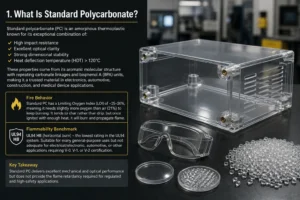
Standard polycarbonate is an amorphous thermoplastic polymer built around repeating carbonate linkages and bisphenol A (BPA) units. Its aromatic molecular backbone gives it a naturally high impact resistance, excellent optical clarity, strong dimensional stability, and a heat deflection temperature (HDT) that comfortably exceeds 120°C — properties that made it indispensable across electronics, automotive, construction, and medical device manufacturing.
From a fire perspective, standard PC is better behaved than many commodity plastics. Its aromatic structure promotes char formation rather than the melt-and-drip behavior seen in polyolefins. The Limiting Oxygen Index (LOI) of standard PC sits at approximately 25–26% — meaning it requires marginally more oxygen than ambient air (21%) to sustain combustion. In practice, standard PC is difficult to ignite from a distant spark, but once ignited with sufficient heat exposure, it will burn and propagate flame.
Standard PC flammability benchmark: UL94 HB (horizontal burn) — the lowest classification in the UL94 framework. This rating is acceptable for many general-purpose applications, but it is not sufficient for electrical/electronic equipment, enclosures with internal ignition sources, automotive interiors, or any product requiring V-0, V-1, or V-2 certification.
Standard PC is available in a wide range of grades optimized for optical clarity, high flow, UV stability, food contact, structural performance, and glass-fiber reinforcement — but none of these grades address fire behavior at the level demanded by modern safety standards.
2. What Is FR-PC (Flame Retardant Polycarbonate)?
FR-PC is polycarbonate that has been compounded with carefully selected flame retardant additives designed to interrupt the combustion cycle. The base polymer is the same — polycarbonate resin with its aromatic backbone — but the additive package transforms its fire behavior from “will burn” to “self-extinguishes.”
The two dominant FR chemistry families used in polycarbonate today are:
- Brominated compounds such as tetrabromobisphenol A (TBBPA) or brominated PC oligomers that work in the gas phase, releasing hydrogen bromide (HBr) to quench combustion radicals. These deliver outstanding V-0 performance at very thin wall sections (as low as 0.4mm) and are widely used in consumer electronics and connector applications.: Halogenated flame retardants
- Organophosphorus compounds such as RDP (resorcinol bis(diphenyl phosphate)) or BDP (bisphenol A bis(diphenyl phosphate)) that promote condensed-phase char formation. These are RoHS and REACH compliant, preferred in European markets and halogen-free environments, and typically achieve V-0 at 1.0mm and above.: Halogen-free flame retardants
Some FR-PC grades combine both approaches for maximum performance across a range of thicknesses, or incorporate secondary synergists (e.g., PTFE anti-drip agents) to suppress the burning drip behavior that fails V-0 and V-1 tests. The specific formulation determines the achievable UL94 rating, the minimum wall thickness for that rating, and the trade-offs in other material properties.
3. FR-PC vs Standard PC: Full Property Comparison
The table below summarizes the key differences across all material dimensions that matter to designers, procurement teams, and quality engineers.
|
Property |
Standard PC |
FR-PC |
|
UL94 Rating |
HB (horizontal burn) |
V-0, V-1, or V-2 (vertical) |
|
LOI Value |
~25–26% |
28–36% (grade dependent) |
|
Self-Extinguishing |
No — continues burning |
Yes — within 10 sec (V-0) |
|
Burning Drips |
Possible under sustained flame |
None permitted at V-0 / V-1 |
|
FR Additives |
None |
Halogenated or halogen-free |
|
Impact Resistance |
Excellent (850 J/m Izod notched) |
Good to excellent (varies by grade) |
|
Transparency |
High (optical grades >88%) |
Opaque or translucent typical |
|
HDT (@ 1.82 MPa) |
~125–135°C |
~115–130°C (slight reduction) |
|
Melt Flow Rate |
Wide range available |
Modified by FR additive package |
|
REACH / RoHS Status |
Fully compliant |
HF grades: compliant; halogenated: restricted in some uses |
|
Relative Material Cost |
Baseline |
15–40% premium (grade/volume dependent) |
|
Typical Applications |
Structural parts, optical lenses, safety glazing, non-regulated housings |
Electronics, EV systems, LED lighting, automotive interiors, medical enclosures |
4. Flame Performance: The Defining Difference in Detail
The most consequential difference between FR-PC and standard PC is not academic — it plays out in a laboratory where a technician applies a controlled flame to a hanging specimen and observes what happens next. Understanding the UL94 test helps you appreciate exactly how different these two materials are in practice.
How the UL94 Vertical Burn Test Works
- A specimen (typically 125mm × 13mm) is conditioned and mounted vertically.
- A 20mm methane flame is applied for 10 seconds, then removed.
- The time to self-extinguish is measured. Then the flame is reapplied for another 10 seconds.
- Burn time, drip behavior, and cotton ignition from drips are all recorded.
- The rating (V-0, V-1, or V-2) is determined by the worst result across five specimens.
|
Rating |
Max Burn per Flame Application |
Max Total Burn (5 specimens) |
Burning Drips Allowed? |
Standard PC Achieves This? |
|
V-0 |
≤10 seconds |
≤50 seconds |
No |
No |
|
V-1 |
≤30 seconds |
≤250 seconds |
No |
Rarely |
|
V-2 |
≤30 seconds |
≤250 seconds |
Yes (no cotton ignition) |
Sometimes |
|
HB |
Slow horizontal burn rate only |
N/A |
N/A |
Yes — typical result |
Why this matters: V-0 is required by IEC 60950 (IT equipment), UL 508 (industrial control equipment), UL 1642 (lithium batteries), and many automotive OEM specifications. A product housing made from standard PC cannot obtain these certifications — regardless of how well it performs on every other test.
5. Physical and Mechanical Property Differences
A common concern when switching from standard PC to FR-PC is: what do I give up? The answer is nuanced — and often less than engineers expect. The FR additive package does affect certain properties, but modern FR-PC formulations have advanced considerably in minimizing trade-offs.
Impact Resistance
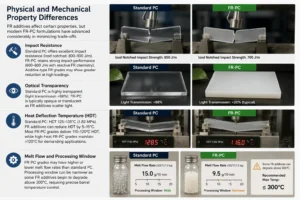
Standard PC is legendary for impact resistance — Izod notched impact strength of 800–900 J/m is typical. FR-PC grades, particularly those using reactive FR chemistry (like co-polymerized TBBPA), can retain 600–800 J/m impact strength — still excellent for most enclosure and structural applications. Additive-type FR grades, particularly at higher loading levels, may show greater reduction. For impact-critical applications, always request the specific impact data at your target wall thickness.
Optical Transparency
Standard PC is available in highly transparent grades (light transmission >88%) used in optical lenses, safety glasses, and light-diffusion panels. FR-PC grades are almost always opaque or at best translucent due to the nature of FR additives — halogenated compounds and phosphorus esters typically scatter light. If transparency is a design requirement, FR-PC is generally not the right material, and alternative approaches (such as FR coatings or inherently low-flammability clear materials like some FR PMMA grades) need to be considered.
Heat Deflection Temperature (HDT)
Standard PC exhibits HDT of 125–135°C under 1.82 MPa load. Phosphorus-based FR additives can act as a slight plasticizer in the PC matrix, reducing HDT by 5–15°C depending on loading level and grade. For most applications, an HDT of 110–120°C in FR-PC is entirely adequate. For high-heat applications (LED drivers, under-hood automotive components, EV battery systems), specify high-heat FR-PC grades — which use PC copolymers or secondary heat stabilizers to maintain HDT above 120°C even with FR additive loading.
Melt Flow and Processing Window
Some FR-PC grades exhibit altered melt flow rates compared to standard PC — either higher (improved flow for thin-wall applications) or lower (more viscous for structural applications). Additionally, the processing window may be narrower: some FR additives begin to degrade above 300°C, making precise barrel temperature control more critical than with standard PC. This is discussed further in the processing section below.
6. Regulatory and Certification Differences
Beyond the material test data, the regulatory difference between FR-PC and standard PC is where the business impact becomes most visible. The certifications and market access enabled by FR-PC are simply not available to standard PC in regulated applications.
What Standard PC Cannot Access
- UL 94 V-0 or V-1 Listed Material status — required by most electronic product safety standards.
- IEC 60950 / IEC 62368 compliance for IT and audio/video equipment.
- UL 508 certification for industrial control panels and enclosures.
- IEC 60335 compliance for household appliances, including GWIT/GWFI requirements.
- Automotive OEM fire performance specifications (FMVSS 302, BMW GS 97034, VW TL 1010).
- IEC 62133 / UN 38.3 compliance for battery-powered products with polymer enclosures.
What FR-PC Unlocks
A UL-listed FR-PC material carries a Yellow Card — a public, verifiable record in UL’s database that confirms the material’s fire rating at a specific thickness, under a specific company file number. When a product manufacturer uses a UL-listed FR-PC material for a component that appears on their UL product listing, that component’s fire rating is accepted without additional testing. This dramatically reduces certification timelines and costs.
Warning: Using a non-listed or unverified “FR” material — one with no UL Yellow Card — and claiming V-0 performance in a certification filing exposes the manufacturer to certification rejection, post-market audit risk, and product liability in the event of a fire-related incident.
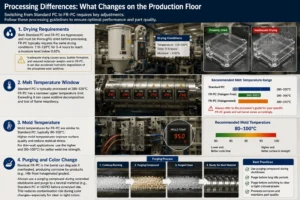
7. Processing Differences: What Changes on the Production Floor
For injection molders and processing engineers, the switch from standard PC to FR-PC introduces several important considerations. Ignoring them leads to degraded material performance, surface defects, and in worst cases, breakdown of the FR additive system — which compromises the very property you added it for.
Drying Requirements
Both standard PC and FR-PC are hygroscopic and must be thoroughly dried before processing. FR-PC typically requires the same drying conditions as standard PC: 110–120°C for 3–4 hours to reach a moisture level below 0.02%. Inadequate drying causes splay, bubble formation, and reduced molecular weight — and in FR-PC, it can also accelerate hydrolytic degradation of the phosphate ester additives.
Melt Temperature Window
Standard PC is typically processed at melt temperatures of 280–320°C. FR-PC, particularly halogen-free phosphorus grades, generally has a narrower upper temperature limit — often 280–300°C maximum before additive decomposition begins. Some halogenated grades are more thermally stable and can tolerate up to 310°C. Always consult the processor’s guide for your specific FR-PC grade and set barrel zones accordingly.
Mold Temperature
Mold temperatures for FR-PC are similar to standard PC: typically 80–100°C. Higher mold temperatures improve surface quality and reduce residual stress. For thin-wall applications where weld line strength matters, mold temperatures at the higher end of the range (90–100°C) are recommended.
Purging and Color Change
Residual FR-PC in a barrel that is subsequently overheated (during a machine stoppage or barrel temperature overshoot) can degrade and produce corrosive by-products — particularly from halogenated grades releasing HBr. Always use a purging compound during extended shutdowns, and purge to a neutral material (such as standard PC or HDPE) before any extended idle periods. This also reduces contamination risk when switching to clear or light-colored standard PC grades.
8. Cost Comparison: When the FR-PC Premium Is Worth It
FR-PC consistently commands a price premium over standard PC — typically 15–40% on a per-kilogram basis, depending on grade, additive system, and order volume. For procurement teams under cost pressure, this premium demands justification.
The True Cost of Using Standard PC in a Regulated Application
- $10,000–$50,000+ for full UL certification cycles, multiplied by each failed attempt.: Certification failure and re-testing fees
- Engineering time and tooling changes if the enclosure must be redesigned for a compliant material.: Product re-design costs
- Each additional certification cycle adds weeks or months to a launch schedule.: Delayed time-to-market
- If a non-compliant product reaches the market and a fire incident occurs, recall costs can run into millions.: Recall and remediation
- Product liability exposure is substantially higher for non-compliant materials.: Insurance and liability
Perspective: The material cost premium of FR-PC over standard PC for a typical electronic enclosure is rarely more than a few cents per unit. The cost of a single failed UL certification cycle can exceed the total material savings of an entire production run. For any regulated application, FR-PC is almost always the lower-cost decision over the product lifecycle.
The exceptions are applications genuinely outside the scope of fire regulations — certain structural components, machine guards, outdoor construction glazing, and unregulated industrial parts where fire safety certification is not required and the end-use environment does not present ignition risk. For these, standard PC remains the right choice economically and technically.
9. How to Choose: FR-PC or Standard PC?
Use this decision framework to determine which material your application requires:
|
If your application involves… |
Choose… |
|
Any electrical/electronic product with internal power source |
FR-PC (V-0 or V-1 required) |
|
EU market product (household, industrial, IT) |
Halogen-free FR-PC (RoHS/REACH compliance) |
|
Automotive interior or under-hood component |
FR-PC meeting FMVSS 302 and OEM spec |
|
EV battery housing or BMS cover |
FR-PC V-0, GWFI 960°C rated |
|
Structural bracket with no ignition exposure (no power) |
Standard PC (unless OEM spec requires FR) |
|
Optical lens or light guide (transparency critical) |
Standard PC (FR alternatives very limited for clear parts) |
|
Machine guard or safety glazing (industrial, no electrical) |
Standard PC — impact performance takes priority |
|
Medical device enclosure (FDA, ISO 13485 scope) |
FR-PC with biocompatibility certification (USP Class VI) |
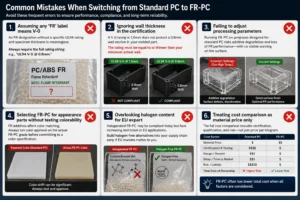
10. Common Mistakes When Switching from Standard PC to FR-PC
Even experienced engineers make avoidable errors when transitioning to FR-PC. These are the ones that appear most frequently:
- An FR designation without a specific UL94 rating and specimen thickness is meaningless. Always require the full rating string: e.g., ‘UL94 V-0 @ 0.8mm.’: Assuming any ‘FR’ label means V-0
- A V-0 rating at 1.6mm does not protect a 0.8mm wall section in your molded part. The rating must be equal to or thinner than your minimum actual wall.: Ignoring wall thickness in the certification
- Running FR-PC on programs designed for standard PC risks additive degradation and loss of FR performance in the finished part — with no visible warning on the surface.: Failing to adjust processing parameters
- FR additives affect color matching. Always run color approval on the actual FR-PC grade before committing to a color specification.: Selecting FR-PC for appearance parts without testing colorability
- Halogenated FR-PC may be compliant today but face increasing restriction in EU applications. Build halogen-free alternatives into your supply chain early if EU markets matter to you.: Overlooking halogen content for EU export
- The full cost comparison includes certification, qualification, and risk — not just price per kilogram.: Treating cost comparison as material price only
The Bottom Line: Not All Polycarbonate Is Created Equal
FR-PC and standard PC share the same foundational polymer chemistry — but they are categorically different materials from a fire safety, regulatory, and application engineering perspective. Standard PC is the right material for applications where flame retardancy is not required and its excellent mechanical and optical properties can be fully utilized. FR-PC is the right material — and often the only legal material — for the wide and growing range of applications where fire safety, UL certification, and regulatory compliance are non-negotiable.
The choice between them is not primarily a cost decision or a performance preference. It is a question of what your application demands, what your target market requires, and what liability you are prepared to carry. Specify correctly from the start, and the 15–40% material cost premium of FR-PC is one of the best investments a product engineer can make.
Not Sure Whether Your Application Needs FR-PC or Standard PC?
Our materials engineering team works with electronics manufacturers, EV suppliers, lighting designers, and industrial equipment builders every day — helping them select the right polycarbonate grade for their specific application, regulatory environment, and processing conditions. We supply both standard and flame retardant PC compounds across a full range of UL94 ratings, wall thicknesses, and FR chemistries, with complete certification documentation and technical support.
Related Posts:
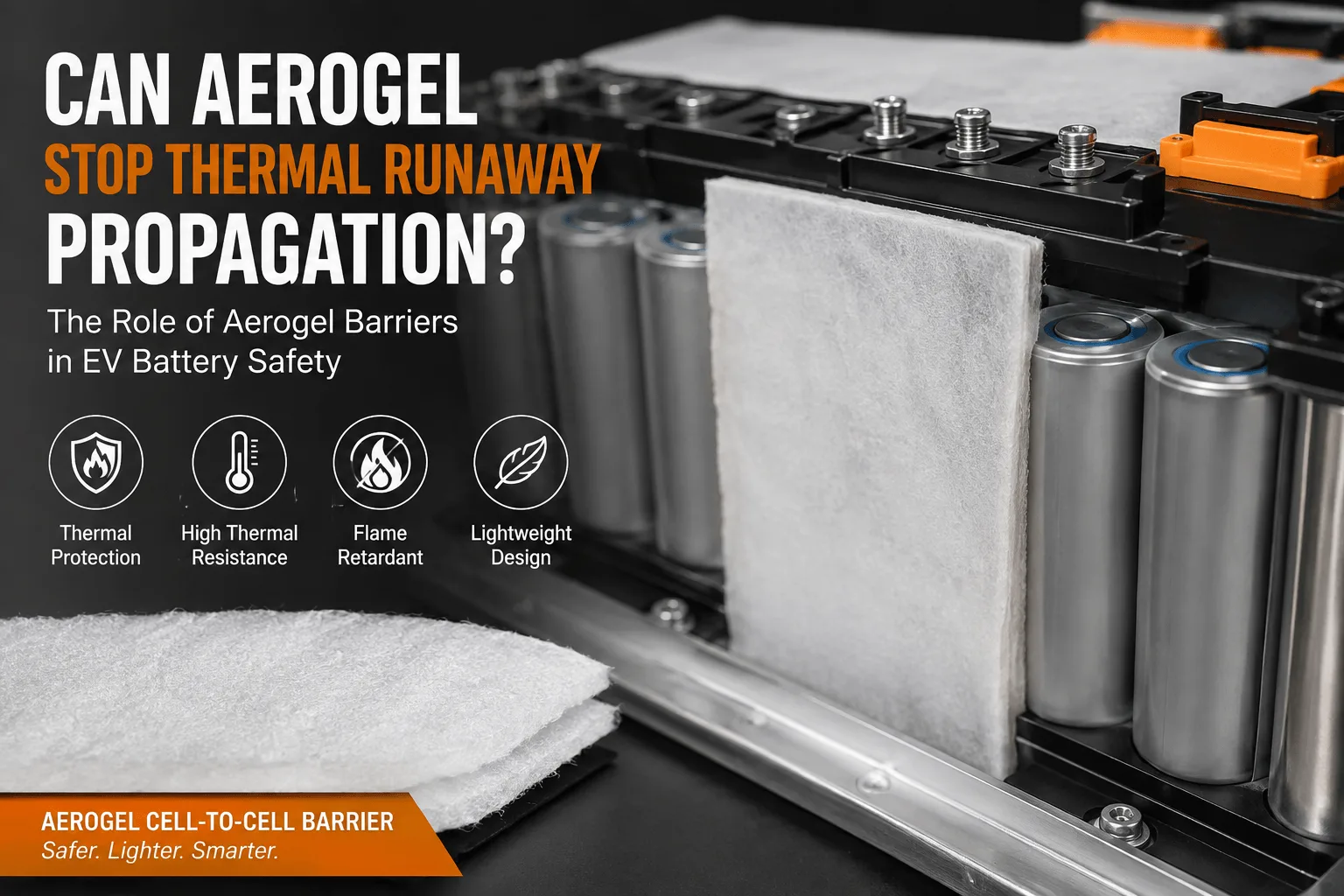
Can Aerogel Stop Thermal Runaway Propagation in EV Packs?
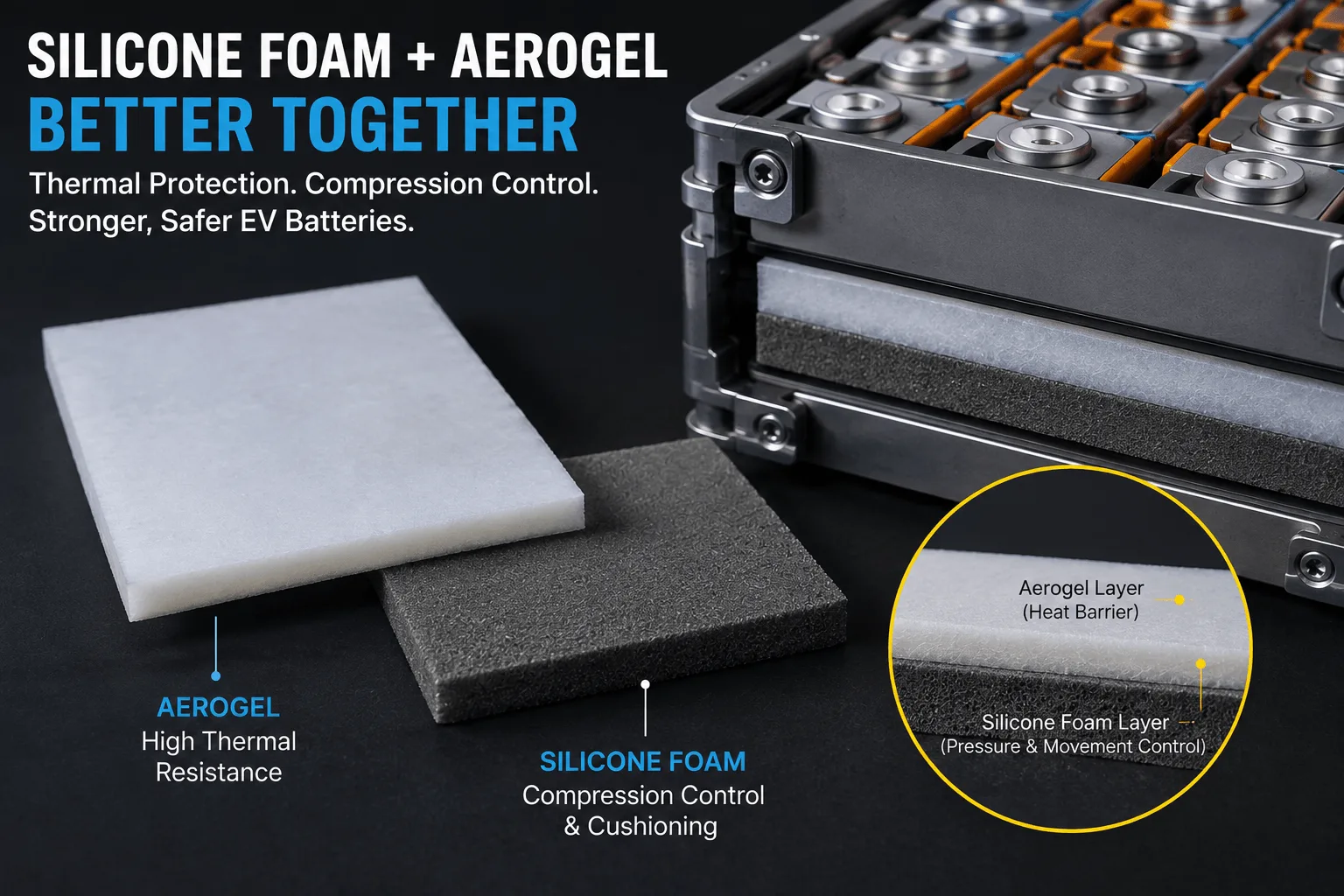
How Does Silicone Foam Work With Aerogel Barriers?
Why Do EV Battery Packs Need Aerogel Insulation Today?
How Much Delay Can an Aerogel Barrier Provide in EV Packs?
How Does Mica Insulation Compare With Polycarbonate?
How Does Flame Retardant Polycarbonate Compare to FR ABS Plastic?
 betty wong