Why Choose a China Factory for Die-Cut Insulation?
Table of Contents
You’re sourcing die-cut insulation parts for electronics, automotive components, or industrial equipment — and the clock is ticking. Lead times, tolerances, material compatibility, and cost all have to align perfectly. Miss one, and you’re explaining delays to your engineering team or watching your margin evaporate. So the question isn’t whether to source strategically — it’s where. Thousands of procurement managers, product engineers, and supply chain directors have already found their answer. And it almost always points to the same place.
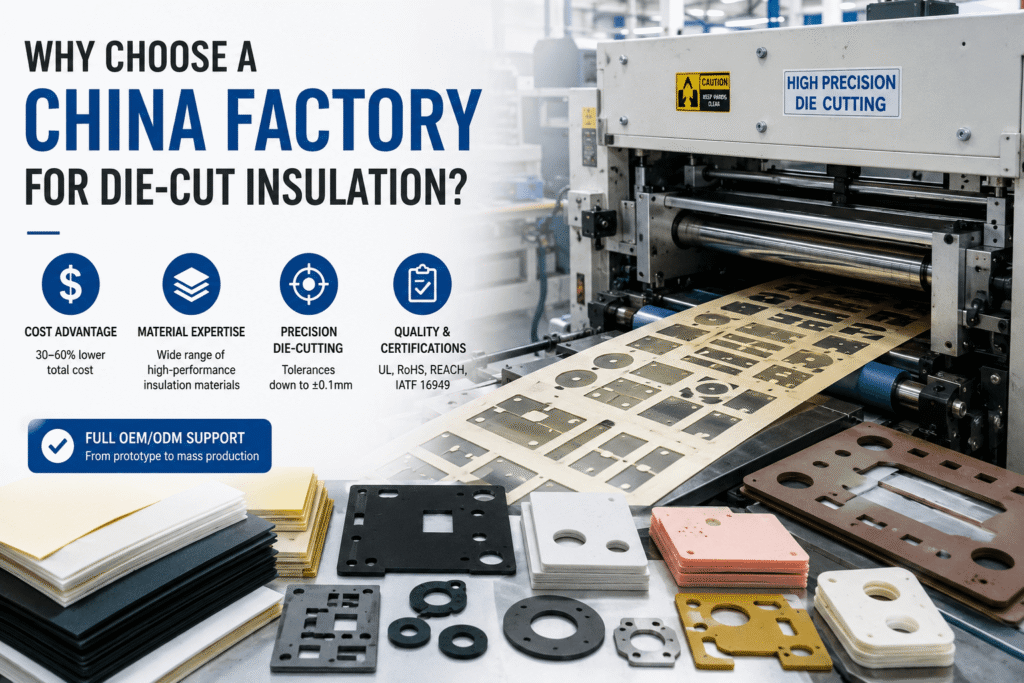
Why choose a China factory for die-cut insulation? Because China-based die-cut insulation manufacturers offer an unmatched combination of competitive unit pricing (typically 30–60% lower than Western suppliers), extensive material expertise across FR4, Nomex, PET, PTFE, silicone foam, and more, tight tolerances down to ±0.1mm, flexible MOQs from prototype to mass production, and full OEM/ODM support — all backed by internationally recognized certifications including UL, RoHS, REACH, and IATF 16949. For global buyers, no other sourcing region delivers this breadth of capability at this price point.
The Global Demand for Die-Cut Insulation — And Why Sourcing Matters
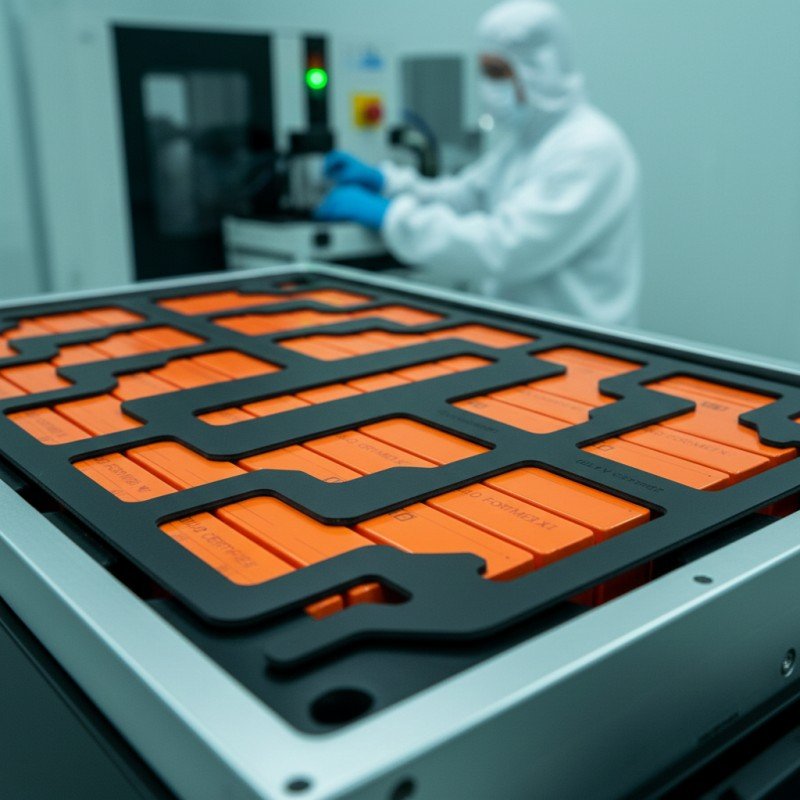
Die-cut insulation is not a commodity. It is a precision-engineered component that sits inside your EV battery pack, your server’s power supply, your medical device chassis, or your HVAC system — performing silently but critically. The wrong cut, the wrong material, the wrong thickness, and you face short circuits, thermal failures, or regulatory rejections.
This precision requirement is exactly why so many engineers and procurement teams have migrated their die-cut insulation sourcing to specialized Chinese factories. The Chinese manufacturing ecosystem has spent two decades building the tooling, material supply chains, and process expertise to serve exactly this need — at scale, at speed, and at a price no competitor can easily replicate.
The global die-cut insulation market is growing rapidly, driven by electrification of vehicles, expansion of consumer electronics, and stricter safety regulations in industrial equipment. Meeting this demand requires a supplier that can move fast, customize freely, and hold tight quality standards. China’s die-cut insulation factories have built their entire operational model around exactly these requirements.
1. Cost Advantage That Goes Beyond the Unit Price
The most immediate reason buyers consider a China factory for die-cut insulation is cost. But the real advantage goes far deeper than a lower per-piece price on your quote sheet.
Raw Material Access at the Source
China is one of the world’s largest producers and processors of insulation materials — from polyimide films and aramid papers to silicone rubber, PET films, and non-woven fabrics. Chinese factories source these materials domestically at volumes that dramatically reduce input costs. Western suppliers import many of the same materials, adding logistics cost, import duties, and currency risk before a single part is cut.
Tooling Economics
Die-cut tooling — the steel-rule dies or rotary dies used for precision cutting — is manufactured locally in China at a fraction of the cost charged by European or North American toolmakers. A custom die set that might cost $800–$2,000 from a US supplier can often be produced for $150–$500 in China, with no compromise in accuracy or lifespan. This opens the door to more frequent design iterations without punishing tooling fees.
Labor and Overhead Structure
China’s manufacturing labor costs remain significantly lower than those in developed economies, even as wages have risen over the past decade. More importantly, specialized manufacturing clusters — regions where dozens of insulation material processors, die-cutting shops, and finishing facilities operate in close proximity — create shared infrastructure that reduces overhead for every participant in the ecosystem.
The combined effect: buyers regularly report total landed cost savings of 30% to 60% compared to equivalent parts sourced domestically in Europe or North America, even after accounting for ocean freight, duties, and inspection costs.
2. Material Expertise Across Every Insulation Category
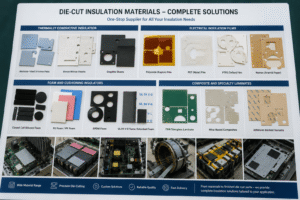
A China die-cut insulation factory worth sourcing from isn’t a shop that cuts one or two standard materials. The leading facilities handle a comprehensive range of insulation substrates, each with its own processing requirements, and can guide buyers toward the optimal material for their specific application.
Thermally Conductive Insulation
- Alumina-filled silicone pads for LED drivers and power modules
- Boron nitride composite sheets for high-power electronics
- Graphite sheets for lateral heat spreading in compact devices
Electrical Insulation Films
- Polyimide (Kapton) film — the gold standard for high-temperature, high-voltage applications
- PET (Mylar) film — cost-effective for general electrical isolation
- PTFE (Teflon) — for extreme chemical resistance and low friction surfaces
- Nomex (aramid paper) — for transformer slot liners and motor insulation
Foam and Cushioning Insulators
- Closed-cell silicone foam for sealing and vibration damping with thermal insulation
- PU foam, PE foam, and EPDM foam for gasketing and acoustic damping
- UL 94 V-0 rated foam for flame-retardant requirements
Composite and Specialty Laminates
- FR4 fiberglass laminate for rigid electrical insulation boards
- Mica-based composites for extreme temperature applications
- Adhesive-backed variants for direct assembly integration
The ability to source, process, and precision-cut all these material categories under one roof — or within a tightly integrated supplier cluster — is one of the strongest structural advantages a China factory offers. It eliminates the need to manage multiple material-specialist vendors for a single product family.
3. Precision Die-Cutting Capabilities at Industrial Scale
Die-cutting sounds simple. It is not. Achieving consistent ±0.1mm tolerances across tens of thousands of pieces, on materials ranging from 0.05mm polyimide film to 10mm silicone foam, requires sophisticated equipment, experienced operators, and tightly controlled processes.
Cutting Technologies Available
Flatbed Die-Cutting: Ideal for complex geometries, small batches, and thick materials. Precision steel-rule or solid dies mounted in a hydraulic press deliver clean edges even on adhesive-coated materials.
Rotary Die-Cutting: High-speed continuous cutting for large-volume production runs. Rotary dies maintain consistent registration and are preferred for thin films and roll-to-roll processing.
Laser Cutting: No tooling cost, unlimited geometric freedom, ideal for prototyping and low-volume complex parts. China factories increasingly offer fiber and CO₂ laser cutting as a standard capability alongside traditional die-cutting.
Kiss-Cutting and Laminating: Die-cut through the material without cutting the liner — essential for peel-and-stick insulation pads. Multi-layer laminating lines combine different insulation, adhesive, and liner materials in a single pass.
Leading Chinese factories maintain CNC-machined dies with hardened steel inserts, automatic registration systems, and 100% optical inspection for critical dimensions. This level of infrastructure is not available at most small-to-mid-size local converters outside China.
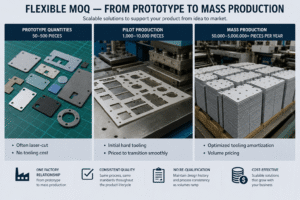
4. Flexible MOQ — From Prototype to Mass Production
One of the most practical advantages of working with a China die-cut insulation factory is MOQ flexibility. Many engineering teams need small prototype runs to validate a new design before committing to production volumes. Traditional Western tooling costs make this expensive. China factories have structured their operations to serve both needs efficiently.
- Prototype quantities: 50–500 pieces, often laser-cut to eliminate tooling cost entirely
- Pilot production: 1,000–10,000 pieces with initial hard tooling, priced to transition smoothly
- Mass production: 50,000–5,000,000+ pieces per year, with optimized tooling amortization and volume pricing
This scalability means a single factory relationship can carry a product from first prototype through full production lifecycle. Engineers are not forced to re-qualify a new supplier when volumes ramp, maintaining design history and process consistency throughout.
5. OEM and ODM Capability — Built for Your Specifications
The distinction between OEM (Original Equipment Manufacturer) and ODM (Original Design Manufacturer) matters for die-cut insulation buyers. China factories offer both:
OEM service: You provide drawings, specifications, and material requirements. The factory manufactures exactly to your design, with your branding if required. Full IP protection through NDA and manufacturing agreements.
ODM service: The factory’s engineering team collaborates on material selection, geometry optimization, and assembly integration. Valuable when you have a functional requirement — thermal management, EMI shielding, vibration isolation — but need help translating it into a manufacturable die-cut insulation design.
China’s leading die-cut insulation factories employ application engineers who understand the downstream systems their products serve — power electronics, battery modules, motors, transformers. This domain knowledge accelerates design-for-manufacturing and prevents costly redesigns after tooling is committed.
6. Quality Systems and International Certifications
A common hesitation about sourcing from China is quality consistency. This concern made sense fifteen years ago. Today’s leading Chinese die-cut insulation manufacturers have invested heavily in quality infrastructure that meets or exceeds international standards.
Certifications Commonly Held
- ISO 9001:2015 — Quality Management System baseline
- IATF 16949 — Automotive-grade quality systems for die-cut insulation used in EV and traditional automotive
- UL Recognition — Material and component approval for North American markets
- RoHS and REACH compliance — Hazardous substance restriction compliance for EU markets
- IEC and GB standards for relevant electrical insulation performance parameters
In-Process Quality Controls
- First article inspection (FAI) with dimensional reports for every new tooling
- Automatic optical inspection (AOI) systems for high-volume runs
- Dielectric strength, breakdown voltage, and thermal conductivity testing in-house
- Statistical process control (SPC) on critical dimensions in mass production
- Full material traceability from raw material lot to finished part
Reputable China factories provide incoming quality control reports for raw materials, in-process inspection records, and outgoing quality inspection (OQI) documentation with each shipment. For buyers supplying to regulated industries — automotive, medical, aerospace — this documentation trail is non-negotiable, and China’s best factories deliver it as standard practice.
China Factory vs Other Sourcing Options: A Direct Comparison
To make the sourcing decision concrete, here is a side-by-side comparison of key factors:
| Factor | China Factory | Local Supplier | Other Asia |
| Unit Price | ★★★★★ Lowest | ★★ Highest | ★★★★ Low |
| MOQ Flexibility | ★★★★★ Very Flexible | ★★★ Moderate | ★★★ Moderate |
| Material Range | ★★★★★ Full Spectrum | ★★★ Limited | ★★★ Limited |
| Lead Time | ★★★★ 7–25 Days | ★★★ 5–15 Days | ★★★ 10–30 Days |
| Custom Die-Cut Precision | ★★★★★ ±0.1mm | ★★★★ ±0.2mm | ★★★★ ±0.2mm |
| OEM/ODM Capability | ★★★★★ Full | ★★ Limited | ★★★ Partial |
| Certifications | UL, RoHS, IATF | Local Only | Varies |
This comparison reflects the general market reality. Individual suppliers in every region vary. The point is that China’s die-cut insulation manufacturing sector has structurally positioned itself to win on the combination of factors that matter most to volume buyers: cost, capability, and flexibility.
7. Fast Tooling and Lead Time Management
Time-to-market pressure is real. A die-cut insulation part that holds up production because tooling is delayed two weeks is not a commodity — it becomes a critical path item. China die-cut factories have optimized their tooling production and scheduling processes around this reality.
- Steel-rule die tooling: typically 3–7 business days from drawing approval
- Solid machined dies: 5–12 business days depending on complexity
- First production samples: delivered within 7–15 business days from tooling approval
- Mass production lead time: 10–25 days for standard orders, expedite available
With established China factory partners, many buyers pre-position tooling for their standard part families and maintain Kanban-style inventory agreements that allow weekly or bi-weekly pull quantities. This converts what might seem like a long-distance supply chain risk into a reliable, predictable replenishment system.
8. Supply Chain Transparency and Communication
Modern China die-cut insulation factories serving international customers have invested in English-speaking sales and technical teams, digital communication infrastructure, and supply chain visibility tools. Video factory audits, real-time production progress updates, and digital quality documentation have become standard expectations — and the better suppliers meet them without friction.
The factories that have built strong international customer bases have done so through transparency: clear quotation breakdowns, honest lead time commitments, proactive communication about material availability, and clean handoffs through customs and logistics. Buyers who have experienced poor China sourcing in the past often discover the issue was supplier selection, not geography.
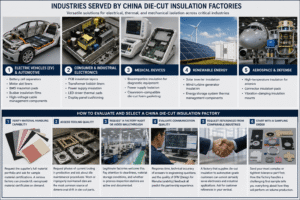
Industries Served by China Die-Cut Insulation Factories
The versatility of die-cut insulation manufacturing in China spans virtually every sector that requires electrical, thermal, or mechanical isolation:
Electric Vehicles (EV) and Automotive: Battery cell separators, motor slot liners, BMS insulation pads, busbar insulation films, and high-voltage cable management components.
Consumer and Industrial Electronics: PCB insulation layers, transformer bobbin liners, power supply insulation, LED driver thermal pads, and display panel cushioning.
Medical Devices: Biocompatible insulation for diagnostic equipment, power supply isolation, and cleanroom-compatible die-cut foam gasketing.
Renewable Energy: Solar inverter insulation, wind turbine generator insulation, and energy storage system thermal management components.
Aerospace and Defense: High-temperature insulation for avionics, connector insulation pads, and vibration-damping insulation mounts.
How to Evaluate and Select a China Die-Cut Insulation Factory
Not every China factory is the right partner. Here is a structured evaluation approach:
- Verify material handling capability — request the supplier’s full material portfolio and ask for sample material certifications. A serious factory can provide UL-recognized material certificates on demand.
- Assess tooling quality — request photos of current tooling in production and ask about die maintenance procedures. Worn or improperly maintained dies are the most common source of dimensional drift in die-cut parts.
- Request a factory audit or video walkthrough — legitimate factories welcome this. Pay attention to cleanliness, material storage conditions, and whether in-process inspection stations are active and documented.
- Evaluate communication quality — response time, technical accuracy of answers to engineering questions, and the quality of DFM (Design for Manufacturability) feedback all predict the partnership experience.
- Request references from comparable industries — a factory that supplies die-cut insulation to automotive-grade customers can almost certainly serve electronics and industrial applications. Ask for customer references in your vertical.
- Start with a sampling order — send your most complex or tightest-tolerance part first. How the factory handles a challenging first sample tells you everything about how they will perform on volume production.
Common Questions from Buyers Sourcing Die-Cut Insulation from China
What is the minimum order quantity?
It depends on the factory and the material. Laser-cut prototypes can be as low as 10–50 pieces. Die-cut production typically starts at 500–2,000 pieces for initial orders, with many factories offering no minimum for repeat orders once tooling is established.
How long does shipping take?
Express air freight (DHL, FedEx, UPS): 3–5 business days. Air freight: 7–10 days. Sea freight LCL (less-than-container load): 20–35 days depending on destination port. Most prototype and initial sample shipments go by express. Production orders typically use sea freight or air freight based on urgency and volume.
Can I get NDA protection for my designs?
Yes. Reputable China factories routinely sign non-disclosure agreements before reviewing customer drawings. For sensitive applications, buyers can also register tooling ownership agreements, ensuring that custom dies remain the intellectual property of the buyer and cannot be used for third-party production.
How do I ensure material authenticity?
Request incoming material inspection reports and ask for original manufacturer material certificates (from DuPont, 3M, Rogers Corporation, Saint-Gobain, etc.) that trace the material to the certified source. Spot-testing incoming materials for key properties — dielectric strength, thermal conductivity, flammability rating — adds an additional verification layer for critical applications.
Conclusion: The Strategic Case for China Die-Cut Insulation
The question is not really “why choose a China factory for die-cut insulation?” — it is “what are you waiting for?” The combination of cost competitiveness, material breadth, manufacturing precision, OEM/ODM flexibility, and internationally recognized quality systems has made China’s die-cut insulation sector the preferred sourcing destination for engineers and procurement teams worldwide.
Whether you are designing your first battery pack, scaling a consumer electronics product, or optimizing an existing supply chain, partnering with the right China die-cut insulation factory delivers outcomes that are difficult or impossible to replicate at comparable cost anywhere else.
The key is supplier selection. The manufacturing capability is there. The materials are there. The quality systems are there. The question is which factory you choose to build that partnership with — and how quickly you start.
Related Posts:
How Does a Mica Insulation Sheet Compare With FR4 Boards?
Which Aerogel Grade Is Best for High-Voltage EV Cells?
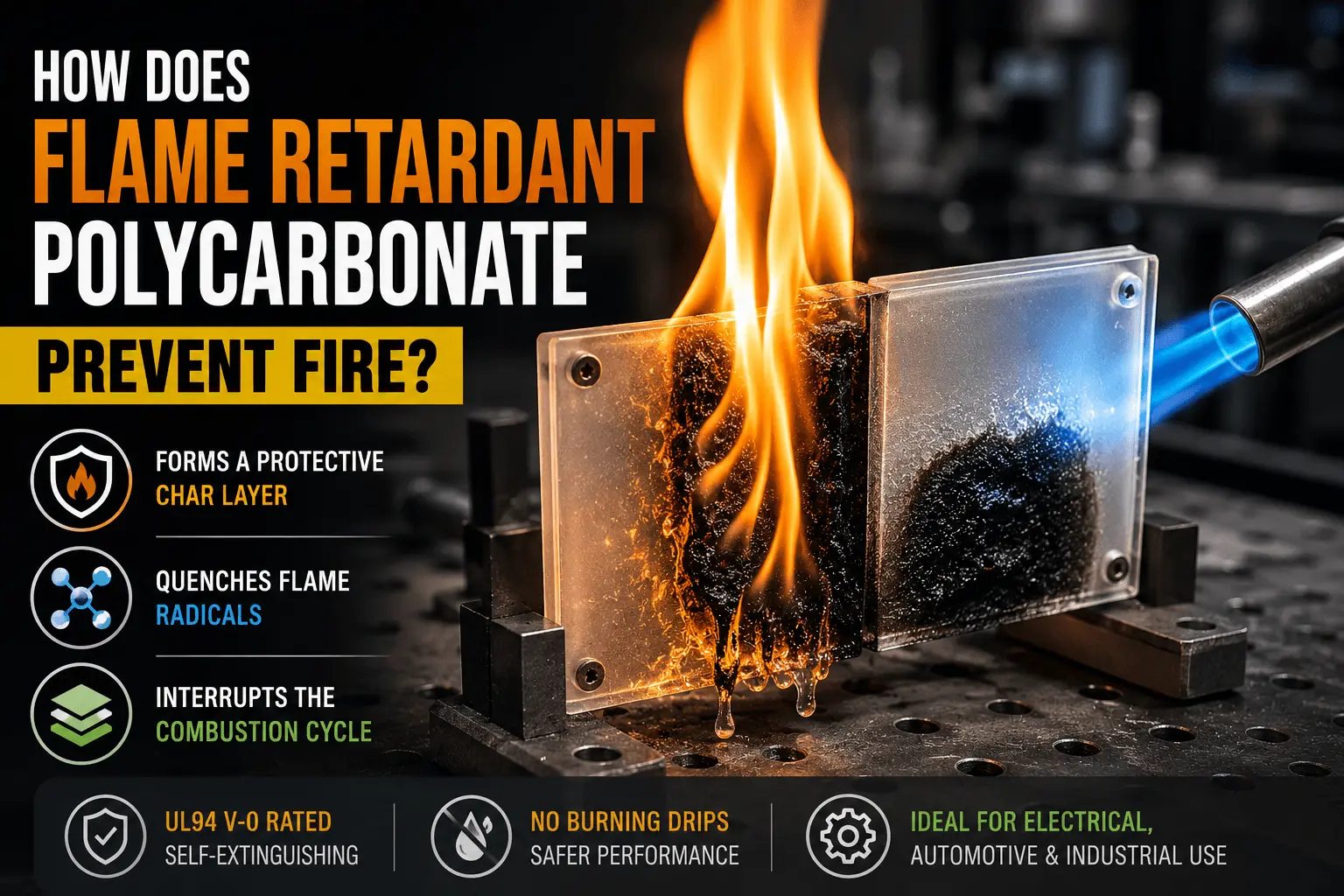
How Does Flame Retardant Polycarbonate Prevent Fire?
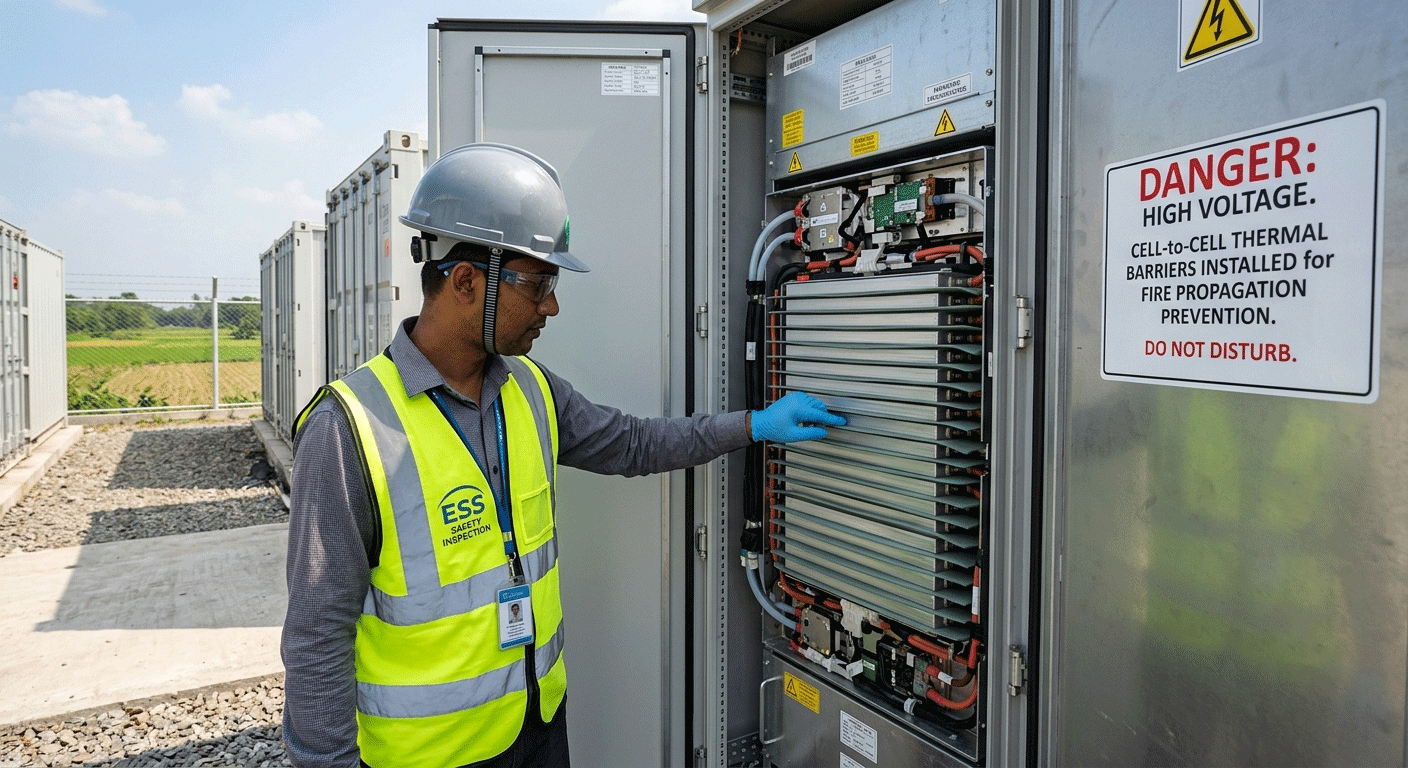
How Does Cell-to-Cell Thermal Barrier Improve ESS Safety?
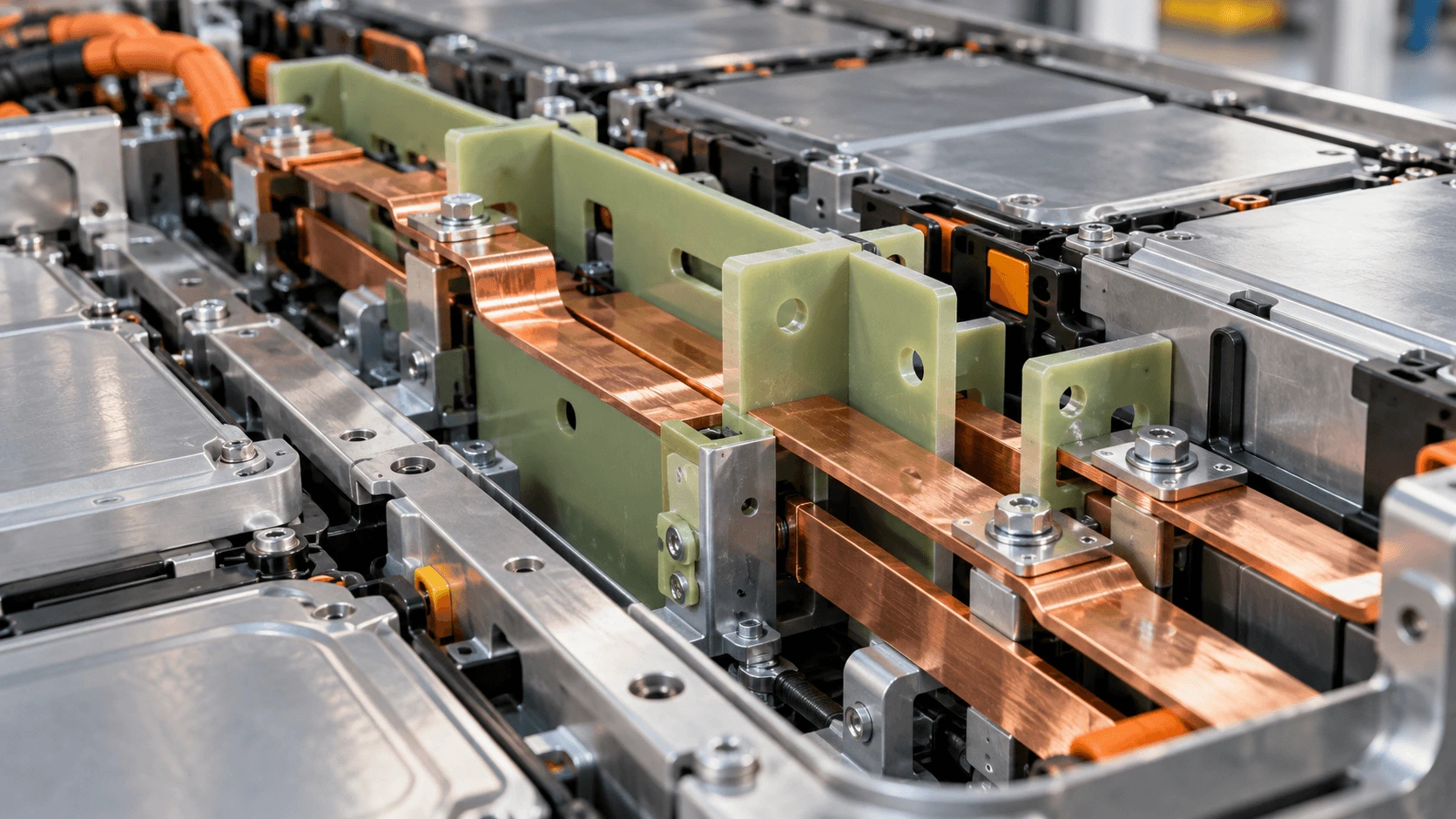
How Does FR4 Insulate EV Battery Busbars?
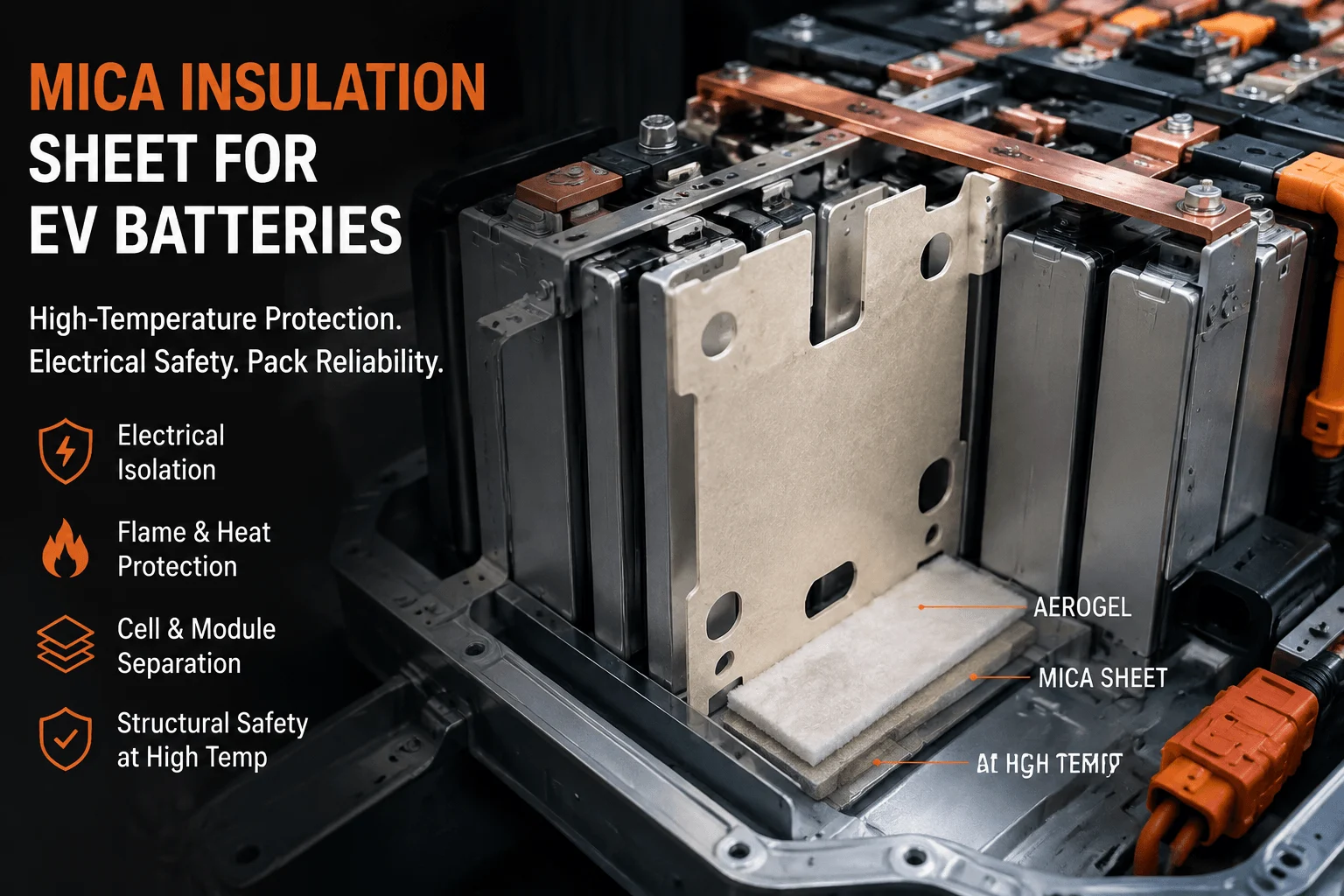
How Does a Mica Insulation Sheet Protect EV Batteries?
 betty wong