What Is ESS Energy Storage Solution & How It Works?
Table of Contents
Your electricity bill just hit a record high. The grid went down for two hours last Tuesday. Your diesel generator cost you $4,000 in fuel last month alone — and that’s before carbon taxes. Sound familiar?
If you’re running a factory, managing a commercial facility, or developing a renewable energy project, energy instability isn’t just an inconvenience — it’s a direct threat to your bottom line. The good news: there’s a smarter way to manage power. More and more forward-thinking businesses are turning to ESS energy storage solutions to cut costs, guarantee reliability, and future-proof their operations. But what exactly is an ESS, how does it work, and — most importantly — is it the right fit for your project?
This guide answers every question you need to make a confident decision.
⚑ QUICK ANSWER
1. What Is an ESS Energy Storage Solution?
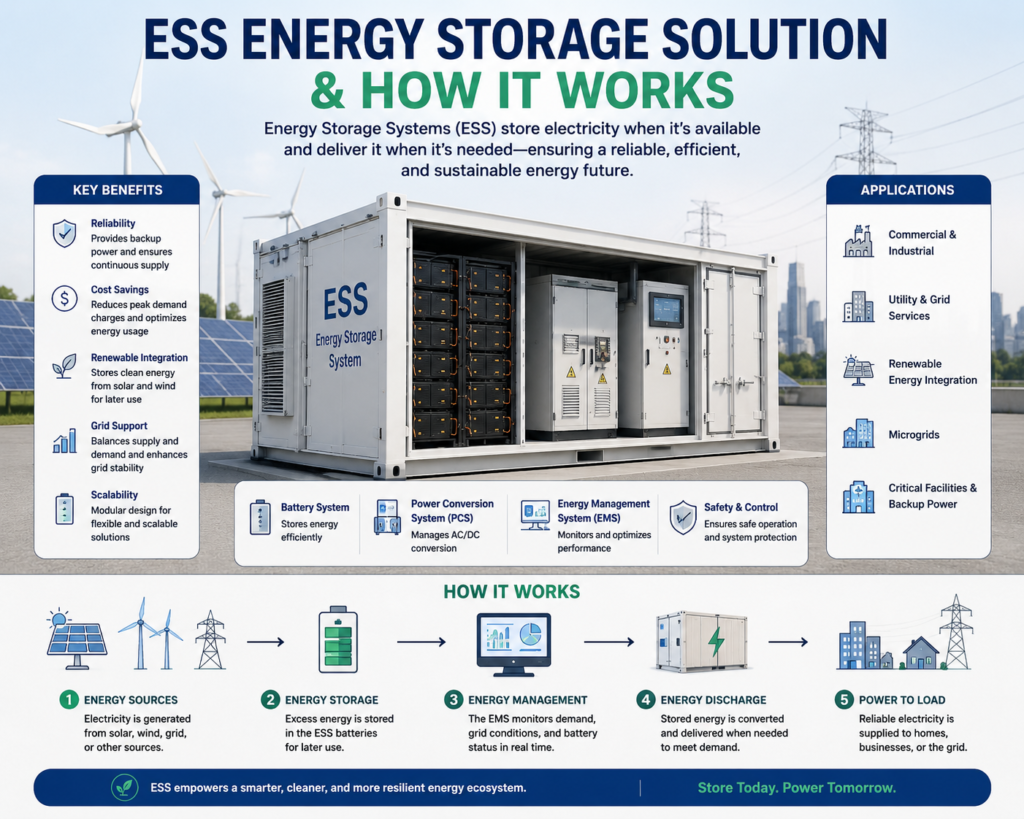
The term ESS — short for Energy Storage Solution — refers to any system that can store electrical energy and discharge it when needed. While the concept of storing energy is not new, modern ESS platforms are highly sophisticated, digitally managed ecosystems that integrate hardware, software, and communication protocols into a single, controllable unit.
Think of an ESS as a large, intelligent rechargeable battery for a building, a factory, or even a power grid. Unlike a simple UPS (uninterruptible power supply) that only offers a few minutes of emergency backup, a well-designed ESS can store hours — or even days — of energy, actively manage power flow in real time, and communicate with grid operators, renewable generation assets, and building management systems simultaneously.
The global energy storage market is expanding rapidly. According to industry research, the global battery energy storage system (BESS) market is projected to exceed USD 120 billion by 2030, driven by the explosive growth of solar and wind power, increasing electricity prices, grid modernization initiatives, and stricter carbon emission regulations. For businesses and developers, this is not a future technology — it is an operational necessity today.
ESS vs. Traditional Backup Power: What’s the Difference?
| Feature | Traditional UPS / Generator | ESS Energy Storage Solution |
| Storage Duration | Minutes (UPS) / Hours (generator) | Hours to days — fully configurable |
| Energy Source | Grid only or diesel fuel | Grid, solar, wind, or hybrid |
| Emissions | High (diesel generator) | Zero (battery-based) |
| Operational Mode | Emergency backup only | Active daily energy management |
| ROI | Cost center only | Revenue generator (peak shaving, arbitrage) |
| Grid Interaction | None | Two-way, including V2G support |
| Intelligence | None / basic | AI-driven EMS with predictive scheduling |
| Maintenance | High (fuel, engine) | Low (no moving parts) |
2. How Does an ESS Energy Storage Solution Work?
Understanding how an ESS works is essential for evaluating whether a system is properly engineered for your application. The operation of an ESS can be broken down into three fundamental phases: Charge, Store, and Discharge — each managed by intelligent software in real time.
Phase 1: Charging — Capturing Energy
During the charging phase, the ESS draws power from an energy source. This source can be:
- The utility grid during off-peak, low-tariff hours
- On-site solar PV panels during daylight hours
- Wind turbines during periods of high generation
- A combination of all three (hybrid charging)
The Power Conversion System (PCS) converts AC power from the grid or renewable source into DC power, which is then stored in the battery modules. The Battery Management System (BMS) simultaneously monitors every cell’s voltage, current, temperature, and state of charge to ensure safe, efficient charging and prevent overcharge.
Phase 2: Storage — Holding Energy Safely
Once charged, the energy is held in the battery modules until it is needed. Modern ESS platforms use lithium iron phosphate (LFP) chemistry as the preferred storage medium for commercial and industrial applications due to its superior thermal stability, long cycle life (4,000–6,000+ cycles), high discharge rate capability, and compliance with international safety standards.
During the storage phase, the BMS continues to actively balance cells, manage temperature, and monitor the State of Health (SOH) and State of Charge (SOC) of the battery. This data is continuously reported to the Energy Management System (EMS), which uses it to make real-time dispatch decisions.
Phase 3: Discharge — Delivering Power on Demand
When the EMS determines that stored energy should be released — because electricity demand is peaking, the grid has lost power, or a financial signal is triggered — the battery modules discharge. The PCS converts DC power back to AC power, making it compatible with the building’s electrical infrastructure or the grid.
The speed of response is one of the key advantages of battery-based ESS: modern systems can go from standby to full output in under 20 milliseconds, far faster than any generator or grid switching mechanism. This makes ESS ideal for applications requiring seamless power quality and frequency regulation.
3. Key Components of a Complete ESS System
A professional-grade ESS energy storage solution is not simply a stack of batteries. It is an engineered system comprising five core subsystems, each with a critical function:
① Battery Module / Battery Pack
The battery module is the heart of the ESS — the physical medium where electrical energy is stored in chemical form. For commercial and industrial ESS applications, lithium iron phosphate (LFP) is the dominant chemistry today due to its combination of safety, longevity, cost-effectiveness, and energy density. Battery modules are grouped into racks, and racks are assembled into battery systems sized to meet the project’s energy capacity requirements (measured in kWh or MWh).
② Battery Management System (BMS)
The BMS is the embedded intelligence within the battery system. It performs real-time monitoring of every cell’s voltage, current, and temperature; executes active or passive cell balancing; enforces protection cutoffs for overvoltage, undervoltage, overcurrent, and overtemperature conditions; and communicates state data (SOC, SOH, SOP) to the EMS. A robust BMS is non-negotiable for safe long-term operation of any ESS.
③ Power Conversion System (PCS) / Inverter
The PCS is the electrical interface between the battery (DC) and the grid or load (AC). It performs bidirectional AC/DC conversion, enabling both charging and discharging. For grid-connected ESS, the PCS also handles grid synchronization, reactive power control, frequency response, and anti-islanding protection. PCS efficiency — typically 96–98.5% for modern units — directly impacts the round-trip efficiency of the overall ESS.
④ Energy Management System (EMS)
The EMS is the brain of the entire ESS platform. It aggregates data from the BMS, PCS, meteorological sensors, electricity tariff signals, and grid operator commands, then executes algorithms to optimize energy dispatch in real time. Advanced EMS platforms incorporate machine learning to improve load forecasting, minimize electricity procurement costs, and maximize the economic return of the ESS asset over its lifetime.
⑤ Thermal Management & Fire Protection System
Thermal management — whether air-cooled or liquid-cooled — maintains battery modules within the optimal operating temperature range (typically 20–35°C), which is critical for maximizing cycle life and preventing thermal runaway. In parallel, fire protection systems using aerosol, FM200, or nitrogen suppression agents, combined with gas detection sensors and active compartment venting, ensure that any incipient thermal event is detected and suppressed before it can escalate.
4. Types of ESS Energy Storage Solutions by Application Scale
ESS platforms are engineered across a wide range of scales to serve different markets. Understanding the categories helps you identify which architecture is appropriate for your project:
| ESS Type | Typical Scale | Primary Use Cases | Common Deployment |
| Residential ESS | 3–20 kWh | Home solar storage, backup | Wall-mounted cabinet |
| Commercial & Industrial (C&I) ESS | 100 kWh – 2 MWh | Peak shaving, demand response, backup | Containerized or indoor cabinet rack |
| Utility-Scale BESS | 5 MWh – 500+ MWh | Grid stabilization, renewable integration, frequency regulation | Multi-container outdoor array |
| Microgrid ESS | 50 kWh – 20 MWh | Off-grid communities, islands, remote sites | Containerized with gen-set integration |
| Telecom & Data Center ESS | 20–500 kWh | Critical backup, UPS replacement | Indoor rack or modular cabinet |
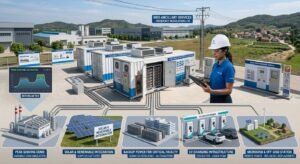
5. Real-World Applications of ESS Energy Storage Solutions
The versatility of ESS platforms means they are deployed across virtually every sector of the modern economy. Here are the most common and commercially significant use cases:
Peak Shaving & Demand Charge Reduction
Electricity utilities in most countries impose demand charges based on a customer’s peak consumption within a billing period. For industrial and commercial users, demand charges can represent 30–50% of the total electricity bill. An ESS discharges stored energy during peak demand windows, flattening the load curve and dramatically reducing demand charges. Payback periods of 3–7 years are common for well-designed peak shaving installations.
Solar & Renewable Energy Integration
Photovoltaic solar systems generate power intermittently — only when the sun shines. Without storage, excess solar generation is either wasted (curtailed) or sold back to the grid at low export tariffs. With an ESS, surplus solar energy is captured and stored for use during evening hours or cloudy periods, maximizing self-consumption rates and improving the economics of the solar investment. For utility-scale solar farms, ESS is increasingly mandated by grid operators to smooth output variability.
Backup Power & Business Continuity
Power outages cost businesses an estimated $150 billion per year globally. For hospitals, data centers, manufacturing lines, and cold chain facilities, even a 30-second interruption can be catastrophic. An ESS provides seamless, near-instantaneous backup power with zero transition time — unlike a diesel generator, which requires 10–30 seconds to start and stabilize. Coupled with its silent, emission-free operation, an ESS backup solution is increasingly preferred for indoor or urban environments.
Grid Ancillary Services & Frequency Regulation
Grid-scale ESS platforms can participate in ancillary service markets, providing frequency regulation, voltage support, spinning reserve, and black start capabilities to grid operators. These services generate ongoing revenue streams for ESS asset owners, improving project returns. In many deregulated electricity markets, frequency regulation is the highest-value service an ESS can provide on a per-MW basis.
Microgrid & Off-Grid Power Systems
Remote communities, islands, mining operations, and military facilities often lack reliable grid access. An ESS combined with solar PV, wind turbines, or small-scale generators can form a stable microgrid that provides 24/7 power without dependence on expensive, polluting diesel fuel. Diesel displacement rates of 70–90% are achievable with a well-designed ESS-based microgrid, translating to substantial operational savings over a 15–20 year project life.
EV Charging Infrastructure
Fast EV charging stations impose large, rapid power demand spikes on the local grid, often triggering high demand charges or requiring expensive grid upgrades. A co-located ESS buffers these spikes, enabling fast charging deployment without grid reinforcement, reducing operating costs and accelerating EV charging rollout in congested urban areas.
6. Key Benefits of Deploying an ESS Energy Storage Solution
Decision-makers evaluating ESS investments consistently cite the following tangible benefits:
- Electricity Cost Reduction: Peak shaving, time-of-use arbitrage, and demand charge management can reduce total electricity costs by 20–45% depending on tariff structure and usage profile.
- Revenue Generation: Participation in ancillary service markets, frequency regulation programs, and capacity auctions can generate ongoing income throughout the ESS asset life.
- Energy Resilience: Zero-transition backup power eliminates the financial and reputational risks of grid outages.
- Carbon Footprint Reduction: Replacing diesel generators and maximizing renewable self-consumption directly reduces Scope 1 and Scope 2 greenhouse gas emissions.
- Grid Independence: Reduces reliance on volatile utility tariffs and grid infrastructure, insulating operations from energy price shocks.
- Asset Longevity: Modern LFP-based ESS systems are designed for 10–15 years of operational life with degradation below 20%, providing long-term energy cost certainty.
- Regulatory Compliance: In many jurisdictions, ESS enables compliance with renewable energy mandates, carbon trading schemes, and grid code requirements.
- Scalability: Containerized ESS architectures can be scaled incrementally — add capacity as your business grows without redesigning the entire system.
7. How to Choose the Right ESS Energy Storage Solution for Your Project
Not all ESS systems are created equal. Selecting the right solution requires a structured evaluation process. Use the following framework as your starting point:
Step 1: Define Your Primary Use Case
Is your primary goal to reduce demand charges, provide backup power, store solar energy, or participate in grid markets? The primary use case determines the optimal ESS architecture, power-to-energy ratio, and control strategy. A backup-first ESS is designed differently from a peak-shaving-first or frequency-regulation-first system.
Step 2: Analyze Your Load Profile
Collect at least 12 months of interval electricity consumption data (15-minute or hourly) from your utility bills or energy management system. This data reveals your peak demand patterns, load variability, and the timing of consumption — all critical inputs for correctly sizing the ESS capacity and defining the charging/discharging schedule.
Step 3: Evaluate Battery Chemistry
For the vast majority of commercial, industrial, and utility applications, lithium iron phosphate (LFP) is the recommended chemistry due to its safety profile, cycle life, and total cost of ownership. Avoid systems using NMC chemistry for large-scale stationary storage unless there is a specific energy density constraint, as NMC carries higher thermal risk and shorter cycle life.
Step 4: Verify Safety Certifications
A professional ESS must hold relevant international certifications. For battery cells and modules: IEC 62619, UL 1973, UN 38.3. For the system: IEC 62477 (PCS), IEC 61850 (communication), and local grid codes. For export markets: CE marking, UL listing, or equivalent regional certifications. Never accept a system that cannot provide full certification documentation — the liability risk is unacceptable.
Step 5: Assess the Supplier’s Engineering Capability
An ESS is a long-lived asset — 10 to 15 years of operational life. Your supplier must offer not just hardware, but comprehensive engineering support: system design and simulation, grid interconnection studies, commissioning support, remote monitoring and diagnostics, firmware updates, and long-term O&M services. A transactional hardware vendor cannot adequately support the lifecycle of a large ESS asset.
Step 6: Calculate the Total Cost of Ownership (TCO)
Do not evaluate ESS options on upfront capital cost alone. Calculate the full TCO over the project life, including installation, grid connection costs, O&M, insurance, warranty, and projected energy savings and revenue. A higher-quality system with better cycle life and efficiency will almost always deliver a superior TCO compared to a cheaper system with inferior performance.

8. Why Partner with a Professional ESS Manufacturer?
The ESS market has expanded rapidly, and so has the number of suppliers — ranging from tier-1 integrated manufacturers to component resellers with limited engineering capability. Choosing the wrong partner can result in underperforming systems, voided warranties, safety incidents, and failed grid interconnections.
A professional ESS manufacturer differentiates itself through:
- Vertically integrated manufacturing: In-house cell selection, module assembly, BMS development, PCS manufacturing, and EMS software development — full control over quality at every level.
- Application engineering: Dedicated engineering teams that design systems for your specific site conditions, load profile, grid tariff structure, and regulatory environment.
- Global certification portfolio: Pre-certified products for major export markets (EU, US, UK, Australia, Southeast Asia, Middle East) accelerate project approvals and grid connection.
- After-sales support: Remote monitoring centers, 24/7 technical support, on-site commissioning and maintenance teams, and guaranteed spare parts availability throughout the warranty period.
- Track record and references: Verifiable installed base across diverse projects and geographies, with quantifiable performance data you can independently verify.
When evaluating manufacturers, ask for completed project references in your target application and region, request access to the EMS platform for a live demonstration, and ask specifically about the response time for technical support and the availability of spare parts. These questions will quickly distinguish between serious manufacturers and opportunistic resellers.
9. Frequently Asked Questions About ESS Energy Storage Solutions
Q: What is the lifespan of an ESS energy storage solution?
A well-designed LFP-based ESS system can deliver 4,000–6,000 charge-discharge cycles with less than 20% capacity degradation. Depending on cycle frequency, this translates to 10–15 years of operational life. Most commercial ESS products carry a 5–10 year manufacturer warranty on the battery system.
Q: How long does it take to install an ESS?
For containerized C&I and utility-scale ESS, the typical timeline from confirmed order to grid-connected commissioning is 12–26 weeks, depending on system size, site readiness, and grid interconnection queue. For smaller cabinet-based systems, installation can be completed in 3–7 days once the equipment arrives on site.
Q: What is the round-trip efficiency of a modern ESS?
Modern LFP-based ESS systems achieve round-trip efficiencies (the ratio of energy discharged to energy charged) of 88–94%. This is significantly higher than pumped hydro (70–80%) or hydrogen storage (30–45%), making battery ESS the most efficient large-scale storage technology available today.
Q: Can an ESS operate during a grid outage (island mode)?
Yes — ESS systems configured for island mode or black-start capability can seamlessly disconnect from the grid and continue to supply power to a defined load zone. This requires appropriate system design, including a transfer switch and specific PCS firmware. Not all ESS products support island mode by default, so confirm this capability with your supplier if backup power is a requirement.
Q: What safety standards should an ESS meet?
At a minimum, a commercial ESS should comply with IEC 62619 (safety requirements for secondary lithium cells for stationary applications), UL 9540 or IEC 62933 (system-level safety), UN 38.3 (transportation), and applicable local grid codes and building codes. For installations in the EU, CE marking is mandatory. For US installations, UL 9540A fire testing and local Authority Having Jurisdiction (AHJ) approval are typically required.
🔋 Ready to Find Your ESS Energy Storage Solution?
Whether you’re planning a utility-scale project, a commercial microgrid, or an industrial backup system, our engineering team is ready to design the right ESS for you — from initial load analysis to full system commissioning.
✅ Custom ESS configurations available for all scales and applications
✅ Factory-direct pricing with full international certification support
✅ One-stop service: system design → manufacturing → delivery → commissioning → O&M
Conclusion
An ESS energy storage solution is no longer a niche technology reserved for grid operators and utility companies. It has become a mainstream tool for any organization serious about controlling energy costs, ensuring operational resilience, and meeting sustainability commitments. Whether you are a solar project developer, a factory manager, a property portfolio owner, or a municipality planning grid modernization, there is an ESS configuration designed for your specific needs.
The key to a successful ESS investment lies in three things: precise sizing based on real load data, a reliable and certified system from a manufacturer with proven engineering capability, and a long-term service partnership that protects the performance of your asset throughout its operational life.
If you are evaluating ESS options for an upcoming project, we encourage you to reach out. Our engineering team provides obligation-free feasibility assessments, detailed savings projections, and customized system specifications — so you can make a fully informed decision backed by solid data rather than marketing estimates.
The energy future belongs to those who store it wisely. Let’s build yours together.
Related Posts:
Why Do EV Battery Packs Use a Mica Insulation Sheet?

How Do You Choose a Flame Retardant PC Supplier?
What Insulation Is Inside a Lithium Battery Module?
Are Flow Batteries a Better ESS Solution Than Lithium-Ion?
What Density Is Best for Battery Aerogel Insulation?
How Does Flame Retardant Polycarbonate Compare to FR ABS Plastic?
 betty wong