Table of Contents
Polycarbonate is one of the most versatile engineering thermoplastics ever developed. It is impact-resistant, optically clear, dimensionally stable across a broad temperature range, and easily processed by injection molding or extrusion. However, in its standard form it has one critical limitation: it burns.
For the rapidly growing number of applications governed by fire safety regulations — consumer electronics, electric vehicle battery systems, commercial construction, medical devices, and transportation interiors — burning is not an option. That is where flame retardant polycarbonate comes in.
This guide provides a comprehensive, technical overview of flame retardant polycarbonate: what it is, how it works, which standards it must meet, where it is used, how to select the right grade, and why specifying it correctly is increasingly non-negotiable for engineers and product designers worldwide.
1. What Is Polycarbonate? A Brief Foundation
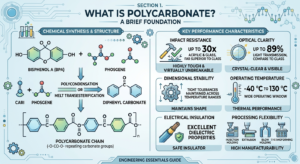
Polycarbonate (PC) is a high-performance thermoplastic polymer produced by polycondensation of bisphenol A (BPA) and phosgene, or via melt transesterification of BPA and diphenyl carbonate. The resulting polymer chain contains repeating carbonate groups (-O-CO-O-), which give the material its name and contribute to its outstanding properties.
Key characteristics of standard polycarbonate include:
- Impact resistance — up to 30 times greater than acrylic and far superior to glass
- Optical clarity — light transmission of up to 89%, comparable to glass
- Dimensional stability — tight tolerances maintained across wide temperature ranges
- Operating temperature — usable from approximately -40 °C to 130 °C
- Electrical insulation — excellent dielectric properties
- Processing flexibility — compatible with injection molding, extrusion, blow molding, and thermoforming
These properties have made polycarbonate the material of choice for eyeglass lenses, automotive headlamp housings, riot shields, aircraft cabin windows, CDs and DVDs, and thousands of electronic enclosures. However, standard polycarbonate is classified as HB (horizontal burning) under the UL 94 flammability standard — meaning it will sustain a flame. For regulated applications, this is insufficient.
2. What Is Flame Retardant Polycarbonate?
Flame retardant polycarbonate (FR PC) is a polycarbonate compound specifically engineered to resist ignition, inhibit flame spread, and self-extinguish when the ignition source is removed. It achieves these properties through one of two fundamental approaches: additive-based flame retardancy or intrinsic (reactive) flame retardancy.
2.1 Additive-Based Flame Retardancy
In additive-based systems, flame retardant chemicals are compounded into the polycarbonate matrix during processing. These additives interrupt the combustion cycle at one or more points — the gas phase, the condensed phase (the polymer surface), or both. The main additive families are:
- Organophosphorus compounds (halogen-free) — the dominant modern choice. Phosphate esters and phosphonates decompose during combustion to release phosphoric acid derivatives that inhibit radical chain reactions in the gas phase and promote char formation on the polymer surface. They meet RoHS and REACH requirements and are the standard in most new product designs.
- Brominated flame retardants — historically dominant, they release HBr radicals that scavenge high-energy OH and H radicals in the flame. Very effective at thin wall sections. Increasingly restricted under EU RoHS, REACH SVHC, and OEM green procurement policies; still used in some regions.
- Silicone-based additives — migrate to the polymer surface during combustion to form a dense silica char layer that insulates the substrate from heat and oxygen. Compatible with halogen-free specifications and offer low smoke density.
- Mineral fillers (ATH, Mg(OH)2) — aluminum trihydrate and magnesium hydroxide decompose endothermically, releasing water vapor that cools the flame zone and dilutes flammable gases. Used at higher loadings; can reduce optical clarity and impact performance.
- Nano-clay and carbon nanotube reinforcements — emerging systems that improve char quality and flame spread resistance at lower additive levels, minimizing mechanical property loss.
2.2 Intrinsic (Reactive) Flame Retardancy
In reactive systems, flame-retardant functionality is chemically incorporated into the polymer backbone itself through copolymerization. This eliminates concerns about additive migration, blooming, or volatilization over the product lifetime. It is particularly valuable in optical applications — lighting diffusers, glazing, and display covers — where additive-induced haze or discoloration is unacceptable.
Reactive FR polycarbonates tend to have higher price points but deliver superior long-term performance and consistency, making them the preferred specification in demanding electronics and medical device applications.
3. Flammability Standards and Ratings Explained
Before specifying any flame retardant polycarbonate grade, engineers must understand the applicable flammability test standards. Different industries, geographies, and applications refer to different standards, and a material certified for one test may not satisfy another.
3.1 UL 94 — The Global Benchmark for Plastics
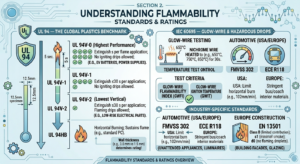
Underwriters Laboratories Standard UL 94 is the most widely referenced flammability standard for plastic materials used in electronic equipment and appliances. It evaluates how plastics respond to a small open flame. The five vertical burn classifications in ascending order of fire performance are:
| Standard | Rating | Burn Time Criteria | Drip Criteria | Common Use |
| UL 94 | V-0 | Extinguish ≤10 s per flame application | No igniting drips allowed | EV batteries, PCBs, power supplies |
| UL 94 | V-1 | Extinguish ≤30 s per application | No igniting drips allowed | Enclosures, junction boxes |
| UL 94 | V-2 | Extinguish ≤30 s per application | Flaming drips allowed | Low-risk electrical parts |
| UL 94 | 5VA/5VB | No burn-through on 125 mm plaque | N/A (plaque test) | Computer housings, automotive |
| IEC 60695-2 | GWIT 850 °C | No ignition; or extinguish ≤30 s | N/A | Household appliances, meters |
| EN 13501 | B-s1, d0 | Very limited contribution to fire | No flaming droplets | Building glazing, facades |
| Critical Specification Note
UL 94 ratings are always tied to a specific wall thickness. A material certified V-0 at 3.0 mm may only achieve V-1 at 1.5 mm. Always verify the certification at the actual wall thickness of your component — thinner walls are inherently harder to certify. |
3.2 IEC 60695 — Glow-Wire Testing
IEC 60695-2 defines the Glow-Wire Ignition Temperature (GWIT) and Glow-Wire Flammability Index (GWFI) tests. A nichrome wire heated to a specified temperature (typically 650 °C, 750 °C, or 850 °C) is applied to the plastic for 30 seconds. The material passes if it does not ignite or extinguishes within 30 seconds with no igniting drip.
The 850 °C glow-wire test is the standard requirement for unattended electrical appliances (IEC 60335) and luminaires (IEC 60598). Many flame retardant polycarbonate grades are certified to both UL 94 V-0 and GWIT 850 °C simultaneously.
3.3 EN 13501 — European Reaction-to-Fire for Construction
For building applications — skylights, facades, noise barriers, glazing — the European classification EN 13501-1 applies. Class B (limited contribution to fire), smoke class s1 (minimal smoke), and droplet class d0 (no flaming droplets) are typically required for polycarbonate in occupied buildings. FR PC sheet products meeting B-s1, d0 are commercially available from major sheet producers.
3.4 FMVSS 302 and ECE R118 — Automotive
Federal Motor Vehicle Safety Standard 302 (USA) limits horizontal burning rate of interior materials to 102 mm per minute. ECE R118 (Europe) sets more stringent requirements for bus and coach interiors. FR PC grades formulated for automotive applications are verified against these standards as part of the OEM approval process.
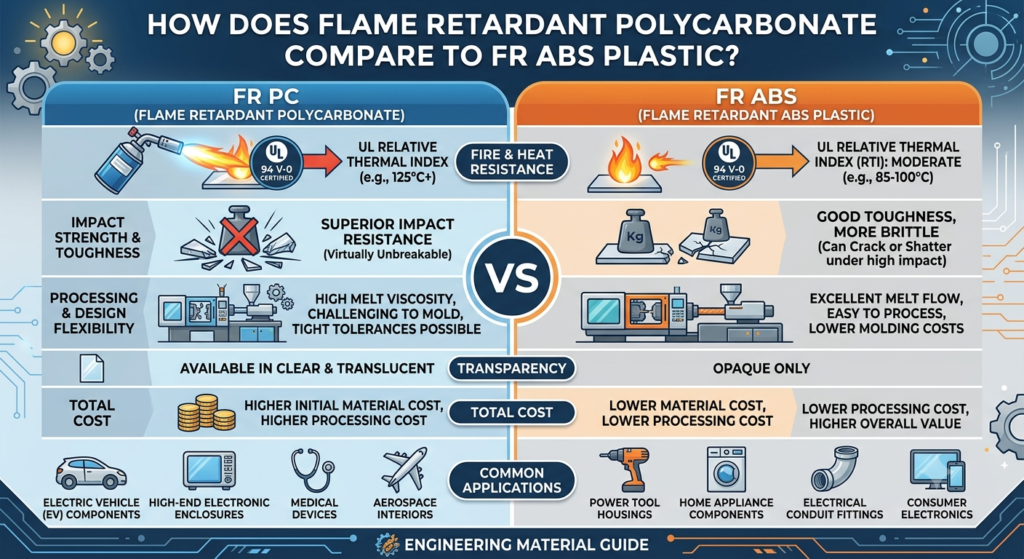
4. Flame Retardant Polycarbonate vs. Standard Polycarbonate
Understanding the trade-offs between FR PC and standard PC is essential for making the right material selection decision.
| Property | Standard PC | FR PC (V-0 Grade) |
| Flammability | HB — slow burning | UL 94 V-0 — self-extinguishing |
| Impact Strength | Very high | High (minor reduction ~10%) |
| Optical Clarity | Excellent | Good (slight haze in some grades) |
| Halogen-Free Option | N/A | Available (phosphorus-based) |
| Heat Deflection Temp | ~130 °C | ~120–128 °C |
| Processing Temp | 260–310 °C | Similar, moisture-sensitive |
| RoHS / REACH Compliance | Standard compliant | HF grades fully compliant |
| Cost vs. Standard PC | Baseline | 15–40% premium |
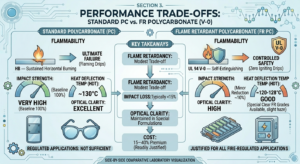
The key insight from this comparison is that the penalty for adding flame retardancy is modest. Impact strength reduction is typically less than 10–15%. Optical clarity is maintained in specially formulated transparent FR grades. The 15–40% cost premium is readily justified in any regulated application where non-compliance would require redesign, re-testing, or product recall.
5. Why Flame Retardant Polycarbonate Matters: Industry Applications
The global importance of flame retardant polycarbonate has accelerated alongside four converging trends: tightening international fire codes, the electrification of transportation, the densification of data centers and computing infrastructure, and increasingly stringent environmental regulations governing both fire safety and chemical content.
5.1 Consumer Electronics and IT Equipment
Laptop housings, smartphone chassis components, PCB substrates, power supply enclosures, USB hubs, and data center server racks all use flame retardant polycarbonate. The governing standards are UL 94 V-0 (at 1.5 mm or thinner), IEC 62368-1 (the unified audio/video and IT equipment standard), and OEM-specific internal fire safety requirements from manufacturers including Apple, Dell, HP, and Lenovo.
The trend toward thinner-wall electronics has made achieving V-0 at sub-1.5 mm thicknesses one of the primary material development challenges in this sector, driving significant innovation in halogen-free FR PC formulations.
5.2 Electric Vehicle (EV) Battery Systems
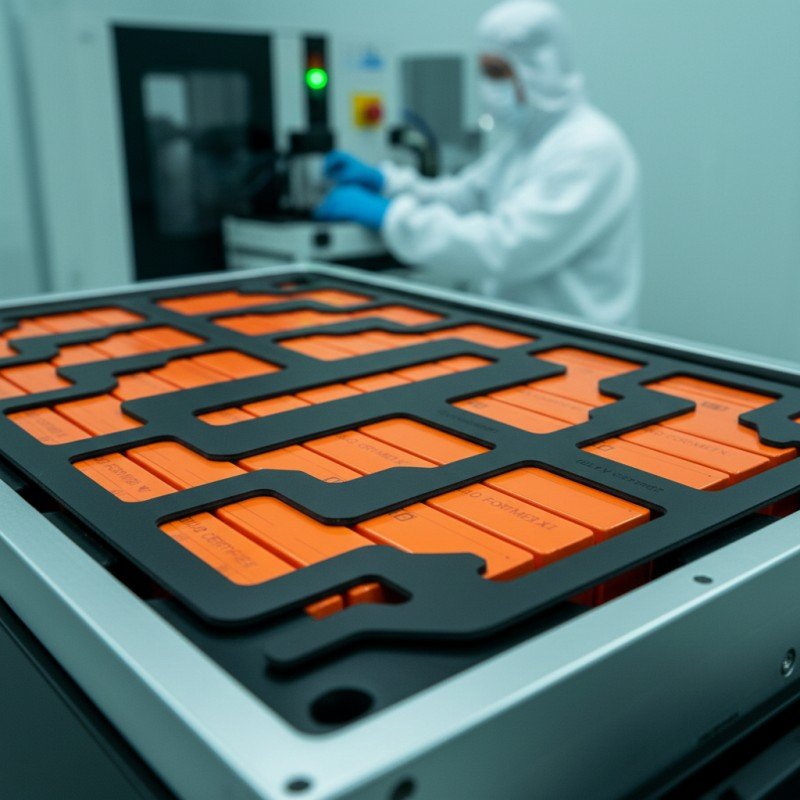
The EV revolution has created enormous demand for flame retardant polycarbonate. Battery module housings, cell separators, bus bar insulators, battery management system (BMS) enclosures, and charging infrastructure components all require high-performance FR PC. Thermal runaway events in lithium-ion batteries release enormous heat, and materials within and surrounding battery packs must be certified to the most demanding fire resistance standards.
Automotive OEMs and Tier 1 suppliers now regularly specify FR PC grades that simultaneously achieve UL 94 V-0 (at 0.8–1.5 mm), UL 94 5VA, GWIT 960 °C, and long-term thermal stability at elevated operating temperatures. This is one of the most demanding application environments for any thermoplastic.
5.3 Construction and Architectural Glazing
Multiwall and solid polycarbonate sheets are used in skylights, atria, sports hall roofing, highway noise barriers, and facade cladding. In all of these applications, national building codes and fire regulations require certified reaction-to-fire performance.
In Europe, EN 13501-1 class B or better is required for most occupied-building polycarbonate glazing applications. FR PC sheets with coextruded UV-stabilized surfaces and certified B-s1, d0 fire performance are the standard product for architectural specification. In North America, NFPA 286 room corner fire tests and IBC flame spread requirements govern polycarbonate sheet use in buildings.
5.4 Medical Devices and Laboratory Equipment
IEC 60601-1, the principal international standard for medical electrical equipment, mandates UL 94 V-0 or better for enclosures and structural components within 50 mm of patient-contact zones. For most diagnostic equipment, imaging systems, infusion pumps, and surgical tool housings, flame retardant polycarbonate is therefore the specified baseline material.
Additional requirements in medical applications include biocompatibility (ISO 10993), resistance to sterilization processes (autoclaving, gamma irradiation, EtO), and chemical resistance to hospital disinfectants — all of which must be verified alongside FR performance.
5.5 LED Lighting Fixtures
LED drivers operate continuously at elevated temperatures in close proximity to power electronics. Luminaire enclosures and diffusers require GWIT 850 °C certification under IEC 60598. Flame retardant polycarbonate is the dominant diffuser material for industrial and commercial LED lighting, combining light transmission of 85–89% with certified fire resistance. The material’s UV stability (when properly stabilized) also makes it suitable for outdoor luminaires.
5.6 Telecommunications and 5G Infrastructure
Outdoor 5G radio units, indoor distributed antenna system (DAS) enclosures, fiber distribution hubs, and network switches all rely on FR PC for housings that must survive both electrical fault conditions and environmental extremes. UL 94 V-0 and glow-wire ratings are standard requirements in telecom industry specifications, and halogen-free grades are increasingly mandated by major network operators.
6. Halogen-Free vs. Halogenated FR Polycarbonate: A Critical Choice
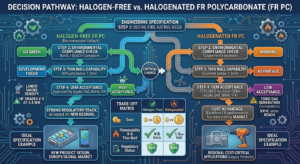
One of the most consequential decisions in flame retardant polycarbonate specification is whether to use halogenated or halogen-free chemistry. This decision has regulatory, environmental, performance, and commercial dimensions.
| Halogenated FR PC
Brominated or chlorinated flame retardants deliver excellent V-0 performance, including at very thin walls below 1.5 mm, and typically cost less than halogen-free alternatives. They remain widely used in regions without RoHS restrictions. However, they are subject to EU RoHS Directive restrictions in many device categories, may be classified as SVHC substances under REACH, are excluded from major OEM green procurement programs (Apple, Dell, BMW, Volkswagen Group), and generate toxic hydrogen halide gases if incinerated at end of life. |
| Halogen-Free FR PC
Phosphorus-based, nitrogen-based, or mineral-filled halogen-free grades are RoHS-compliant, REACH-compatible, and accepted under all major OEM sustainability programs. They typically produce lower smoke density when burned, simplifying evacuation safety calculations in building applications. Trade-offs include greater difficulty achieving V-0 at wall thicknesses below 1.5 mm, and some grades exhibit slightly reduced impact strength or flow. Development of next-generation halogen-free FR PC grades achieving V-0 at 0.8 mm has been a major industry focus since 2018. |
For new product design and development, halogen-free flame retardant polycarbonate is the strongly recommended default. The regulatory trajectory in major markets — EU, UK, South Korea, Japan, and China — is clearly toward expanded halogen restrictions. Designing with halogen-free materials from the outset avoids costly material substitution later in the product lifecycle.
7. Processing Flame Retardant Polycarbonate: Key Considerations
Flame retardant polycarbonate requires more careful processing attention than standard PC grades. The following guidelines represent industry best practice:
7.1 Pre-Drying
Flame retardant additives — particularly phosphate esters — can accelerate hydrolytic degradation of the PC backbone in the presence of moisture. Pre-drying is therefore more critical for FR PC than for standard PC. Industry best practice is to dry FR PC pellets at 110–120 °C for 4 to 6 hours in a dehumidifying hopper dryer, targeting a moisture content below 0.02% (200 ppm). Inadequate drying produces molecular weight reduction, surface defects (silver streaks, splay), and potential loss of mechanical and fire performance.
7.2 Melt Temperature and Residence Time
FR PC should be processed at the lower end of the recommended melt temperature window — typically 270–290 °C for most halogen-free V-0 grades. Higher temperatures increase additive decomposition risk and may cause discoloration or gas generation within the tool. Residence time in the barrel must be minimized. During production pauses or tool changes, purge the barrel promptly. Extended residence at temperature is the most common cause of FR PC processing problems in production environments.
7.3 Regrind Policy
Regrind from FR PC processing can be reused, but within strict limits. Maximum regrind content is typically 20–25% by weight, blended homogeneously with virgin material. Regrind must be kept dry, clean, and free from contamination. Accumulation of reground material should be audited regularly — multiple reprocessing cycles degrade both molecular weight and additive effectiveness. For components requiring UL 94 certification, confirm with your material supplier whether regrind content affects the scope of the certification.
7.4 Tool Design for FR Parts
Certain FR additives — particularly phosphate esters — can be mildly corrosive to tool steel under prolonged production. For high-volume FR PC production, tools should be fabricated from corrosion-resistant tool steels (e.g., H13, 420 SS) or have chrome or nickel-plated cavities. Gate design also matters: restricted gates can cause localized thermal degradation of the FR additive at high shear rates, producing streaks or discoloration in the part.
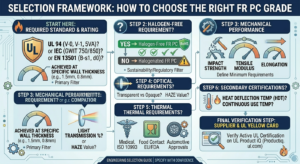
8. How to Select the Right Flame Retardant Polycarbonate Grade
With dozens of commercial FR PC grades available across multiple suppliers, a structured selection framework is essential. Use the following decision criteria:
- Required standard and rating — Identify the specific certification needed (UL 94 V-0, V-1, or 5VA; GWIT 750 °C or 850 °C; EN 13501 B-s1,d0) and the wall thickness at which it must be achieved. This is the primary filter that narrows the candidate field significantly.
- Halogen content requirement — Determine whether your regulatory environment, customer requirements, or corporate sustainability policy mandates halogen-free chemistry. If yes, eliminate halogenated grades from consideration.
- Mechanical performance — Define minimum impact strength, tensile modulus, and elongation requirements. FR PC grades span a wide range of mechanical performance; high-flow grades for thin-wall injection molding typically sacrifice some toughness.
- Optical requirements — If the component is a lighting diffuser, glazing panel, or display cover, confirm the grade is available in transparent form with defined light transmission and haze values.
- Thermal requirements — For applications near heat sources (LED drivers, power electronics, EV battery packs), confirm heat deflection temperature (HDT) and continuous use temperature meet design requirements.
- Secondary certifications — For medical devices, confirm ISO 10993 biocompatibility. For food contact, confirm EU Regulation 10/2011 or FDA 21 CFR compliance. For automotive, confirm PPAP-readiness and OEM-specific material approvals.
- UV and weathering stability — For outdoor applications (construction glazing, telecom enclosures), confirm the grade includes UV stabilization and verify retained fire performance after UV aging.
- Supplier and UL Yellow Card verification — Always verify the UL 94 certification is current and active by checking the UL Product iQ database (previously the UL Yellow Card system). A material supplier’s datasheet claim is not a substitute for an active certification.
9. Representative Commercial FR PC Grades
The following are established product families from major resin producers. This is not an exhaustive list, and specifications should always be verified against current technical datasheets and UL certification listings:
- Covestro Makrolon® FR series — halogenated and halogen-free V-0 grades; the Makrolon® RE grades are based on recycled content
- SABIC LEXAN™ HF series — leading halogen-free FR PC portfolio; thin-wall V-0 performance down to 0.8 mm in select grades
- Trinseo CALIBRE™ FR — broad portfolio including high-flow grades for thin-wall electronics
- Mitsubishi Iupilon® FN / FE series — including optically clear FR grades for lighting and display applications
- Lotte Chemical Infino™ FR — expanding Asian market FR PC portfolio with halogen-free options
For sheet and film applications, major producers including SABIC, Covestro, and Palram offer co-extruded FR PC sheets with UV-stabilized cap layers certified to EN 13501 and UL 94.
10. Frequently Asked Questions
Is flame retardant polycarbonate safe for indoor use?
Yes. Modern halogen-free FR PC grades are RoHS-compliant, have been validated for use in consumer electronics, office equipment, and buildings, and do not release flame retardant chemicals during normal service. During thermal processing, standard industrial ventilation practices for thermoplastics apply.
Can flame retardant polycarbonate be recycled?
Halogen-free FR PC can generally be recycled through standard polycarbonate streams with appropriate disclosure. Some resin producers now offer FR PC grades based on post-consumer recycled (PCR) content — Covestro Makrolon® RE is one example. Halogenated grades are more complex to recycle and may require dedicated recovery streams.
Does flame retardant polycarbonate cost significantly more?
Typically 15–40% more per kilogram at commercial volumes, depending on grade, additive system, and order volume. This premium is consistently justified in regulated applications by avoiding the far greater costs of redesign, re-certification, or product recall associated with using a non-compliant material.
What is the difference between self-extinguishing and flame retardant?
Self-extinguishing describes the observable behavior: the material stops burning when the ignition source is removed. Flame retardant describes the mechanism and chemistry that produces this behavior. In regulatory and commercial usage, a material certified to UL 94 V-0 is both flame retardant and self-extinguishing by definition.
Can I apply a flame retardant coating to standard polycarbonate instead?
Intumescent surface coatings can improve the fire performance of standard PC in specific test scenarios, but they cannot achieve a certified UL 94 V-0 rating for the base material — the rating applies to the compound, not the surface treatment. For any application governed by a flammability standard, use a pre-certified FR PC compound rather than relying on surface coatings.
How do I verify a UL 94 V-0 certification is current?
Search the UL Product iQ database (productiq.ul.com) using the manufacturer’s name and material designation. Active certifications will show the current scope including the certified wall thicknesses. A historical datasheet or catalog citation is not sufficient — always confirm the active certification directly.
Conclusion: Flame Retardant Polycarbonate as an Engineering Essential
Flame retardant polycarbonate is not standard polycarbonate with a safety label attached. It is a precisely engineered, certified material system that combines polycarbonate’s outstanding mechanical, optical, and processing characteristics with rigorously tested fire resistance.
In an era defined by electrified transportation, densifying electronics, tightening global fire codes, and expanding environmental regulations, specifying the right grade of flame retardant polycarbonate from the outset of a design program is not optional — it is fundamental engineering practice.
The engineer or product designer who understands the differences between V-0, V-1, and 5VA; between halogenated and halogen-free chemistries; between additive and reactive FR systems; and between a valid UL Yellow Card and a supplier’s marketing claim will make better decisions, reach market faster, and avoid the significant costs of non-compliance.