What Is a Mica Insulation Sheet for EV Battery Packs?
Table of Contents
What happens when a battery-pack component must remain electrically insulating during normal service, retain its shape when nearby temperatures rise sharply, and resist flame or hot particles during a cell failure? A conventional plastic film may provide excellent dielectric isolation but soften under severe heat, while a low-conductivity pad may delay heat without offering the rigid flame protection needed around a busbar, module wall, or pack lid. This is the design gap that mica insulation sheets are commonly selected to fill.
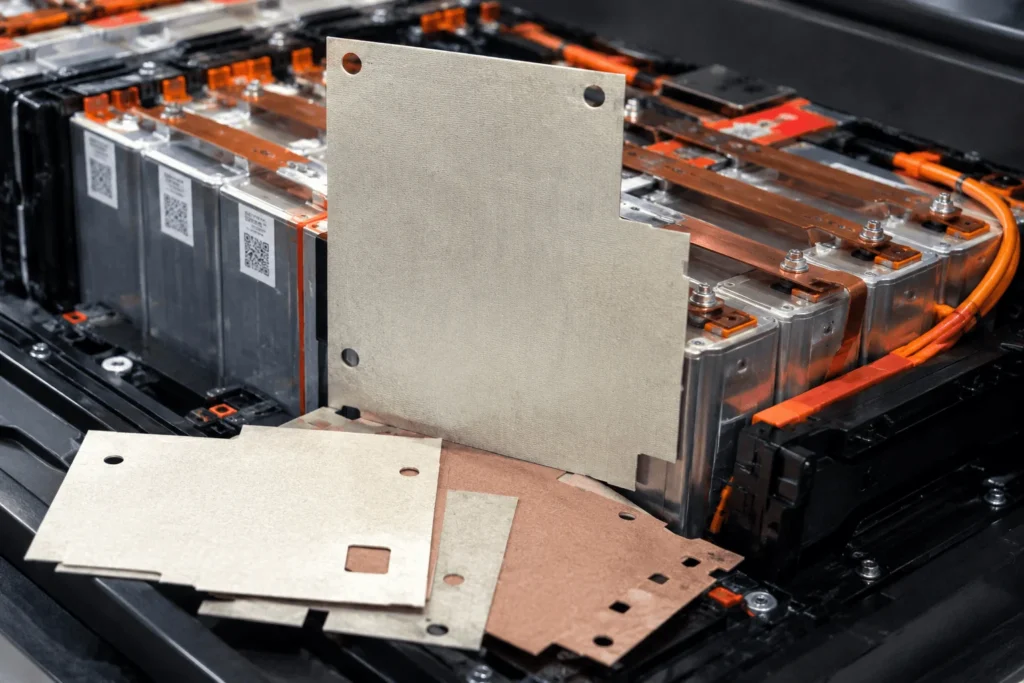
| A mica insulation sheet for EV battery packs is a thin rigid or flexible barrier made from natural mica laminations or reconstituted mica paper bonded into a controlled sheet. It combines high-temperature stability, electrical insulation, flame resistance, and dimensional integrity. In EV packs, mica sheets are used between modules, under pack covers, around busbars and high-voltage parts, near vent paths, and sometimes between cells. The exact grade, thickness, binder, reinforcement, adhesive, and die-cut geometry must be validated in the final module or pack. |
Mica Insulation Sheet for EV Battery Packs: Quick Guide
| Battery Location | Mica Function | Typical Construction | Main Validation |
| Pack lid and vent corridor | Flame, hot-gas, and particle shield | Rigid or flexible mica, sometimes reinforced | Jet/flame exposure and pack test |
| Module wall or perimeter | High-temperature dielectric boundary | Rigid mica board or laminated panel | Dielectric, vibration, and propagation test |
| Busbar and HV junction | Electrical insulation and arc protection | Thin mica sheet or adhesive-backed tape | Withstand voltage and aging |
| Cell-to-cell interface | Flame and dielectric barrier | Mica alone or mica with aerogel/foam | Compression and module propagation |
What Is a Mica Insulation Sheet for EV Battery Packs?
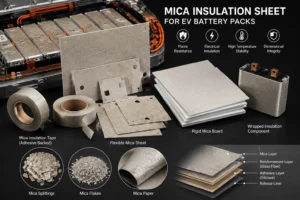
Mica is a family of layered silicate minerals that can be separated into thin plate-like structures. Commercial EV insulation parts are rarely cut directly from one perfect natural crystal. Most are engineered products made from mica paper, mica splitting’s, or fine mica flakes combined with a binder and, when needed, glass fiber, film, fabric, silicone adhesive, or another reinforcement.
The result can be a rigid board, a semi-flexible sheet, a thin tape, a wrapped insulation component, or a multilayer fire barrier. The construction is selected according to the required temperature, dielectric strength, bending radius, mechanical load, thickness, flame exposure, and assembly method.
The word “mica” therefore does not identify one universal material. A supplier should define whether the part uses muscovite or phlogopite mica, natural or reconstituted mica, the binder system, reinforcement, finished thickness, density, dielectric properties, thermal behavior, and approved manufacturing source.
For battery engineering, the finished converted component is the real product. A mica core laminated with adhesive and film can perform differently from the unlaminated sheet. Edges, holes, bends, adhesive zones, and compressed areas can determine whether the component remains an effective electrical and fire barrier.
Why a Mica Insulation Sheet for EV Battery Packs Is Used
Mica is selected when an EV pack needs several demanding functions in a limited space. Its first major advantage is dielectric performance. Mica has a long history in motors, generators, cables, heaters, and other high-voltage equipment because it can provide strong electrical isolation at elevated temperature.
Its second advantage is high-temperature integrity. Many polymers begin to soften, shrink, melt, or carbonize during severe battery failure. A properly engineered mica sheet can remain as a physical barrier after nearby polymeric layers have degraded. This makes it valuable near cell vents, high-voltage junctions, module walls, and the underside of the pack cover.
Its third advantage is flame and particle resistance. During thermal runaway, a cell may release hot gases, flame, droplets, and solid debris. Mica can protect a surface from direct exposure or reinforce a composite barrier. Application-specific products have been developed for flame mitigation and electrical insulation in EV batteries.
Its fourth advantage is design flexibility. Mica can be supplied as rigid panels, flexible sheets, tapes, wrapped parts, punched shapes, or composites with silicone foam and other materials. This allows one material family to serve several locations inside the battery system.
How a Mica Insulation Sheet for EV Battery Packs Is Constructed
Reconstituted mica sheet is commonly made by processing mica into fine flakes or mica paper, adding a binder, consolidating the layers, and curing them into the required thickness. The binder may be silicone-based, epoxy-based, or another high-temperature resin. Glass fabric or glass fiber can improve tensile strength and handling.
Natural mica laminates use selected mica splitting’s bonded into a built-up structure. They can offer strong dielectric performance but may have different cost, thickness control, flexibility, and sourcing characteristics from reconstituted paper products.
A production-ready EV part may include four or more layers: the mica barrier, a reinforcing carrier, a pressure-sensitive adhesive, and a release liner. Other designs add PET, PI, polycarbonate, silicone foam, ceramic fabric, or printed identification.
Every layer changes performance. The binder controls flexibility and high-temperature behavior. Reinforcement changes strength and thermal conduction. Adhesive affects bonding, flame response, and heat transfer. A release liner affects assembly efficiency but is removed before installation. These details must be fixed in the bill of materials and change-control system.
Muscovite vs Phlogopite Mica Insulation Sheet Grades
Muscovite and phlogopite are the two mica types most frequently discussed in technical insulation. Muscovite is widely valued for dielectric properties, dimensional stability, and electrical applications. Phlogopite is often selected when the application demands higher temperature capability and flame exposure.
This does not mean phlogopite is automatically best for every battery part. A busbar barrier operating mainly under normal service may prioritize dielectric strength, thinness, and punch quality. A shield near a vent or pack lid may prioritize high-temperature integrity. A flexible tape around a curved conductor may prioritize conformability and adhesive reliability.
The binder and reinforcement can be as important as the mica species. A high-temperature mica paper can still fail early if the adhesive softens, the glass carrier delaminates, or the edge construction opens under flame.
Ask suppliers to provide data for the exact finished grade rather than relying on generic statements about muscovite or phlogopite. The approved material should be verified at the specified thickness, orientation, and layer construction.
Where a Mica Insulation Sheet for EV Battery Packs Is Installed
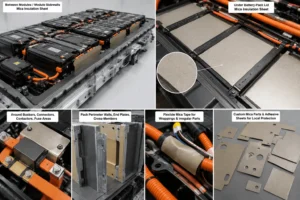
One common location is between modules or at module sidewalls. Rigid mica parts can provide a combined fire, thermal, and dielectric boundary that helps limit heat and flame movement from one module region to another.
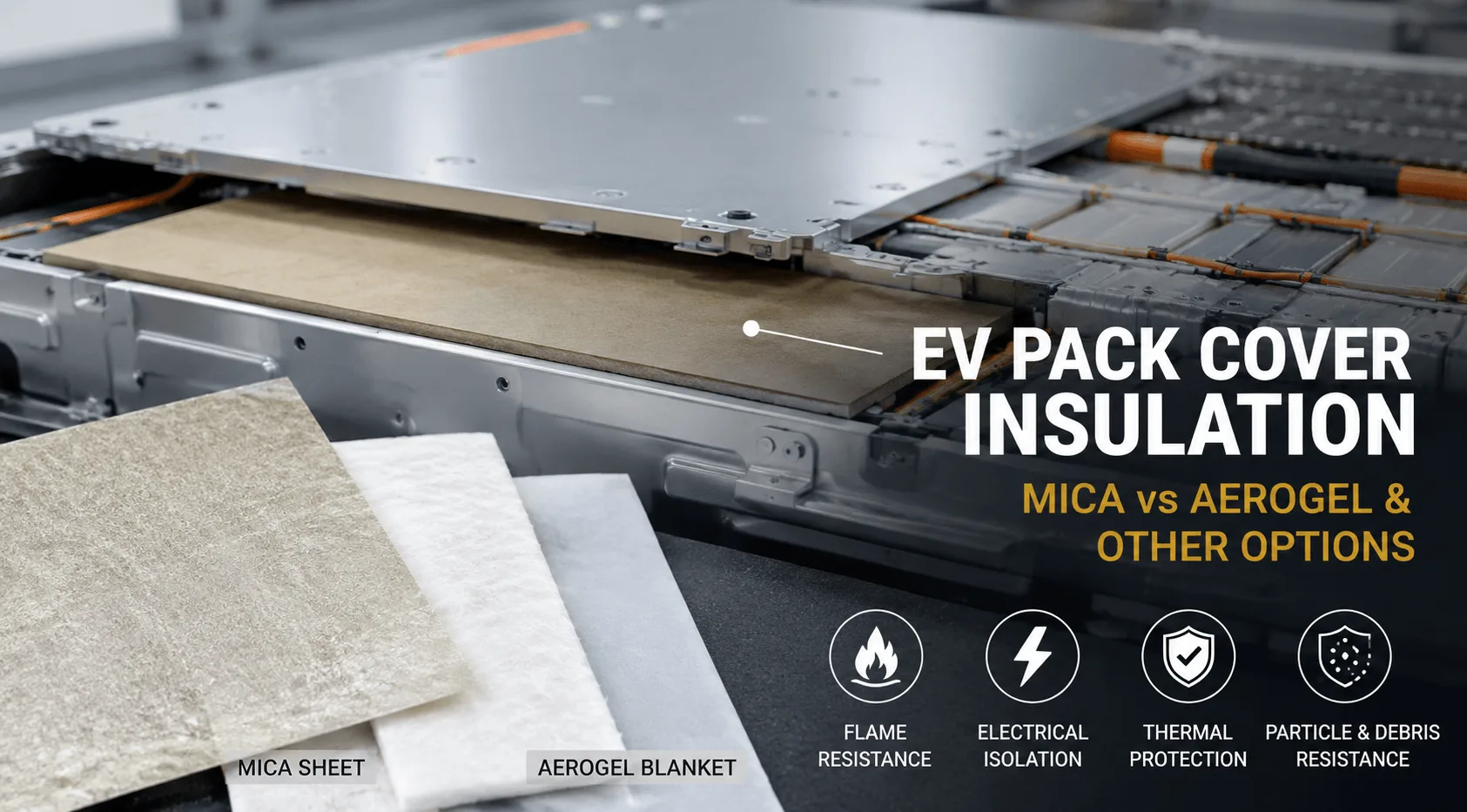
Another important location is beneath the battery-pack lid. During a severe failure, upward venting can expose the cover to flame, hot gas, and particles. A mica sheet or mica-based composite can protect the lid, passenger-side structure, wiring, or service components above the cells.
Mica is also used around busbars, high-voltage connectors, contactors, fuse areas, and junction boxes. In these applications, electrical isolation, puncture resistance, creepage support, and arc or flame protection may be more important than minimizing thermal conductivity.
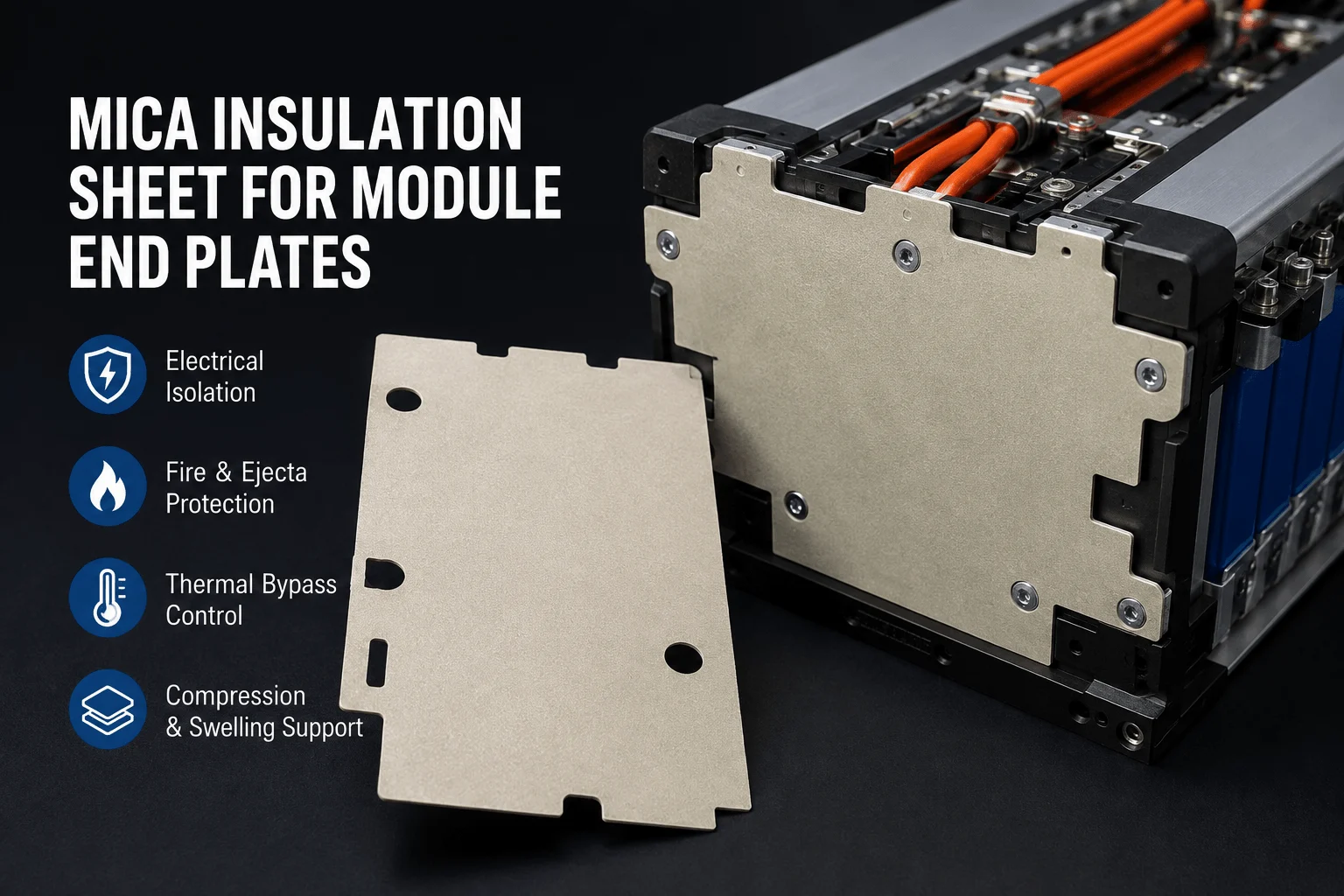
Pack perimeter walls, end plates, cross-members, and service disconnect areas can use custom mica liners. Flexible mica tape can wrap conductors, corners, or irregular components. Thin adhesive-backed mica can cover local holes or metal edges that are difficult to protect with a rigid panel.
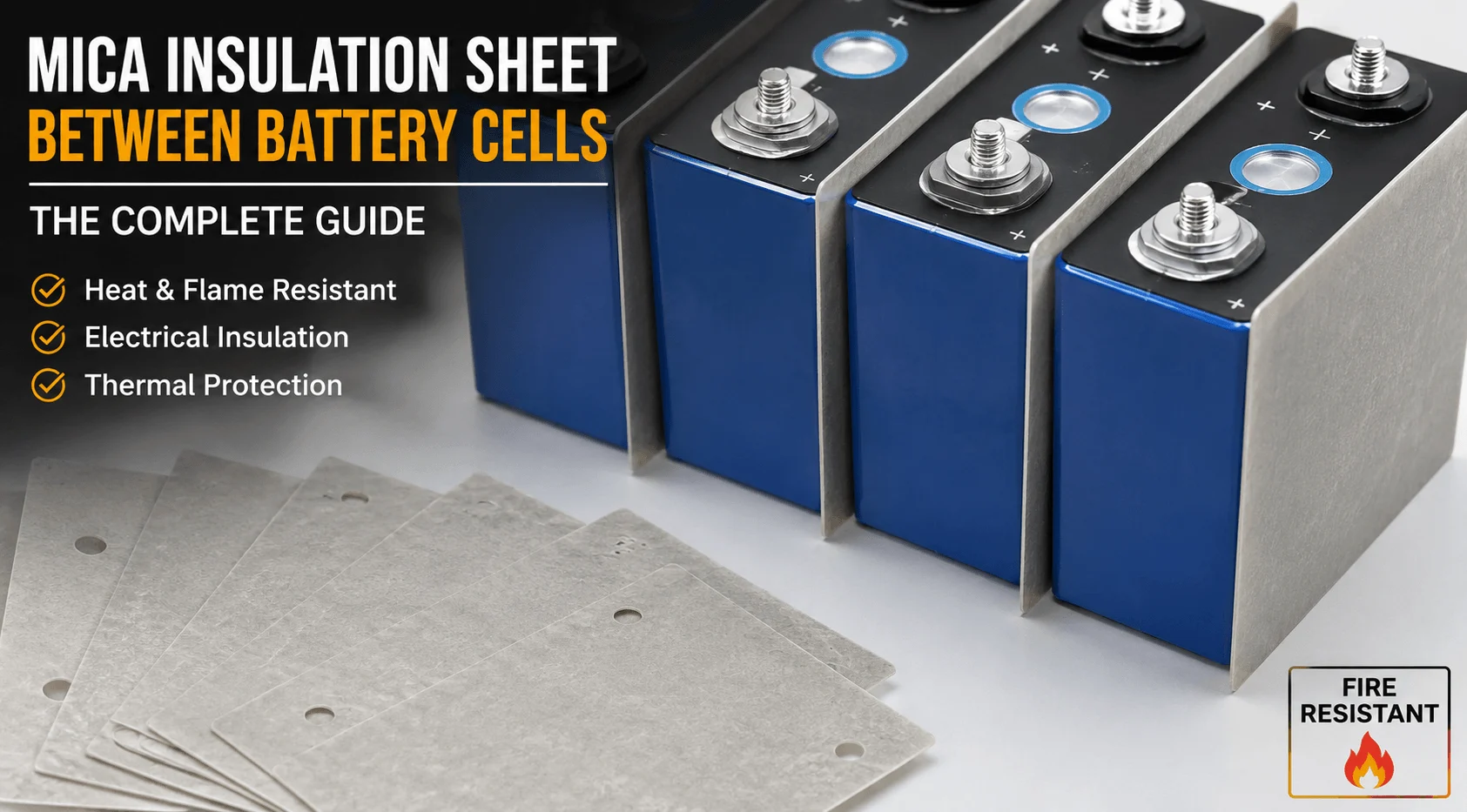
Between individual cells, mica may be used alone when the primary need is high-temperature flame and dielectric protection. However, because mica does not necessarily provide the same low thermal conductivity per millimeter as aerogel, high-energy cell-to-cell designs may use a mica-plus-aerogel or mica-plus-foam composite.
How Mica Protects Against Thermal Runaway
Thermal runaway propagation is a system event. Heat can move from a failing cell through direct contact, radiation, hot gases, flame, particles, busbars, cooling plates, frames, and enclosure surfaces. A mica sheet helps by preserving a physical and electrical barrier under high-temperature exposure.
At the broad interface between two cells or modules, mica can reduce direct flame exposure and separate conductive surfaces. Near a vent, mica can shield the receiving surface from flame and ejecta. Under a pack lid, it can delay structural heating and reduce damage to components above the battery.
Mica should not be described as a universal non-propagation solution. A thin panel may be penetrated at an unsupported hole, bypassed at an uncovered edge, or overwhelmed by a direct jet if the thickness and support are inadequate. Metal heat paths can carry energy around the sheet.
The barrier must be coordinated with vent routing, cell spacing, cooling, sensing, electrical protection, and enclosure design. The final result must be demonstrated in representative module and pack tests.
Is Mica a Thermal Insulator or a Flame Barrier?
Mica is often called a thermal insulation material, but its greatest battery value is not always the lowest possible thermal conductivity. Compared with aerogel, mica may conduct more heat through the sheet. Its strength is that it remains electrically insulating and physically present at temperatures where many polymer layers lose integrity.
This makes mica particularly effective as a flame barrier, hot-particle shield, dielectric separator, and structural fire layer. Aerogel is usually stronger when the objective is maximum resistance to cell-to-cell heat transfer in a very thin gap.
The two materials are therefore complementary. A mica facing can resist direct flame and particle impact, while aerogel behind it reduces heat transfer. Silicone foam can add compression management, and polycarbonate can add puncture-resistant dielectric structure.
Selection should follow the actual failure path. If the main risk is slow conduction across a cell face, prioritize thermal resistance. If the risk is a high-temperature vent jet striking a pack cover, prioritize flame-facing integrity. Many EV packs require both.
Mica Insulation Sheet for EV Battery Packs and High Voltage
Modern EV packs commonly operate at hundreds of volts, and the system may contain conductors at significantly different potentials in a compact enclosure. Mica can contribute to primary or secondary dielectric isolation around high-voltage components.
A high-voltage specification should define dielectric strength, insulation resistance, test voltage, dwell time, leakage-current limit, minimum thickness, temperature, humidity conditioning, and post-aging requirements. A generic “high dielectric strength” statement is not sufficient.
Edges and cutouts matter. A mica sheet may have excellent center-area dielectric performance while a cracked edge, burr, exposed adhesive, metal fastener, or contaminated surface creates a local failure path. Creepage and clearance depend on geometry, not only material properties.
When puncture or abrasion is possible, mica may be laminated with flame-retardant polycarbonate or a qualified dielectric film. The structural layer protects the mica and provides a clean surface near busbars, frames, and fasteners.
Can a Mica Insulation Sheet Improve Creepage and Clearance?
Mica can help create a solid insulating barrier between conductors and structural metal, which may support the required electrical path. However, creepage and clearance are defined by the complete three-dimensional design.
A flat sheet can extend the surface path between energized components, but an exposed edge, moisture track, metal insert, screw, slot, or adhesive contamination can shorten the effective route. The barrier should be designed with the system voltage, pollution level, environment, and applicable standard in mind.
Folded tabs and shaped walls can improve separation, but tight bends may crack a rigid mica grade. Flexible mica tape or a mica-polymer laminate may be better for curved geometries.
The engineering drawing should identify high-voltage keep-out zones, edge distances, hole diameters, minimum webs, bend radii, and protected metal surfaces. Dielectric testing should include the final geometry.
Rigid vs Flexible Mica Insulation Sheet for EV Battery Packs
Rigid mica boards are suitable for flat covers, module boundaries, sidewalls, end plates, and large structural barriers. They retain their shape and can support accurate positioning, but they may crack if bent or installed over an uneven surface.
Flexible mica sheets and tapes are used around curves, corners, busbars, harnesses, and surfaces that require conformability. Flexibility is created by the mica-paper structure, binder, reinforcement, thickness, and backing.
A flexible product is not automatically more durable. Repeated bending, sharp folds, adhesive stress, and high-temperature cycling can cause delamination. A rigid product is not automatically stronger in every direction because mica-based materials can be layered and brittle at punched edges.
Choose the format from the geometry and installation method. A hybrid assembly can use a rigid mica panel for the main flame zone and flexible mica tape to close gaps or wrap local conductors.
How Thick Should a Mica Insulation Sheet Be?
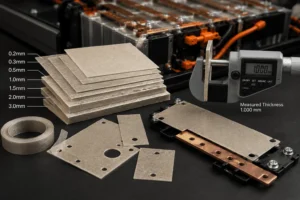
There is no universal thickness for EV battery mica. Thin sheets may be suitable for dielectric wrapping, busbar insulation, local surface protection, or curved parts. Medium-thickness sheets may be used for module walls and pack liners. Thicker rigid boards may be selected for severe flame exposure or structural boundaries.
Thickness should be derived from the required dielectric voltage, flame or heat exposure, unsupported span, mechanical load, available envelope, weight, and validation target. A product that resists a small laboratory flame may not withstand a high-energy battery vent jet at the same thickness.
The specified value should include tolerance. A nominal sheet can vary because of mica-paper mass, binder content, pressing, curing, grinding, film, and adhesive. The minimum production thickness is often more important than the nominal average.
For die-cut parts, local thickness at compressed edges and adhesive zones should be checked. The qualification test should use the minimum finished-part thickness allowed by the drawing.
How Binder Content Changes Mica Sheet Performance
Built-up mica sheets depend on a binder to hold mica paper or flakes together. More binder can improve flexibility, toughness, and processability, but the polymer phase can reduce high-temperature performance, increase smoke, change flame behavior, and affect dielectric properties.
Silicone binders are commonly used for high-temperature flexibility. Epoxy systems may provide rigidity and strength for structural boards. Other resin systems are available for specialized requirements.
A supplier should identify the binder chemistry, percentage, curing condition, and thermal limitations. The mica may remain stable while the binder decomposes, causing delamination or loss of mechanical support.
Testing should examine post-exposure integrity rather than only whether the material ignites. A barrier that becomes powder or separates from the substrate may no longer protect the next stage of the event.
Mica Insulation Sheet Adhesive and Lamination Design
Adhesive-backed mica simplifies installation, reduces fasteners, and helps maintain position before the module is clamped. Pressure-sensitive adhesive can bond to aluminum, steel, polymer frames, and other substrates when the surface and adhesive are compatible.
The adhesive must be selected for temperature, substrate, surface energy, vibration, humidity, electrolyte exposure, and expected lifetime. A strong room-temperature peel value does not prove long-term performance in an EV pack.
Full-face adhesive provides maximum initial contact but adds a continuous polymer layer and may increase cost, mass, and heat transfer. Selective adhesive zones can reduce these effects while maintaining alignment.
The release liner, pull tab, adhesive keep-out areas, and application pressure should be designed for production. Operators should not need to touch the adhesive or flex a brittle mica part excessively during installation.
Mica, Silicone Foam, and PC Insulation Composites
A mica sheet alone provides limited compliance. If the cell stack requires swelling accommodation or controlled preload, the mica can be combined with silicone foam. The foam absorbs dimensional variation, while the mica layer provides a flame and dielectric barrier.
Composite suppliers now offer mica-plus-foam intercell structures designed to combine thermal-propagation mitigation with cell-swelling management. This reflects an industry shift from single-function sheets to integrated parts.
Flame-retardant polycarbonate can be added where puncture resistance, structural shape, large-area dielectric coverage, or clean mounting features are required. PC should remain outside the most severe direct-flame zone unless the exact grade and stack have been validated.
The complete multilayer part must be tested at installed pressure. Foam compression can bend or crack mica, a rigid PC skin can create an edge heat bridge, and a full adhesive layer can change the thermal path.
Mica vs Aerogel in EV Battery Packs
Aerogel is generally selected when the design needs very high thermal resistance in a thin gap. Mica is generally selected when the design needs high-temperature structural integrity, dielectric isolation, and flame or particle protection.
For broad cell-to-cell interfaces, aerogel may provide a longer propagation delay per millimeter. For pack lids, vent corridors, module partitions, and busbar zones, mica may provide a more durable flame-facing barrier.
A combined structure can use mica on the hot side and aerogel on the protected side. The mica resists erosion and flame, while the aerogel limits heat transfer. This arrangement must avoid rigid edge bridges and maintain the required compressed thickness.
Cost, weight, thickness, handling, dust, stiffness, and supplier capability also influence the decision. A material comparison should use the final converted parts under the same test conditions.
Where a Mica Insulation Sheet Should Not Be Used Alone
Mica should not be used as the only control when hot gases can flow freely around the barrier. Vent routing and pack relief remain necessary.
It should not replace a thermal interface pad on an intended cooling path. A barrier that blocks normal heat removal can increase operating temperature and accelerate cell aging.
It should not be relied on to absorb large cell swelling unless it is combined with a compliant layer or the module design manages pressure separately.
It should not be installed over sharp burrs or unsupported openings without reinforcement. A brittle sheet can crack during assembly or vibration.
It should not be described as pack-compliant because one raw material has a flame classification. The full assembly must be validated.
UL 94 and Mica Insulation Sheet Claims
Mica is inorganic, but commercial mica sheets include binders, adhesives, films, and reinforcements that can burn or degrade. Some finished mica tapes and composites are rated UL 94 V-0 or equivalent at a specified construction.
A UL 94 rating is useful for material preselection, but it is a small-scale flammability classification. It does not prove resistance to a battery vent jet, thermal-runaway propagation, or vehicle-level compliance.
Verify the exact grade, thickness, adhesive, backing, color, and certification record. A V-0 mica tape and an untested laminate are not the same product.
Marketing content should identify what is actually rated. Technical data and test reports should be available for review, and pack-level claims should be tied to representative application tests.
Testing a Mica Insulation Sheet for EV Battery Packs
Material screening should cover thickness, density or areal mass, dielectric strength, insulation resistance, binder content, tensile or flexural strength, flame response, high-temperature shrinkage, and moisture conditioning.
Finished-part testing should add dimensional inspection, edge cracks, delamination, adhesive peel, liner release, puncture, bend performance, vibration, thermal cycling, humidity, and chemical exposure.
Thermal coupon tests can compare cold-side temperature, flame exposure, heat flux, edge penetration, and post-test integrity. Direct impingement tests are useful for parts near vents, but they do not replace cell testing.
Module thermal-propagation tests should include the actual cell format, state of charge, electrical connections, vent direction, busbars, cooling structure, compression, and enclosure geometry. Pack or vehicle testing confirms the complete safety strategy.
Current regulatory development under UN Regulation No. 100 continues to emphasize system-level thermal-propagation performance. A mica supplier should support test samples and data, not promise compliance from a sheet datasheet.
DFM for Die-Cut Mica Insulation Sheet Parts
Mica-based sheets can crack, delaminate, fray, or produce dust during cutting. The risk depends on grade, binder, reinforcement, thickness, feature width, tool design, and support liner.
The drawing should define overall dimensions, thickness, hole sizes, corner radii, minimum webs, adhesive pattern, liner split, pull tabs, bend or forming zones, edge-quality limits, flatness, cleanliness, and packaging orientation.
Sharp internal corners and narrow bridges concentrate stress. Larger radii, local reinforcement, or a flexible grade may improve yield. Unsupported holes near the edge may require a protective film or adjusted geometry.
Flatbed die cutting, rotary die cutting, CNC cutting, laser cutting, or stamping may be considered according to material and volume. Laser cutting can create heat-affected edges or binder fumes and therefore requires application-specific evaluation.
Prototype the actual laminate before freezing the module drawing. A design that works in CAD may crack during liner removal or installation.
Quality Control for Mica Insulation Sheet Parts
Incoming inspection should confirm raw-material manufacturer, grade, mica type, binder, reinforcement, thickness, width, density or areal mass, surface condition, and certificates.
In-process controls should monitor tool condition, cut profile, edge damage, dust, adhesive alignment, liner registration, orientation, and part count. Vision inspection and dimensional measurement can identify cracks or missing features.
Final inspection should include critical dimensions, flatness, edge quality, adhesive contamination, packaging, labels, and lot traceability. Electrical or flame testing may be performed according to the control plan.
Automotive programs should apply APQP, PFMEA, control plans, measurement-system analysis, capability studies, PPAP, non conformance control, and formal change notification.
Industry Insight: Mica Is Moving Into Multifunctional EV Barriers
The EV market is moving from single rigid mica boards toward thinner, shaped, adhesive-backed, flexible, and composite barriers. Mica-plus-foam structures can combine flame resistance with cell-swelling management. Mica-plus-aerogel structures can combine jet protection with lower heat transfer.
Higher pack integration is accelerating this trend. Cell-to-pack and cell-to-chassis layouts reduce module walls, so safety materials must perform more functions in less space. Under-lid, perimeter, and high-voltage insulation parts are becoming more geometrically complex.
Regulatory pressure is also shifting buyer attention from material certificates to system-level evidence. Engineers increasingly request heat-flux curves, vent-impingement data, dielectric aging, installed-thickness information, and representative module tests.
For a die-cut converter, the opportunity is not simply to resell mica sheet. It is to provide a traceable, manufacturable component with controlled geometry, adhesive, reinforcement, clean edges, and rapid prototype support.
How to Specify a Mica Insulation Sheet for EV Battery Packs
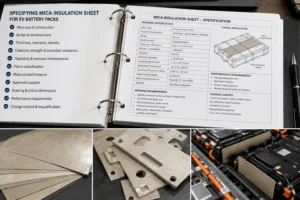
A useful material specification should identify mica type, product construction, binder, reinforcement, thickness and tolerance, density or areal mass, flexibility, dielectric strength, insulation resistance, operating and short-term exposure temperatures, flame classification, moisture performance, and approved supplier.
The drawing should identify the protected surfaces, high-voltage zones, vent and terminal keep-outs, critical dimensions, holes, bends, adhesive zones, liner design, edge-quality requirements, cleanliness, orientation, labeling, and packaging.
Performance requirements should include the relevant voltage test, mechanical aging, flame or heat exposure, and module-level acceptance criterion. Avoid copying a generic maximum-temperature value without stating duration and test method.
Change control should cover the mica paper, binder, reinforcement, film, adhesive, liner, thickness, converter, and process. Requalification may be required when any critical layer changes.
RFQ Checklist for Mica Insulation Sheet Parts
Provide the cell or module layout, pack voltage, protected component, vent location, heat and flame exposure, available thickness, electrical-clearance requirement, substrate, assembly method, annual volume, and target production location.
Send 2D drawings or CAD files with dimensions, tolerances, radii, holes, adhesive pattern, liner split, pull tabs, forming zones, and packaging requirements.
Define the required material evidence: mica type, binder, reinforcement, dielectric data, temperature data, flame classification, adhesion, environmental aging, traceability, and restricted-substance compliance.
State the prototype quantity, validation schedule, PPAP level, expected annual volume, target cost, and current design problem. This allows the converter to recommend a suitable rigid, flexible, adhesive-backed, or composite construction.
How Boost Insulation Supports Mica EV Battery Projects
Boost Insulation positions itself as a China-based EV battery insulation and precision die-cut manufacturer with IATF 16949 and ISO 9001 quality systems. Its public capabilities include DFM support, in-house tooling, cleanroom lamination and die cutting, APQP and PPAP support, and lot traceability.
The company states that suitable custom parts can be produced to tight dimensional tolerances and that prototype samples can be supplied rapidly. Its material portfolio includes EV dielectric insulation, flame-retardant polycarbonate, aerogel, mica, silicone sheets, thermal pads, and adhesives.
For a mica project, engineering support can include grade selection, rigid or flexible construction, adhesive pattern, foam or PC lamination, edge reinforcement, die-cut geometry, prototype tooling, dimensional inspection, withstand-voltage testing, aging tests, and production packaging.
To receive a useful recommendation, upload the cell, module, pack-cover, busbar, or enclosure drawing and include the voltage, temperature, flame exposure, target thickness, assembly method, test plan, annual volume, and current failure risk.
| Need a custom mica barrier, busbar insulator, or pack-lid part?
Send Boost Insulation your module, busbar, pack-cover, or enclosure drawing together with the voltage, temperature, flame exposure, target thickness, adhesive needs, validation method, annual volume, and PPAP requirements. The engineering team can review mica, flame-retardant PC, silicone foam, aerogel, films, adhesives, and precision die-cut constructions. Visit boostinsulation.com to upload a drawing or request a quote |
Frequently Asked Questions
Is mica the same as aerogel insulation?
No. Mica is primarily valued for high-temperature structural integrity, electrical insulation, and flame protection. Aerogel is primarily valued for very low thermal conductivity. They can be combined in one barrier.
Can mica be used between individual battery cells?
Yes, especially when flame and dielectric protection are important. High-energy cells may require mica combined with aerogel or foam to obtain sufficient thermal resistance and compression control.
Which is better for EV batteries: muscovite or phlogopite mica?
Muscovite is often selected for dielectric performance, while phlogopite is often selected for higher-temperature exposure. The binder, reinforcement, thickness, and final test conditions determine the best grade.
Does a mica insulation sheet need UL 94 V-0?
Project requirements vary. Some finished mica tapes and laminates carry UL 94 V-0 or equivalent classifications. Verify the exact construction and do not treat the rating as proof of pack-level thermal-runaway performance.
Can mica insulation sheets be adhesive-backed?
Yes. Silicone or acrylic pressure-sensitive adhesives may be used. The adhesive must be compatible with the substrate, temperature, flame exposure, aging, and assembly process.
Can a mica sheet protect an EV battery-pack lid?
Yes. Mica sheets and composites are commonly considered for under-lid and perimeter fire barriers. The correct thickness, attachment, coverage, vent path, and pack test must be defined.
How are mica insulation sheets die-cut?
Depending on the grade and volume, they may be flatbed die-cut, rotary die-cut, CNC-cut, stamped, or processed by other methods. Tooling and support must prevent cracking, delamination, and dust.
What files are needed for a custom mica part?
Provide a PDF or CAD drawing, thickness, mica grade or performance target, adhesive areas, voltage requirement, flame or temperature exposure, tolerances, annual volume, and validation plan.
Technical References
- Boost Insulation. EV battery insulation, precision die cutting, DFM, rapid prototyping, quality testing, APQP, PPAP, and traceability capabilities. Source
- United Nations Economic Commission for Europe. UN Regulation No. 100, Revision 3, rechargeable electrical energy storage system and thermal-propagation requirements. Source
- Saint-Gobain Tape Solutions. Understanding the Benefits of Mica Tape in EV Applications, 2024. Source
- Saint-Gobain Tape Solutions. CHR FR1000 Mica Tape Technical Data Sheet, 2025. Source
- Saint-Gobain Tape Solutions. EV Battery Composites: mica/foam and other multifunctional thermal-propagation barriers. Source
- Electro lock. Thermal Runaway Protection in EV Batteries: The Role of Mica. Source
- Kim, H. S. et al. Flame-Retardant Battery Pack Case Design for Delaying Thermal Runaway Propagation. Materials, 2025. Source
- Bai, Q. et al. Influence of Insulation Material Thickness on Spread of Thermal Runaway in a Battery Module. Processes, 2023. Source
Related Posts:
What Are the Main Components Inside an ESS Storage Solution?
How Does Flame Retardant Polycarbonate Compare to FR ABS Plastic?
How Is a Mica Insulation Sheet Used on Module End Plates?
Which Insulation Material Is Best Under EV Pack Covers?
Can a Mica Insulation Sheet Work Between Battery Cells?
How Do You Choose a Flame Retardant PC Supplier?
 betty wong