What Are the Main Components Inside an ESS Storage Solution?
Table of Contents
You’ve shortlisted three ESS suppliers. They all quote similar capacities. Their brochures look equally polished. So how do you actually tell them apart — and make sure you’re not signing a purchase order for a system built on substandard parts?
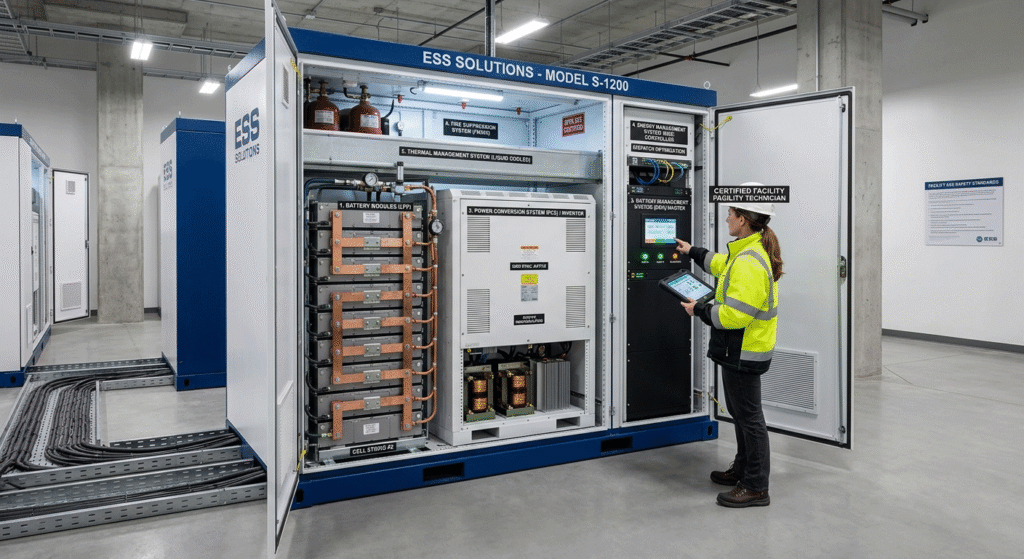
The answer lies inside the box. What goes into an ESS storage solution matters far more than the nameplate capacity on the spec sheet. The quality, integration, and engineering behind each internal component will determine how long your system lasts, how reliably it performs, and whether it delivers the ROI your business is counting on — or becomes an expensive lesson in due diligence.
This guide breaks down every main component inside a professional ESS storage solution, explains what each one does, and tells you exactly what to look for when evaluating suppliers. If you’re responsible for specifying, procuring, or approving an ESS purchase, this is the technical grounding you need.
⚑ QUICK ANSWER
Why Understanding ESS Components Matters for Every Buyer
Most ESS purchases are made by project developers, facility managers, or procurement teams who are experts in their industry — not necessarily in battery storage engineering. Suppliers know this, and the less technically informed a buyer is, the easier it is to substitute lower-quality components while maintaining the appearance of a competitive system.
Understanding what each component is, what it should do, and what distinguishes a high-quality version from a mediocre one gives you three critical advantages:
- Specification authority: You can write detailed technical requirements that suppliers must meet — not merely accept whatever they propose.
- Comparative evaluation: You can compare offers on actual technical merit rather than marketing claims and price alone.
- Risk mitigation: You identify potential failure points before contract signing — when you still have negotiating leverage — rather than after deployment, when the cost of failure is yours to bear.
Let’s go through each of the six main components in detail.
1. Battery Modules & Cell Chemistry
The battery module is the energy core of the ESS — the physical medium where electrical energy is stored in chemical form. It is also the largest single cost component, typically representing 40–55% of total system CAPEX, and the component most subject to cost-cutting substitution in budget-grade systems.
How Battery Modules Are Structured
Individual battery cells are grouped into modules (a fixed cluster of cells in a protective housing), and modules are assembled into racks or strings. Multiple racks are interconnected to form the battery system. The hierarchy runs: Cell → Module → Rack → Battery System.
Cell chemistry determines almost everything about the battery system’s performance characteristics. For commercial, industrial, and utility-scale stationary storage, lithium iron phosphate (LiFePO4 / LFP) is the industry standard. Here’s why:
| Property | LFP (Preferred) | NMC | LTO |
| Cycle Life (80% DoD) | 4,000–6,000+ | 2,000–3,500 | 15,000+ |
| Thermal Stability | Excellent | Moderate | Excellent |
| Energy Density | Moderate | High | Low |
| Cost per kWh | Low–Medium | Medium–High | Very High |
| Fire / Safety Risk | Very Low | Higher | Very Low |
| Temperature Range | –20°C to +60°C | –20°C to +55°C | –40°C to +65°C |
| Best-fit Application | C&I, Utility | EV, Portable | Cold-climate, Fast-charge |
What to Look For in Battery Modules
- Cell brand & traceability: Insist on traceable cell provenance. Tier-1 cell manufacturers include CATL, BYD, EVE, CALB, and Gotion. Request cell test reports, batch traceability certificates, and incoming quality control documentation.
- Capacity verification: Request independent third-party capacity test reports for the specific cells supplied, not just the cell model’s datasheet. Cell manufacturers produce cells in different quality grades; not all batches are equal.
- UN 38.3 certification: Mandatory for all lithium battery transportation and sale in international markets. Non-compliant cells cannot legally be shipped via air freight.
- IEC 62619 compliance: The international safety standard for secondary lithium cells and batteries for use in stationary applications. This is non-negotiable for any professional ESS installation.
2. Battery Management System (BMS)
The Battery Management System is the embedded intelligence within the battery system. A high-quality BMS is what separates a safe, long-lived ESS from one that degrades prematurely or — in the worst case — causes a thermal runaway event. Despite its critical importance, the BMS is often where budget suppliers cut corners first.
Core BMS Functions
- Real-time monitoring: Measures cell voltage (individual and grouped), current, temperature (at multiple points), and insulation resistance continuously — typically at sample rates of 10–100 ms.
- State estimation: Calculates State of Charge (SOC), State of Health (SOH), State of Power (SOP), and Remaining Useful Life (RUL) using validated algorithms — essential for accurate energy management.
- Cell balancing: Active or passive balancing corrects voltage imbalances between cells to maximize usable capacity and prevent premature aging of weaker cells. Active balancing (energy-transfer based) is superior to passive balancing (energy-dissipation) for large battery systems.
- Protection enforcement: Triggers protection cutoffs for overvoltage, undervoltage, overcurrent, overtemperature, under temperature, and short-circuit conditions — protecting both the battery and connected equipment.
- Communication: Reports state data to the EMS via standardized protocols (CAN bus, RS485, Modbus, CAN open, or Ethernet-based protocols). Communication reliability is critical for EMS control quality.
- Fault logging: Maintains a time-stamped fault log and event history, essential for remote diagnostics, warranty claims, and performance analysis.
What to Look For in BMS
- Architecture level: Distinguish between cell-level BMS (monitors every individual cell), module-level BMS, and pack-level BMS. Cell-level monitoring provides the highest safety resolution and is required for professional-grade systems.
- Balancing method: Active balancing is preferred for >100 kWh systems. Ask for quantitative data on balancing current and efficiency.
- Algorithm validation: Request documentation of the SOC estimation algorithm’s accuracy (typically ±2–3% for a quality BMS). Inaccurate SOC estimation leads to underutilization or over discharge — both costly over system lifetime.
- Cybersecurity: For grid-connected systems, BMS communication interfaces should comply with IEC 62351 or equivalent cybersecurity standards.
3. Power Conversion System (PCS) / Inverter
The Power Conversion System is the electrical gateway between the battery (operating at DC voltage, typically 600–1500 V) and the AC grid or load (50/60 Hz, single or three-phase). It is the fastest-responding component in the ESS and its efficiency and reliability directly determine the economic output of the system.
What the PCS Does
A bidirectional PCS performs two functions simultaneously: during charging, it rectifies AC power to DC to charge the batteries; during discharging, it inverts DC power to AC for delivery to the grid or loads. Advanced PCS units also provide:
- Grid synchronization and islanding detection / anti-islanding protection
- Reactive power (VAR) support — voltage regulation for the local grid
- Active power ramp rate control — smoothing renewable generation variability
- Frequency regulation response — sub-100ms active power response to grid frequency deviations
- Harmonic distortion control — maintaining power quality for sensitive loads
- Black start capability — ability to energize a de-energized microgrid from battery without external power reference
Key PCS Performance Metrics
| Metric | Good Performance | Industry-Leading |
| Peak Efficiency | ≥97.0% | ≥98.5% |
| CEC Weighted Efficiency | ≥96.5% | ≥97.5% |
| Response Time (0→100%) | <100 ms | <20 ms |
| Power Factor Range | 0.9 lead/lag | 0.8 lead/lag |
| THD (Total Harmonic Distortion) | <3% | <1.5% |
| Operating Temperature | –10°C to +50°C | –25°C to +60°C |
| MTBF | >100,000 hours | >150,000 hours |
What to Look For in PCS
- Grid code compliance: The PCS must comply with the specific grid code of the deployment country (e.g., IEEE 1547 in the US, EN 50549 in Europe, AS4777 in Australia). Non-compliant PCS units will fail grid interconnection approvals.
- UL 1741 / IEC 62477 certification: These are the primary safety standards for grid-connected power conversion equipment. Insist on independent certification, not self-declaration.
- Warranty & MTBF: Request the PCS manufacturer’s published MTBF data and warranty terms. A 5-year warranty with 97% uptime guarantee is the minimum acceptable for commercial deployments.
- Brand lineage: Tier-1 PCS manufacturers include Sungrow, SMA, Huawei, ABB, and Schneider Electric. Understand whether the ESS supplier manufacturers their own PCS or integrates a third-party unit — and which supplier’s unit is included.
4. Energy Management System (EMS)
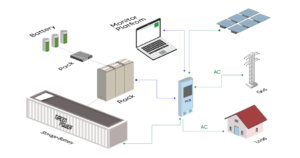
If the BMS is the nervous system of the battery and the PCS is the muscle, the EMS is the brain of the entire ESS. It is the software-defined control layer that determines when the system charges, when it discharges, how it interacts with the grid, and how it maximizes economic returns over time. The EMS is also the most frequently underestimated and under-specified component in budget ESS proposals.
EMS Core Functions
- Data aggregation: Collects real-time data from the BMS (cell-level state data), PCS (power flow measurements), meteorological sensors (solar irradiance, ambient temperature), smart meters (load data), and external signals (grid operator commands, tariff signals, wholesale electricity prices).
- Dispatch optimization: Executes algorithms — ranging from rule-based logic to machine learning models — to determine the optimal charge/discharge schedule that maximizes a user-defined objective function (e.g., minimize electricity cost, maximize self-consumption, maximize ancillary service revenue, or a combination).
- Grid interaction management: Communicates with grid operators and aggregators via standardized protocols (IEC 61850, Open ADR, OCPP, Modbus TCP) to respond to demand response events, frequency regulation signals, and capacity market dispatches.
- Forecasting: Integrates load forecasting (based on historical consumption patterns) and generation forecasting (based on weather data) to make predictive dispatch decisions rather than purely reactive ones.
- Remote monitoring & diagnostics: Provides the operator dashboard and cloud-based monitoring portal for real-time visibility, alarm management, historical performance reporting, and remote configuration.
- Cybersecurity: Protects the ESS control system from unauthorized access via role-based access control, encrypted communications, and compliance with IEC 62351 cybersecurity standards.
What to Look For in EMS
- Open vs. proprietary: A proprietary EMS that only works with the supplier’s hardware locks you in permanently. Prefer an EMS that supports open protocols and can integrate with third-party equipment.
- Machine learning capability: Basic rule-based EMS performs adequately but cannot adapt to changing conditions. An ML-enhanced EMS that learns from actual load patterns and forecasting accuracy can improve energy savings by 10–20% over rule-based approaches.
- SLA & uptime: The EMS is cloud-connected; demand a Service Level Agreement (SLA) specifying minimum uptime (99.5% or better), response time for critical alarms (<5 minutes), and data retention policy.
- API & SCADA integration: For C&I and utility clients with existing SCADA or building management systems, the EMS must offer a well-documented API (REST or SOAP) for integration.
5. Thermal Management System
Temperature is the single biggest enemy of battery longevity. Operating LFP cells above 35°C accelerates calendar aging and capacity fade. Operating below 0°C during charging can cause lithium plating — a safety hazard that permanently damages cells. A well-designed thermal management system maintains every cell in the optimal operating window under all ambient conditions, year-round.
Air Cooling vs. Liquid Cooling
Two primary thermal management approaches are used in ESS storage solutions:
| Factor | Air Cooling | Liquid Cooling |
| Cooling Efficiency | Moderate | High — 3–5× more effective |
| Temperature Uniformity | ±5–8°C cell-to-cell | ±1–2°C cell-to-cell |
| Energy Consumption | ~2–3% of stored energy | ~1–1.5% of stored energy |
| System Complexity | Low | Higher (coolant loop, pump, chiller) |
| Maintenance | Filter cleaning, fan replacement | Coolant quality, leak checks |
| Best For | Moderate climates, <500 kWh | Hot climates, high C-rate, >500 kWh |
| Relative Cost | Lower upfront | Higher upfront, better long-term ROI |
What to Look For in Thermal Management
- Cooling strategy match to climate: A system designed for a temperate European climate may significantly underperform in tropical Southeast Asia or the Middle East. Always provide your site’s ambient temperature range (min/max) and altitude to the supplier and request thermal simulation results.
- Redundancy: Professional systems include redundant cooling channels so that a single component failure (fan motor, pump) does not immediately take the battery system offline.
- Integration with BMS: The thermal management controller must receive temperature data from the BMS and respond automatically to thermal events — not require manual intervention.
- Heating for cold climates: In regions with sub-zero winters, a heating subsystem is required to bring battery temperature above 0°C before charging commences. Verify that this is included and tested.
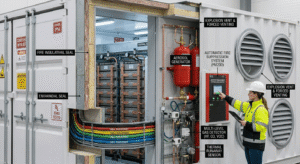
6. Structural Enclosure & Fire Suppression System
The enclosure provides the physical housing, environmental protection, electrical isolation, and fire containment for the ESS. It is not merely a metal box — it is an engineered system that determines whether a minor thermal event in one battery module becomes an isolated incident or a catastrophic multi-container fire.
Enclosure Requirements
- IP rating: Outdoor enclosures should carry a minimum IP54 rating (dust and splash protection) and ideally IP65 for dusty or high-humidity environments. Confirm this is tested, not just claimed.
- Structural integrity: The enclosure must withstand local wind, seismic, and snow load requirements. Request engineering calculations or certified structural analysis for your deployment region.
- Electrical isolation: All high-voltage DC components must be physically isolated from access panels and low-voltage control systems. Compliance with IEC 60529 and local electrical codes is mandatory.
- Cable management: Proper cable tray, conduit, and connection labeling reduces installation errors, simplifies maintenance, and reduces fire risk from loose connections.
Fire Suppression — The Non-Negotiable
Lithium battery fires are chemically distinct from conventional fires and cannot be reliably extinguished with water or CO2. A professional ESS enclosure integrates a purpose-designed fire suppression system that includes:
- Multi-level gas detection: hydrogen fluoride (HF), CO, VOC, and smoke sensors at cell, module, and enclosure level
- Thermal runaway detection: individual cell temperature monitoring with early-warning algorithms (typically triggering 3–7 minutes before thermal runaway cascades)
- Automatic suppression: aerosol, FM200 (HFC-227ea), or nitrogen inerting systems that activate within seconds of confirmed fire signal
- Compartmentalization: physical fire barriers between battery strings to contain propagation to a single module or rack
- Forced venting: pressure relief mechanisms and hot gas exhaust routing that prevent enclosure over-pressurization
Verify that the fire suppression system complies with NFPA 855 (US), UL 9540A fire propagation testing, or equivalent local standards. Ask specifically whether the system has been independently tested using the UL 9540A method — this is the most rigorous fire propagation test for battery storage systems and is increasingly required by local fire authorities.
How All Six Components Work Together
An ESS storage solution is only as strong as its weakest component — and its performance is only as good as the integration between components. Here is the data flow that ties everything together in a complete operating cycle:
- The EMS receives load data from smart meters, solar forecast data from weather services, and electricity tariff signals from the utility. It calculates the optimal charging schedule for the next 24 hours.
- The EMS commands the PCS to begin charging at a specified power setpoint. The PCS converts AC grid power to DC at the battery’s operating voltage.
- The BMS monitors every cell’s voltage and temperature as charging proceeds. It balances cells, enforces protection limits, and reports SOC to the EMS every 10 seconds.
- The Thermal Management System maintains battery temperature within ±2°C of target, modulating cooling capacity in response to real-time cell temperature data from the BMS.
- At peak demand time, the EMS commands discharge. The PCS converts battery DC to AC in under 20 ms, supplying the facility load and avoiding the demand charge peak.
- If a thermal event occurs, the fire suppression system detects gas signatures, alerts the EMS, isolates the affected string, and activates suppression — all within seconds, without human intervention.
This seamless data flow between all six components is what defines a professionally integrated ESS. A system where components are loosely integrated — or where the EMS cannot access BMS data in real time, or where the fire suppression is a standalone system with no EMS connectivity — is not a professional product. It is a collection of parts.
Component Quality Red Flags: What to Walk Away From
Not everything that looks like a tier-1 ESS is one. These are the warning signs that a system’s internal components may not meet professional standards:
- No cell traceability documentation: If a supplier cannot provide individual cell batch test reports with manufacturer-issued traceability documentation, assume the cells are off-spec, reconditioned, or unverified.
- Passive-only cell balancing for systems >200 kWh: Passive balancing dissipates energy as heat and is inadequate for large battery systems operating at high cycle rates. It shortens cell life and reduces round-trip efficiency.
- PCS efficiency below 96.5%: Every percentage point of PCS inefficiency translates directly to lost energy — and lost revenue — over the system’s lifetime. At 1 MWh daily throughput, a 2% efficiency gap costs approximately $8,000–$15,000 per year in lost energy.
- Proprietary communication protocols (no open protocol support): Traps you in permanent dependency on one supplier for EMS upgrades, software support, and third-party integration.
- Air cooling in a tropical deployment: Air-cooled systems deployed in ambient temperatures above 35°C will struggle to maintain optimal battery temperature, accelerating aging and increasing fire risk.
- No independent fire propagation testing data: Self-certified fire protection that has never been validated by UL 9540A or an equivalent independent standard is a liability — for you, your insurer, and your site.
- Missing certifications: Any system missing IEC 62619 (cells), UL 9540 (system), and grid code compliance certification for your jurisdiction is not deployable without significant regulatory risk.
10 Technical Questions to Ask Your ESS Supplier About Components
Use these questions to quickly distinguish serious manufacturers from commodity resellers:
- Which cell manufacturer and chemistry are used? Can you provide the cell batch test report and UN 38.3 certification for the specific cells in this proposal?
- Does the BMS provide cell-level monitoring? What is the BMS sampling rate, and what is the stated SOC accuracy across the full temperature range?
- Is balancing active or passive? What is the balancing current, and at what SOC differential does balancing activate?
- What is the PCS peak efficiency and CEC weighted efficiency? Which grid code does it comply with for our deployment country?
- Is the EMS proprietary or open-protocol? Does it support Open ADR, IEC 61850, and REST API for SCADA integration?
- What is the EMS SLA uptime commitment? What is the maximum response time for critical BMS alarm escalation?
- Is cooling air-based or liquid-based? What is the system’s thermal performance guarantee at the maximum ambient temperature of our deployment site?
- What fire suppression agent is used? Has the system undergone UL 9540A fire propagation testing? Can you provide the test report?
- Which certifications does the system hold? Please provide IEC 62619, UL 9540, grid code compliance certification, and CE/UL system-level certification documents.
- Can you provide three reference projects of similar scale and application where this specific hardware configuration has been deployed? May we contact the project operators directly?
A supplier who can answer all ten questions with supporting documentation is a supplier worth doing business with. A supplier who deflects, generalizes, or cannot provide documentation for more than two or three of these questions should be removed from your shortlist immediately.
Frequently Asked Questions
Q: Is the BMS always built into the battery module, or is it a separate unit?
Both architectures exist. In module-integrated BMS designs, the BMS electronics are embedded within the battery module itself. In rack-level or system-level BMS designs, a separate BMS controller manages the entire battery string. For large commercial and utility ESS, a hierarchical BMS architecture is typical: a cell-level or module-level BMS handles cell monitoring and protection, while a rack-level or system-level BMS aggregates data and communicates with the EMS. The exact architecture varies by manufacturer — always request a detailed BMS architecture diagram.
Q: Can I upgrade the EMS software after the system is deployed?
With a professional EMS, yes — and you should expect regular software updates throughout the system’s life. Firmware and algorithm updates should be deployable remotely (over the air), subject to version control and rollback capability. Confirm that software updates are included in the maintenance agreement and clarify whether future EMS capability upgrades (e.g., new market participation algorithms) require additional licensing fees.
Q: How does liquid cooling affect system warranty and maintenance requirements?
Liquid cooling systems require periodic maintenance of the coolant loop: checking coolant pH and conductivity annually, inspecting hose connections for leaks, and cleaning the heat exchanger every 2–3 years depending on ambient conditions. Most professional suppliers include these maintenance items in their O&M service contract. The additional maintenance overhead is generally offset by significantly better battery longevity — liquid-cooled systems consistently show 10–15% better cycle life retention compared to equivalent air-cooled systems under the same operating conditions.
Q: What happens if one component fails? Does the whole ESS go offline?
In a well-designed ESS, the answer is no. Professional systems are designed with redundancy at multiple levels: multiple battery strings that can operate independently if one is isolated, redundant cooling channels, redundant communication pathways between BMS and EMS, and automatic protective isolation that takes a failed module or string offline without shutting down the entire system. Always ask suppliers to document their system redundancy architecture and quantify the minimum output capacity the system can maintain during a partial component failure.
Q: Are all components from the same manufacturer, or is an ESS a multi-supplier integration?
This varies significantly by supplier. Some ESS manufacturers design and produce all major components (cells excluded) in-house — this is the highest level of integration quality. Others are system integrators who source BMS, PCS, and EMS from different suppliers and assemble them into a containerized solution. Neither model is inherently inferior, but the integrator model requires more rigorous evaluation of the individual component suppliers and the quality of integration testing. Always ask for the brand and model of each major component, and verify the component specifications independently.
Get Component-Level Transparency on Your Next ESS Quote
Most ESS quotes are written to obscure component details, not reveal them. Our engineering team does the opposite: every proposal we send includes full component specification sheets, certification documentation, and third-party test reports for every major subsystem.
✅ Component-level BOM (Bill of Materials) provided with every proposal
✅ Full certification pack: IEC 62619, UL 9540, grid code compliance documents
✅ Independent capacity test reports for every cell batch
✅ UL 9540A fire propagation test report on request
✅ Reference project contacts available for all comparable installations
Conclusion: Components Are Everything
An ESS storage solution is not a commodity. It is a precision-engineered system whose lifetime performance, safety profile, and economic returns are determined by the quality and integration of six distinct subsystems: the battery modules, the BMS, the PCS, the EMS, the thermal management system, and the structural enclosure with fire suppression.
Every decision you make in specifying and procuring an ESS — from the cell chemistry you specify to the fire suppression standard you require — shapes the project’s risk profile and long-term economics. Buyers who understand what’s inside their ESS consistently achieve better outcomes: longer system life, fewer unplanned outages, stronger supplier accountability, and superior return on investment.
We built our ESS product line with the belief that every buyer deserves full transparency into what they’re purchasing. If you’re evaluating energy storage options for an upcoming project, we invite you to hold every potential supplier — including us — to the standard of technical transparency this guide describes. The best suppliers will welcome the scrutiny. The ones who don’t will tell you everything you need to know.
Related Posts:
How Is Aerogel Used Between Prismatic EV Battery Cells?
Where Is Aerogel Used Inside Modern EV Battery Packs?
How Is Aerogel Used Near EV Battery Module End Plates?
What Is a Mica Insulation Sheet for EV Battery Packs?
How Does Battery Aerogel Insulation Work in EV Packs?
What Temperature Can a Mica Insulation Sheet Withstand?
 betty wong