
How Can You Prevent UV Yellowing in FR Polycarbonate?
Table of Contents
Have you ever pulled a polycarbonate component off the production line — pristine, optically clear, exactly to specification — only to see that same part return from the field six months later with an unmistakable amber tint? If you work with FR polycarbonate in any outdoor or UV-exposed application, you already know UV yellowing isn’t a hypothetical risk. It’s a field failure timeline, a warranty claim waiting to happen, and — in lighting, glazing, or appearance-critical applications — a direct threat to your product’s perceived quality and your customer’s confidence. What makes this even more challenging is that the flame retardant additives in FR polycarbonate can actively accelerate that yellowing process, making UV protection far more critical for FR PC than for standard grades. The good news: it’s a solvable problem — if you know where to start.
UV yellowing in FR polycarbonate can be prevented through five complementary strategies:
- Specifying FR PC grades already formulated with UV absorbers (UVAs) and hindered amine light stabilizers (HALS) built into the resin.
- Applying UV-protective hard coatings — silicone-based or acrylic-based — that intercept UV radiation before it reaches the bulk polymer.
- Selecting FR systems where the flame retardant additive chemistry is UV-compatible and does not itself accelerate photo-oxidation.
- Optimizing injection molding conditions to protect the UV stabilizer package from thermal degradation during processing.
- Designing parts to reduce UV dose through geometry, orientation, and protective overlays.
The most durable outdoor-rated FR PC components combine all five approaches, achieving 5–10-year service life with yellowness index (YI) values within specification across automotive, electrical, and architectural applications.
Why Does FR Polycarbonate Yellow? The Science Behind the Problem
Before solving the problem, it helps to understand exactly what is happening at the molecular level when FR polycarbonate is exposed to sunlight. Yellowing is not simply a surface discoloration — it reflects a cascade of photochemical reactions that progressively degrades both the optical and mechanical properties of the material.
Polycarbonate and UV Sensitivity
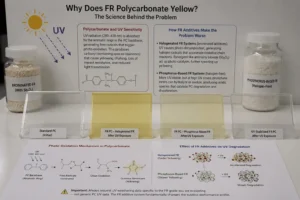
Standard polycarbonate is inherently UV-sensitive because of its bisphenol-A (BPA) backbone, which contains aromatic rings that absorb ultraviolet light — particularly in the 280–400 nm wavelength range most damaging to organic polymers. When UV photons are absorbed by these chromophore groups, they provide enough energy to break chemical bonds and generate reactive free radical species. These radicals initiate a chain oxidation process (photo-oxidation) that produces carbonyl-containing species — particularly quinone structures — that are intensely yellow in color.
The result is a progressive shift in the yellowness index (YI) of the component, accompanied by surface chalking, embrittlement, loss of impact resistance, and reduction in light transmission. In transparent FR PC parts such as lighting lenses or glazing panels, this optical degradation is immediately visible. In opaque colored parts, surface chalking and gloss loss signal the same underlying degradation.
How FR Additives Make the Problem Worse
This is the crucial insight that many engineers miss: the flame retardant additives incorporated into FR polycarbonate can significantly accelerate UV-induced yellowing compared to standard PC.The mechanism varies by FR system type:
Halogenated FR systems (brominated additives): UV radiation can cause photo-decomposition of halogenated flame retardants, generating reactive halogen radicals that accelerate oxidative chain reactions in the polymer backbone. The synergists commonly used with halogenated FRs — particularly antimony trioxide — can themselves act as photo-catalysts, further accelerating surface degradation. The net effect is a materially faster yellowing rate compared to standard PC under equivalent UV exposure.
Phosphorus-based FR systems (halogen-free grades): Organophosphate-based flame retardants are generally more UV-stable than halogenated systems, but they are not immune. At elevated UV doses, some phosphate esters can hydrolyze or oxidize, generating acidic species that catalyze PC chain scission and contribute to discoloration. The effect is smaller than for halogenated systems — one reason halogen-free FR PC often shows better outdoor durability — but the interaction between FR chemistry and UV degradation must still be engineered around.
⚠ Important: Always request UV weathering data specific to the FR grade you are evaluating — not generic PC UV data. The FR additive system fundamentally changes the outdoor performance profile.
Five Proven Strategies to Prevent UV Yellowing in FR Polycarbonate
Strategy 1: Specify UV-Stabilized FR PC Grades
The most effective starting point for preventing UV yellowing is selecting an FR polycarbonate grade that already incorporates UV protection chemistry as part of the resin formulation — rather than relying entirely on surface coatings or design mitigation.
UV Absorbers (UVAs): The First Line of Defense
UV absorbers are molecules dispersed through the bulk of the polymer that competitively absorb UV photons before they can damage the PC backbone. They convert the absorbed UV energy into harmless heat through intramolecular processes. The most widely used UVAs in FR PC are benzotriazole derivatives (e.g., Tinuvin 328, Tinuvin 329) and benzophenone derivatives — both effective in the 280–380 nm range most damaging to PC.
The critical performance parameter for a UVA in FR PC is UV compatibility with the FR system: some UVA molecules can be deactivated or decomposed by halogenated FR additives or their decomposition products under UV exposure, dramatically reducing their protective lifetime. Resin formulators who develop high-quality UV-stable FR PC grades validate this compatibility and optimize UVA loading and type for the specific FR system in use.
Hindered Amine Light Stabilizers (HALS): The Regenerating Radical Trap
HALS work through a fundamentally different mechanism from UVAs — rather than absorbing UV radiation before it causes damage, HALS molecules scavenge the free radical intermediates generated after photo-oxidation has begun. Through a catalytic cycle, HALS regenerate themselves during the radical-scavenging process, giving them exceptional longevity in the polymer matrix compared to UV absorbers (which are consumed as they absorb UV photons).
HALS are most effective in combination with UVAs: the UVA reduces the initial rate of radical formation by intercepting UV photons, while the HALS manages the radicals that are generated despite the UVA protection. In FR PC formulations, careful selection of HALS type is critical — some HALS molecules (particularly basic HALS) can interact negatively with acidic FR additives, reducing their stabilization efficiency. Acidic HALS variants or NOR-HALS systems are often preferred in halogen-containing FR PC grades to avoid this incompatibility.
What to Look for on a Technical Data Sheet
When evaluating UV-stabilized FR PC grades from resin manufacturers, request or verify the following:
- Accelerated weathering data: Xenon arc exposure per ISO 4892-2 or SAE J2527, reported as ΔYI (change in yellowness index) and ΔE (color change) after defined kJ/m² doses. For outdoor applications, look for ΔYI ≤5 after 2500 kJ/m² xenon exposure.
- Specific stabilizer system disclosed or validated: Leading resin suppliers (SABIC, Covestro, Mitsubishi Chemical) specify UV stabilizer type and loading in their product documentation for UV-stabilized grades.
- UV-FR compatibility validated: The data sheet or technical support team should confirm that the UV stabilizer package was developed and tested together with the specific FR system in the grade — not simply blended from generic components.
- 5-year or 10-year outdoor performance data: Premium UV-stable FR PC grades from established resin producers provide real-world outdoor exposure correlation data, either from direct weathering programs or validated QUV/xenon correlation factors.
Strategy 2: Apply UV-Protective Hard Coatings
Hard coatings are the second critical layer of UV protection for FR polycarbonate — and for many demanding outdoor applications, they are not optional. A properly formulated hard coat provides two simultaneous benefits: UV protection and surface abrasion resistance, both of which deteriorate together under outdoor exposure without coating protection.
Silicone-Based Hard Coats
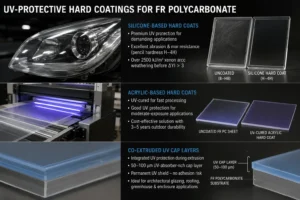
Silicone hard coatings are the premium standard for UV-exposed FR PC applications — particularly automotive headlamp lenses, transparent glazing, and traffic signal lenses. Applied by dip coating, flow coating, or spray coating, then thermally cured, silicone hard coats typically achieve pencil hardness of H–4H (vs. the uncoated PC substrate’s B–HB), dramatically improving abrasion and mar resistance alongside UV protection.
UV-functional silicone hard coats incorporate UV absorbers directly into the coating matrix — typically at higher concentrations than are practical in the bulk polymer — creating a UV-absorbing barrier layer at the exposed surface. The best silicone hard coat systems for FR PC provide over 2500 kJ/m² of xenon arc weathering resistance before ΔYI exceeds 3, which corresponds to approximately 5–8 years of outdoor service in temperate climates.
Acrylic-Based Hard Coats and UV Coatings
UV-cured acrylic hard coatings are an alternative to silicone systems, offering faster cure cycles (seconds under UV lamp vs. minutes in oven for silicone) and compatibility with inline or roll-to-roll processing for FR PC sheet and film. Their UV protection performance is generally good for moderate-exposure applications but typically falls below silicone systems in extreme outdoor durability benchmarks. For cost-sensitive applications where 3–5-year outdoor performance is sufficient, UV-cured acrylic coats represent excellent value.
Co-Extruded UV Cap Layers
For FR PC sheet and profile applications produced by extrusion, co-extruded UV-protective cap layers offer an integrated alternative to post-process coating. A thin layer (typically 50–100 μm) of UV-absorber-rich acrylic or PVDF is co-extruded directly onto the FR PC substrate surface, forming a permanent UV shield without adhesion risk. This approach is widely used in architectural glazing, roofing panels, and agricultural greenhouse glazing — and is increasingly applied in FR PC sheet products for outdoor electrical enclosure and transit vehicle applications.
Strategy 3: Choose FR Additive Systems That Are UV-Compatible
Not all FR polycarbonate grades are created equal in UV performance — and a significant part of the variation comes from the flame retardant additive chemistry itself, independent of any UV stabilizer system added.
Halogen-Free FR PC: The UV Stability Advantage
As discussed in the chemistry section above, halogenated flame retardants (brominated additives combined with antimony trioxide synergists) create multiple UV degradation pathways that are absent in halogen-free formulations. Several independent weathering studies have demonstrated that halogen-free FR PC grades — using phosphorus-based FR systems such as BDP (bisphenol-A bis(diphenyl phosphate)) or other organophosphate systems — show measurably lower yellowing rates under accelerated weathering compared to equivalent halogenated FR grades with similar UVA/HALS loading.
The practical implication: when outdoor UV performance is a primary requirement alongside flame retardancy, specifying halogen-free FR PC gives you a material platform that is intrinsically more UV-compatible — and allows your UV stabilizer package to work more efficiently without being undermined by FR-generated photo-catalysts.
Impact of FR Loading Level
Within any given FR system type, higher flame retardant loading levels generally correlate with faster UV-induced yellowing — because more FR additive means more photo-reactive species per unit volume. This creates a design tension in FR PC development: maximizing FR loading to achieve thin-wall V-0 performance vs. minimizing FR loading to preserve UV stability. Premium FR PC resin developers optimize this balance through proprietary FR system design, often using synergists or additive combinations that achieve V-0 at lower total FR loading while maintaining full UV stabilizer performance.
Strategy 4: Optimize Processing to Protect the UV Stabilizer Package
UV stabilizers — particularly UVAs — are heat-sensitive organic molecules that can degrade during high-temperature injection molding if processing conditions are not carefully controlled. Processing-induced degradation of the UV stabilizer package effectively reduces the UV protection lifetime of the finished part, even if the virgin resin was correctly formulated.
Melt Temperature and Residence Time Control
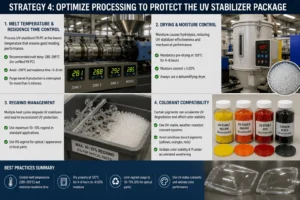
FR PC is typically injection-molded at barrel temperatures of 280–320°C. Processing at the high end of this range, or with extended residence time in the barrel (e.g., during machine start/stop or production interruptions), exposes the UV stabilizer molecules to elevated thermal stress. At temperatures above 310°C with residence times exceeding 5–8 minutes, measurable UV stabilizer depletion has been documented in FR PC grades containing benzotriazole UVAs.
Best practice: process UV-stabilized FR PC at the lowest melt temperature that still achieves adequate mold filling and surface quality — typically 280–295°C for unfilled FR PC. Monitor residence time and purge the barrel if production is interrupted for more than 5 minutes.
Drying and Moisture Control
Undried or inadequately dried FR PC generates hydrolysis byproducts during processing — including bisphenol-A and phenol derivatives — that can interact with UV stabilizers and reduce their effectiveness. Mandatory pre-drying at 120°C for 4–6 hours in a dehumidifying dryer to below 0.02% moisture is the non-negotiable starting point. Never process UV-stabilized FR PC from an undried condition, even if part aesthetics appear acceptable — the molecular weight reduction from hydrolysis compromises both UV stability lifetime and impact performance simultaneously.
Regrind Management
Regrind — recycled sprues, runners, and reject parts — from UV-stabilized FR PC should be used with caution and within defined blend ratios (typically maximum 10–15% regrind in standard UV performance programs, or 0% regrind for optical/appearance-critical parts). Multiple heat cycles through regrind progressively deplete the UV stabilizer package with each pass, creating parts with heterogeneous UV stability in the molded batch.
Colorant Compatibility
Not all colorant systems for FR PC are UV-neutral. Certain organic pigments — particularly some yellows, oranges, and reds based on azo or diazo chemistry — can absorb UV radiation themselves and generate reactive species that interact with the UV stabilizer package or the PC backbone. For outdoor FR PC applications where color stability is specified, request UV-stable colorant systems from your color masterbatch supplier and validate color stability alongside overall YI under accelerated weathering.
Strategy 5: Design Components to Minimize UV Dose
Materials engineering and coating solutions address the UV vulnerability of FR PC at the material level. Design engineering addresses it at the system level — by reducing the UV dose that the material actually experiences in service.
Geometric orientation: Where possible, orient FR PC surfaces away from direct solar incidence. Vertical panel surfaces receive 20–30% lower annual UV dose than horizontal surfaces at equivalent latitude. Recessing panels behind protective facias, frames, or overhangs can reduce UV dose by 40–60% while maintaining functional optical performance.
Protective film overlays: UV-protective polyester or acrylic self-adhesive films (such as protective glazing films or surface protection films with UV-blocking additives) can be applied during installation and removed later, or left permanently as a sacrificial UV-absorbing layer over FR PC glazing or panel surfaces.
Window glass filtration: For interior automotive or building applications where FR PC components are visible through glass, standard laminated safety glass already filters wavelengths below 380 nm. Interior FR PC components behind such glass experience dramatically reduced UV dose compared to exterior applications — enabling lighter UV stabilizer specifications or lower-cost grades in interior-only use cases.
How to Evaluate and Test UV Performance in FR Polycarbonate
Preventing UV yellowing in FR polycarbonate is only half the challenge — verifying that your prevention measures are working before committing to production requires the right test methods and performance targets.
| Standard | Test Method | What It Measures |
| ASTM G154 | UVA-340 / UVB-313 fluorescent UV lamp cycling | Overall UV + moisture weathering simulation for plastics |
| ISO 4892-2 | Xenon arc lamp weathering (cyclic) | Full-spectrum UV + visible + IR; simulates real sunlight closely |
| SAE J2527 | Xenon arc (automotive specific) | Automotive exterior component UV/weathering standard; widely referenced by OEMs |
| ASTM D1925 | Yellowness Index (YI) — spectrophotometry | Measures degree of yellowing; ΔYI target typically ≤2-3 for appearance-critical parts |
| ASTM E313 | Yellowness Index (CIE illuminant D65/10°) | ISO-aligned YI measurement; used in global programs alongside D1925 |
| ISO 11341 | Xenon arc weathering (general plastics) | Gloss retention, color change (ΔE), and YI after defined UV dose |
| DIN 75220 | Automotive sunlight simulation in vehicles | Simulates heat + UV inside passenger compartment; relevant for interior FR PC |
| ASTM D4459 | Xenon arc for plastics in indoor applications | UV exposure for interior-use plastics; simulates artificial lighting + window glass filtered sunlight |
Setting Your Yellowness Index (YI) Target
Yellowness Index (ΔYI, measured per ASTM D1925 or ASTM E313) is the primary metric for quantifying UV yellowing in polycarbonate. Industry benchmarks for acceptable ΔYI limits by application are:
- Automotive headlamp lenses: ΔYI ≤1–2 after SAE J2527 equivalent UV dose (premium OEM programs may specify ΔYI ≤1)
- Outdoor electrical enclosures: ΔYI ≤4–5 after ASTM G154 or ISO 4892-2 equivalent to 5–7 years outdoor exposure
- Architectural glazing: ΔYI ≤3 after xenon arc equivalent to 10 years exposure
- Traffic and signage lenses: ΔYI ≤2 per optical performance requirements
- Interior automotive trim: ΔYI ≤6 after DIN 75220 / SAE J2412 interior heat-UV cycling
Always establish your ΔYI target before qualifying a FR PC grade — and request accelerated weathering data at the specific UV dose corresponding to your target service life and geographic exposure class. A supplier who cannot provide this data against a specific standard is not equipped to support outdoor-rated FR PC applications.
Application-Specific UV Protection Requirements
| Application | UV Protection Strategy | Recommended Standard | YI Target (ΔYI) |
| Automotive headlamp lens/bezel | UV-stable FR PC + silicone hard coat + UV cap layer | SAE J2527 / ISO 4892-2 | ≤1 (luxury OEM programs) |
| Outdoor electrical enclosure | UV-stabilized FR PC + HALS system | ASTM G154 / IEC 60068-2-5 | ≤4 (10-year target) |
| Building / architectural glazing | UV-stable transparent FR PC + hard coat | ISO 4892-2 / EN 513 | ≤3 (Class A glazing) |
| Rail / transit interior panels | UV-co-extruded FR PC cap layer or UV-absorbed blend | EN 45545 / ISO 4892-2 | ≤5 |
| Traffic & signage lenses | UV-stable FR PC + UV absorber in bulk | ASTM G154 / SAE J2527 | ≤2 |
| EV charge port cover (exterior) | UV-stable FR PC + surface hard coat | SAE J2527 / ISO 4892-2 | ≤3 |
| Interior automotive trim | UV absorber in compound or paint/coat | DIN 75220 / SAE J2412 | ≤6 (interior UV) |
Automotive Lighting
Automotive headlamp outer lenses and bezel components face among the most demanding UV environments of any polymer application: direct solar loading in stationary and moving conditions, combined with elevated temperatures from lamp heat generation, road vibration, stone chip abrasion, and chemical exposure to cleaning fluids and road salts. For this application class, a three-layer UV protection system is standard: UV-stabilized FR PC substrate (LEXAN™ EXL, Makrolon® 2407 UV, or equivalent UV-grade resins), followed by silicone primer adhesion coat, followed by UV-absorbing silicone top coat. The resulting system must pass SAE J2527 1500+ hours (equivalent to approximately 5 years outdoor exposure in Arizona equivalent) with ΔYI ≤1–2.
Outdoor Electrical Enclosures
FR polycarbonate is increasingly used in outdoor electrical enclosures — particularly for EV charging stations, solar inverter housings, smart meter covers, and industrial distribution boards. In these applications, UL 94 V-0 flame performance is required alongside IK impact rating, IP ingress protection, and 10-year outdoor UV stability. UV-stabilized FR PC grades meeting ASTM G154 Cycle 8 (1000+ hours) with ΔYI ≤4 and retained gloss above 80% of initial value are the minimum performance threshold for credible 10-year outdoor service claims.
Architectural Glazing and Building Panels
In architectural glazing — canopies, skylights, safety glazing panels, and daylight roofing systems — FR polycarbonate must maintain optical clarity, impact resistance, and color stability over a 10–25-year installed service life. This application demands co-extruded UV cap layer systems (PVDF or acrylic cap on FR PC substrate), because no coating-based system applied post-extrusion can reliably bond and maintain integrity across 20+ years of outdoor thermal cycling without delamination risk. UV performance specification targets are typically ΔYI ≤3 and minimum 90% light transmission retention after xenon arc exposure equivalent to 10 years.
Choosing the Right UV-Stable FR PC Grade: A Practical Checklist
Use this checklist when evaluating FR PC grades for UV-exposed applications:
- Confirm the grade is specifically marketed as UV-stabilized — not all FR PC grades include UVA/HALS systems. Request the product-specific data sheet showing UV protection additive type and loading.
- Request accelerated weathering data to the relevant standard — ISO 4892-2, SAE J2527, or ASTM G154 depending on your application. Verify that the UV exposure dose in the test data corresponds to your target service life.
- Specify halogen-free grades when outdoor UV performance is a primary driver — the intrinsic UV compatibility of phosphorus-based FR systems delivers a performance advantage over halogenated grades at equivalent UVA/HALS loading.
- Verify FR-UV stabilizer system compatibility — ask whether the UV stabilizer package was specifically formulated and validated with this grade’s FR system, or whether it is a generic addition.
- Define your ΔYI acceptance target before material qualification — application-specific yellowness index limits determine which grades are acceptable. Without a defined target, qualification data is meaningless.
- Specify coating requirements upfront if applicable — for automotive or architectural applications, the resin UV stability specification and the coating UV protection specification must be developed together as an integrated system.
- Review processing guidelines for UV stabilizer protection — confirm barrel temperature ranges, maximum residence time, and regrind ratio limits specific to the UV-stabilized grade.
Work With a Supplier Who Understands UV-Stable FR PC
Preventing UV yellowing in FR polycarbonate is not a problem you can solve by simply searching a material database for a grade with “UV stabilized” in the product name. The interaction between FR chemistry, UV stabilizer systems, processing conditions, and application service environments is complex — and getting it wrong means field failures, warranty claims, and customer confidence damage that cost far more than any material savings.
An experienced FR polycarbonate supply partner provides value at every stage of this process:
- Grade selection support: matching UV stability level, FR performance, and mechanical requirements to your specific application environment and service life target.
- Weathering data on file: access to accelerated weathering databases across multiple standard test protocols for the grades in the portfolio, rather than relying on generic resin manufacturer data that may not reflect your specific FR grade.
- Processing optimization: specific recommendations for melt temperature, residence time, regrind ratio, and drying protocol for UV-stabilized FR PC grades.
- Coating system referrals: connections to validated coating partners whose hard coat systems have been tested and approved in combination with the specific FR PC substrate you are using — not generic compatibility assumptions.
- Qualification support: assistance in structuring your weathering test program, selecting the right standard, and interpreting ΔYI results in the context of your application service life and climate exposure class.
Whether you are developing a new product that will face direct solar exposure, upgrading an existing FR PC specification that has shown premature yellowing in the field, or trying to extend the service life of an outdoor FR PC component beyond its current capability, our materials team brings both the technical depth and the product access to find the right solution — and validate it before you commit to production.
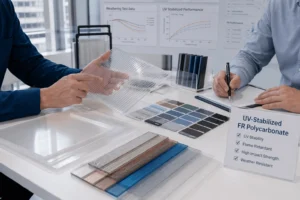
Conclusion: UV Yellowing Is Preventable — With the Right System Approach
UV yellowing in FR polycarbonate is not an inherent or unavoidable limitation of the material. It is a predictable degradation pathway with well-understood chemistry and well-established prevention strategies. The key is recognizing that FR PC is a more complex UV challenge than standard polycarbonate — the FR additive system adds photo-reactive species that must be engineered around, not ignored.
The five-strategy approach presented in this article — UV-stabilized resin grades, protective hard coatings, UV-compatible FR chemistry, processing optimization, and design-level UV dose reduction — provides a comprehensive framework for achieving outdoor FR PC performance targets of 5, 10, or even 20+ years depending on application requirements and climate class.
The engineers and procurement specialists who get this right consistently are those who engage both their material supplier and their coating partner early in the design process, define their ΔYI and weathering test requirements before material qualification, and choose FR PC grades that were specifically developed to perform as outdoor materials — not simply commodity grades that happen to be FR.
If you are ready to specify a UV-stable FR polycarbonate for your next application — or if you are troubleshooting yellowing in an existing product — we are here to help you find the right material, the right coating, and the right test protocol for your requirements.
Request a Free UV-Stable FR Polycarbonate Consultation and Sample Quote
Related Posts:
How Does FR4 Insulate EV Battery Busbars?
How Do You Test Bend Damage in Ceramic-Fiber Aerogel?
Where Is Aerogel Used Inside Modern EV Battery Packs?
What is UL94 V0? Guide to Flame Retardant PC Film Testing
How Does Aerogel Slow Cell-to-Cell Heat Transfer in EVs?
How Does Mica Insulation Compare With Polycarbonate?
 betty wong