What Insulation Does an Energy Storage System Need?
Table of Contents
A single weak link between two battery cells is sometimes all it takes. When a lithium-ion cell inside an energy storage system goes into thermal runaway, internal temperatures can exceed 800°C within seconds — and without the right barrier in place, that heat jumps straight to the next cell, then the next module, then the rack beside it. Energy storage fires have made international headlines across the United States, China, and Australia over the past two years, and post-incident investigations consistently point back to gaps in thermal design and propagation control. The materials standing between a contained fault and a catastrophic failure make up a small fraction of total system cost — yet they decide whether your ESS passes certification, survives its warranty period, or ends up in an incident report. So what insulation does an energy storage system actually need?
⚑ QUICK ANSWER
This guide breaks down each of those five categories, explains the technical specifications worth putting in your purchase spec, and walks through why precision die-cutting — not just material selection — ultimately determines whether your insulation performs as designed once it’s inside a real battery pack.
1.Why Insulation Decisions Make or Break ESS Safety and Performance
Lithium-ion energy storage is scaling faster than almost any other category of industrial equipment, and battery energy density is climbing right alongside deployment volume. Higher energy density means more stored energy packed into the same physical footprint — and more energy released if a cell fails. Insulation is the layer of engineering that keeps that equation safe.
Four things ride on the insulation decisions made early in an ESS design.
Safety: Thermal runaway propagation is the scenario every modern fire code now assumes will eventually happen somewhere in a large-scale deployment. Thermal barrier insulation isn’t meant to stop a single cell from ever failing — that’s the battery management system’s job. Its job is to make sure one cell’s failure doesn’t become every cell’s failure. NFPA 855’s 2026 edition leans even harder on large-scale fire testing, and UL 9540A’s 6th edition, published in March 2026, generates exactly the kind of data that comes from how a system’s internal barriers perform under abuse conditions.
Performance and cycle life: Battery cells degrade faster outside their ideal operating window, typically 20–35°C. Thermal management materials — gap fillers, conductive pads, graphite sheets — exist to keep every cell inside that window, which directly protects round-trip efficiency and the multi-thousand-cycle lifespan customers expect from a modern system.
Regulatory compliance. China’s GB 44240-2024 became mandatory for energy storage lithium batteries and packs above 100 kWh on August 1, 2025, layering onto established frameworks like GB/T 36276-2023, IEC 62619, and UL 9540 / UL 9540A. None of these standards can be satisfied with a generic insulation sheet pulled off a shelf — they require documented, repeatable material performance.
Total cost of ownership: A failed UL 9540A test, a voided certification, or a field recall costs orders of magnitude more than the insulation materials themselves. Insulation is one of the few line items in an ESS bill of materials where spending slightly more upfront for verified, traceable material measurably reduces downstream risk.
2. The 5 Categories of Insulation Every Energy Storage System Needs
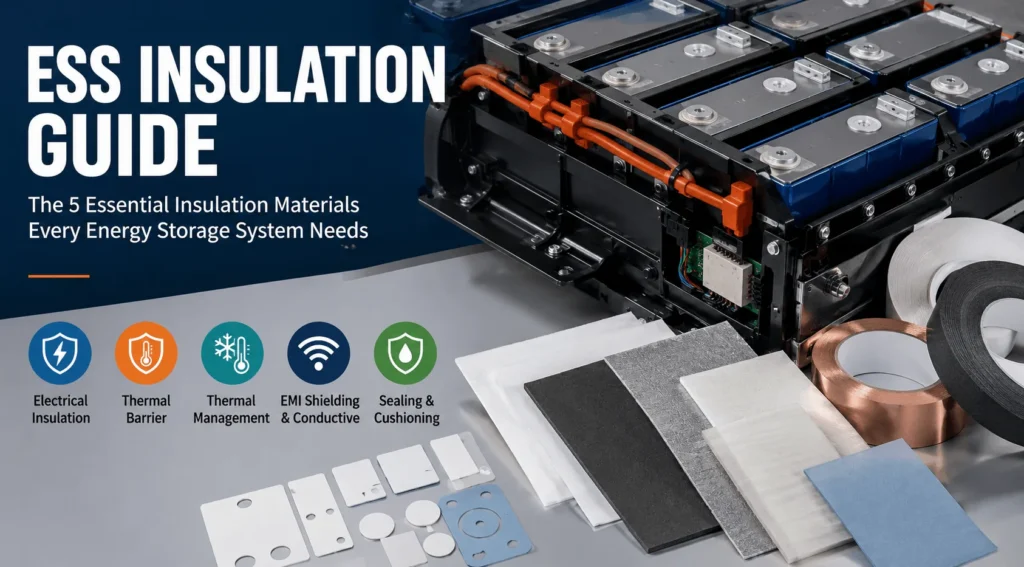
Whether you’re building a 5 kWh residential cabinet or a 20 MWh utility-scale container, the same five functional categories of insulation are doing the work. The chemistry, form factor, and supplier may differ, but the job each category performs stays constant
Electrical (Dielectric) Insulation
Electrical insulation keeps current where it belongs. Inside a battery pack, that means preventing short circuits between adjacent cells, between cell tabs and busbars, between busbars and the metal enclosure, and between high-voltage components and anything a technician might touch during servicing.
The most common materials for this role are insulating paper, PET film, polycarbonate (PC) film, and mica-paper-based insulation sheet. What separates a usable material from a liability is dielectric strength (commonly several kV/mm, depending on thickness and material), consistent thickness across the full roll, and a UL94 V-0 flame-retardant rating, since these films often sit directly against energized conductors.
Thermal Barrier Insulation for Thermal Runaway Protection
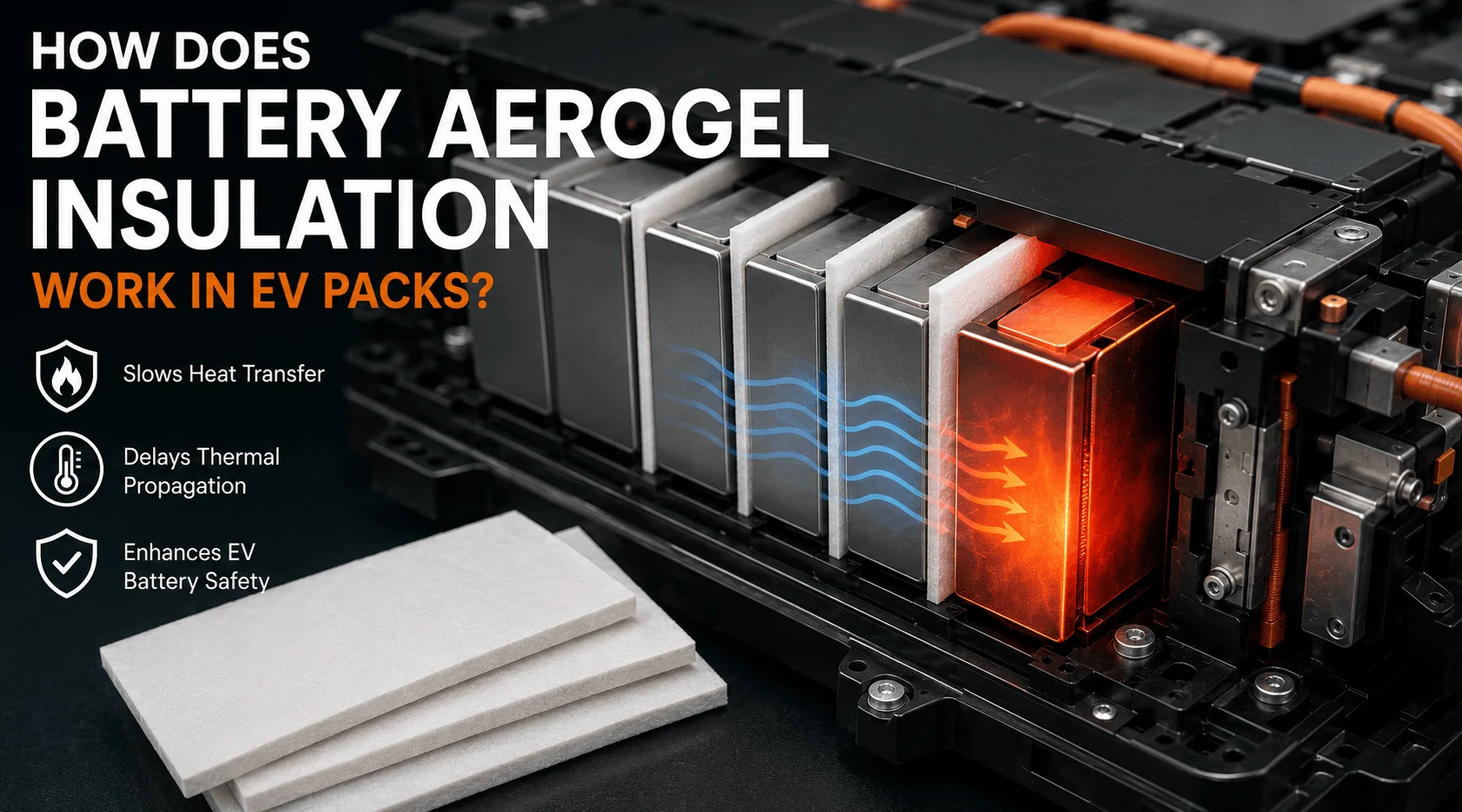
This is the category that gets the most attention in safety reviews, and for good reason. When a cell goes into thermal runaway, temperatures inside the cell itself can climb past 1,000°C. Thermal barrier insulation is placed between cells and between modules specifically to absorb and block that heat before it reaches a neighboring cell and triggers the same failure there.
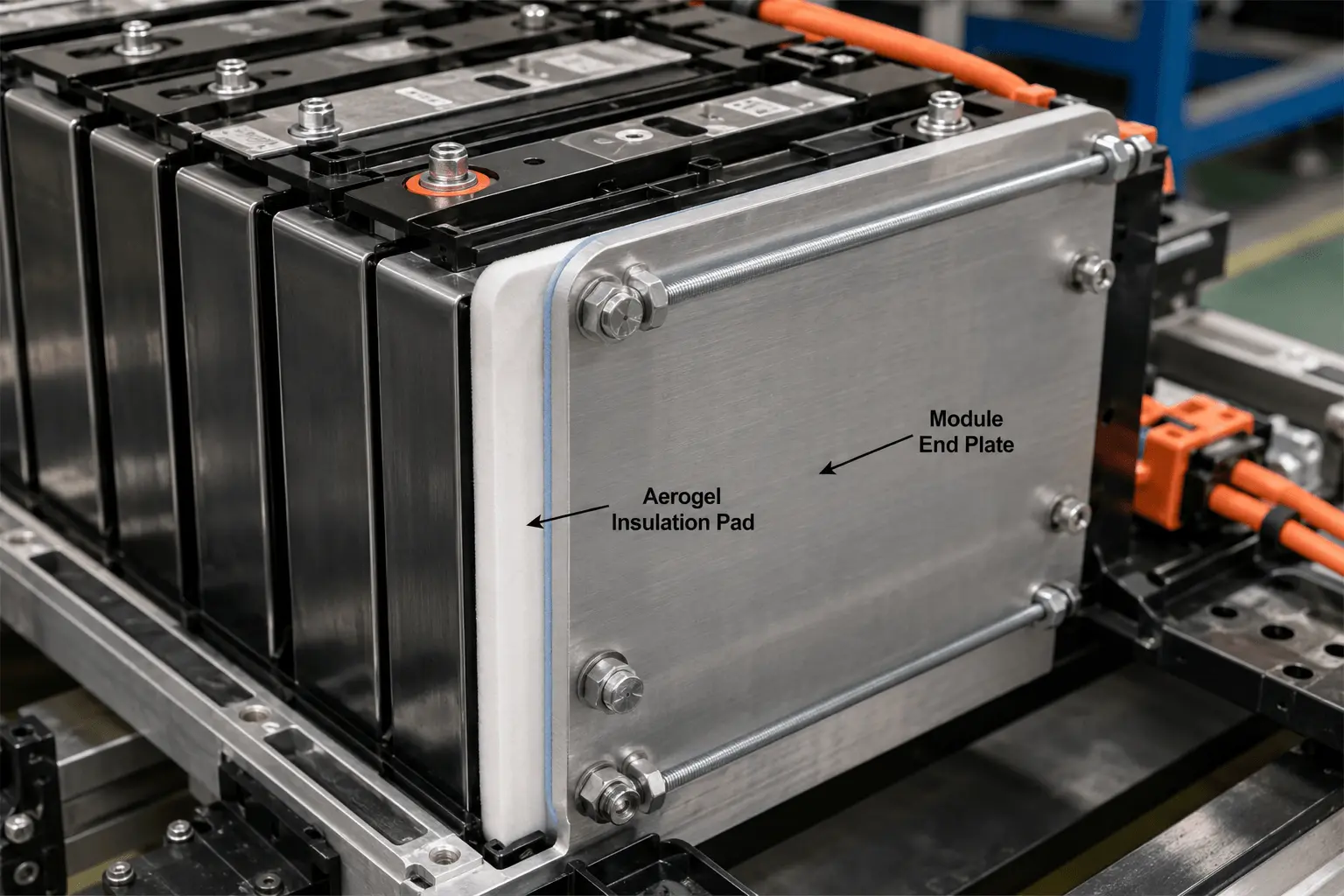
Mica sheet and aerogel felt are the two materials that dominate this role, and they solve the problem differently. Mica maintains exceptional dimensional stability at sustained high temperatures and resists electrical tracking, making it a reliable barrier once heat is already very high. Aerogel felt brings an extremely low thermal conductivity — commonly in the range of 0.018–0.024 W/m•K — into a thin, flexible format, which is why a 1–3 mm aerogel layer can do the work that would otherwise require a much thicker, heavier barrier. Ceramic fiber board fills a similar role at the module or compartment level, where bulk and rigidity matter less than raw heat-blocking capacity. As cell energy density keeps climbing, more ESS designs now combine a thermal barrier layer with a heat-dissipating layer in the same assembly, rather than relying on insulation alone.
Thermal Management Materials for Heat Dissipation
Thermal management materials do the opposite job of a thermal barrier: instead of blocking heat, they move it — efficiently and predictably — away from the cells during normal operation and toward the system’s cooling plate or liquid-cooling loop.
Thermally conductive silicone sheets and pads are the workhorse here, filling the microscopic air gaps between a cell and a cold plate that would otherwise act as thermal insulators themselves. Graphite chip sheets offer extremely high in-plane thermal conductivity at a fraction of the weight of metal, which makes them useful for spreading heat evenly across a module before it reaches the cooling system. Specified correctly — typically in the 1–6 W/m•K range depending on the application — these materials keep every cell inside its ideal temperature band, which protects both cycle life and the accuracy of the BMS’s state-of-health calculations.
EMI Shielding and Conductive Materials
An ESS is a noisy electrical environment. High-current busbars, switching power electronics in the PCS, and dense communication wiring between the BMS and EMS all generate electromagnetic interference that can corrupt sensor readings or communication signals if it isn’t controlled.
EMI foam, copper foil tape, and conductive tape handle this job, shielding sensitive components and providing the grounding and equipotential bonding paths that keep the system’s electronics stable. This category is easy to under-budget early in a design and then discover is mission-critical the moment a prototype fails EMC testing — which is exactly when it becomes the most expensive and time-consuming to fix.
Sealing, Cushioning, and Environmental Protection
The final category protects the entire assembly from the outside world. Containerized and outdoor ESS units face moisture, dust, salt fog, and constant vibration — first during transport, then for a decade or more of field operation.
Closed-cell foam products handle sealing around enclosure seams and connector penetrations, while also absorbing the shock and vibration loads cells and modules experience during shipping and operation — the same category of stress evaluated in transportation tests like UN 38.3. Skimping here doesn’t show up on a datasheet; it shows up eighteen months later as moisture ingress or a connector that’s worked itself loose.
3. Key Specifications to Demand From Your ESS Insulation Supplier
Material names only tell half the story. Two rolls labeled “mica sheet” from two different suppliers can behave completely differently once they’re inside a battery pack under thermal runaway conditions. When you’re writing a purchase specification — or simply evaluating a quote — these are the data points that actually matter.
| Property | Why It Matters | Typical Target Range |
| Flame retardancy | Pass/fail under direct flame exposure | UL94 V-0 |
| Thermal conductivity – barrier materials | Lower values block heat more effectively | 0.018–0.05 W/m·K |
| Thermal conductivity – TIM / gap filler | Higher values dissipate heat more effectively | 1–6 W/m·K |
| Dielectric strength | Determines short-circuit and arc-over resistance | 3–10+ kV/mm (material-dependent) |
| Continuous operating temperature | Material must survive normal pack temps without degrading | –40°C to 125°C+ (higher for mica/ceramic) |
| Thickness tolerance | Inconsistent thickness creates air gaps or assembly stress | ±0.05–0.1 mm for die-cut parts |
| Halogen content | Required for many export markets and RoHS-aligned programs | Halogen-free preferred |
| Compression set (foam/TIM) | Determines long-term sealing and contact performance | Low set after extended loading |
A datasheet with these numbers is the minimum bar. The next question to ask is whether the supplier can back those numbers with batch-level test reports and material traceability — not just a one-time certification from years ago. That distinction matters more than it sounds: it’s the difference between being able to isolate one bad production lot and having to question every system you’ve shipped with that material.
4. Why Precision Die-Cutting Determines Whether ESS Insulation Actually Works
Choosing the right material is only step one. A roll of aerogel felt or a sheet of mica isn’t useful inside a battery pack until it’s converted into a finished part that fits exactly around cell tabs, busbars, vents, and connectors — and that’s where die-cutting quality becomes just as important as material selection.
Tolerance is the first reason. An oversized cutout leaves a gap that can become an arc path or a thermal runaway propagation route; an undersized part creates assembly stress, won’t seat correctly, or compresses a thermal barrier below its design thickness. At BOP, our precision tooling holds tolerances as tight as ±0.05 mm using CNC engraving and high-speed rotary die-cutting equipment, specifically because that margin is what separates a part that performs as specified from one that doesn’t.
Multilayer composite construction is the second reason. Many real-world ESS insulation parts aren’t a single material — they’re laminates combining an aerogel or mica core with a reinforcing scrim, a pressure-sensitive adhesive layer, and a release liner. Cutting these composites cleanly, without delamination or adhesive bleed at the edge, takes purpose-built tooling and process control, not a generic cutting table.
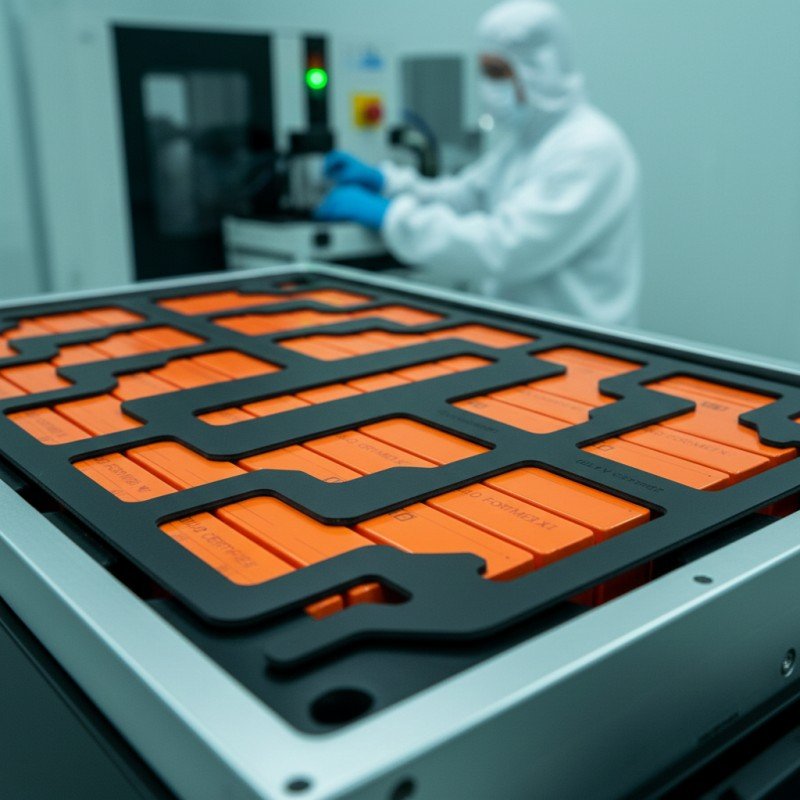
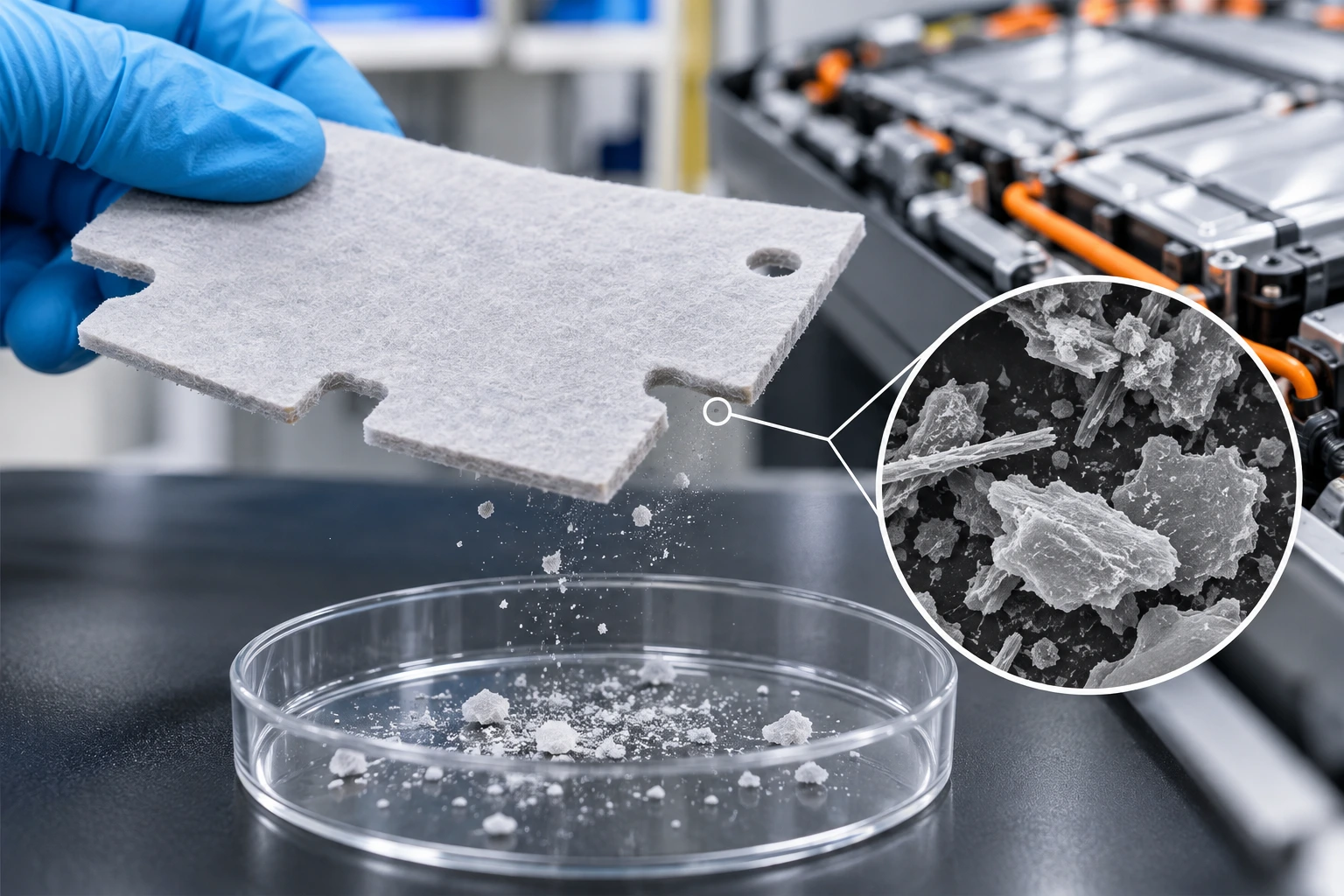
Cleanroom production is the third reason, and it’s one buyers rarely think about until it bites them. Particulate debris generated during cutting can itself become a contamination and short-circuit risk inside a sealed battery enclosure. Producing insulation components in an ISO-certified cleanroom environment isn’t a marketing line — it’s a direct safety requirement for the part you’re buying.
Finally, speed matters because ESS programs move fast. Module and pack designs go through several iterations before they’re locked for mass production, and every round of die-cut prototypes that takes two weeks instead of two days adds delay to your certification timeline. We built our prototyping process around 48-hour sample turnaround for exactly this reason, backed by 50+ production lines and the capacity to scale a validated design straight into mass production without re-sourcing or re-qualifying a new supplier.
5. 7 Mistakes Engineers Make When Sourcing ESS Insulation Materials
Even experienced teams repeat these mistakes, usually because insulation gets treated as a commodity line item instead of a safety-critical engineering decision.
- Treating insulation as one material instead of a system. Specifying a single all-purpose foam or film to do the job of electrical, thermal, EMI, and sealing materials almost always under-performs a properly layered stack.
- Buying on price per square meter instead of performance per system. A cheaper substitute material can look identical on a spec sheet and still fail thermal runaway propagation testing — at which point the “savings” disappear entirely.
- Underestimating thickness tolerance. A ±0.2 mm variance across a die-cut part doesn’t sound like much until it creates an air gap that defeats a thermal barrier’s entire purpose.
- Assuming cell-level certification covers the assembled system. Passing UN 38.3 at the cell level says nothing about whether the assembled module passes UL 9540A or GB 44240 at the system level.
- Leaving EMI and grounding as an afterthought. Shielding and grounding issues discovered during EMC testing, late in development, are far more expensive and slower to fix than if they’d been specified up front.
- Skipping material traceability. Without batch records and test certificates, one defective production lot can force a recall of every system that might contain it, instead of a targeted fix.
- Underbuilding environmental sealing. Vibration and moisture-related field failures during shipping or installation are frequently misdiagnosed as cell or BMS problems, when the real cause is inadequate sealing and cushioning.
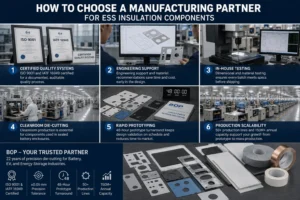
6. How to Choose a Manufacturing Partner for ESS Insulation Components
Once you know which materials and specifications you need, the supplier you choose determines whether you actually get them — consistently, batch after batch, for the life of the program. A short checklist is worth running through before you commit:
- Certified quality systems. ISO 9001 and IATF 16949 certification indicate a documented, auditable quality process rather than ad hoc manufacturing.
- Engineering support, not just catalog sales. A partner who reviews your CAD files and recommends material improvements early saves far more time and cost than one who simply quotes whatever you specify.
- In-house dimensional and material testing. Batch-level inspection — using tools like second-dimension testers — catches problems before parts ship, not after they’re already in a customer’s pack.
- Cleanroom die-cutting capability. As covered above, this isn’t optional for components going inside a sealed battery enclosure.
- Rapid prototyping turnaround. Fast, reliable samples keep your design validation on schedule instead of becoming the bottleneck.
- Production scalability. A partner with enough production lines and annual capacity to take a validated design straight into volume production, without forcing you to re-qualify a second supplier.
We built BOP around this exact checklist over 22 years of precision die-cutting for battery, EV, and energy storage manufacturers — ISO 9001 and IATF 16949 certified, cleanroom production, ±0.05 mm tolerance, 48-hour prototyping, and more than 50 production lines supporting annual capacity above 150 million units. If you’re evaluating insulation partners for an upcoming ESS program, that’s the bar we’d encourage you to hold every quote against — including ours.
7. Frequently Asked Questions About ESS Insulation
What is the best insulation material for a lithium-ion energy storage system?
There’s no single “best” material — the right choice depends on the function. Aerogel felt and mica sheet are the leading choices for thermal-runaway propagation barriers, thermally conductive silicone handles heat dissipation, and insulating paper or PET/PC film handles electrical isolation. Most ESS packs use three or more of these materials together rather than relying on just one.
Does ESS insulation need to be UL94 V-0 certified?
For any material used inside or near the battery compartment, yes. UL94 V-0 is effectively the baseline flame-retardancy standard the industry expects, and most system-level certifications — including UL 9540 and GB 44240 — assume the component materials underneath already meet it.
What’s the difference between thermal insulation and electrical insulation in a battery pack?
Thermal insulation blocks heat transfer, protecting against thermal runaway propagation or unwanted heat loss. Electrical insulation blocks current flow, preventing short circuits between conductive parts. A few materials, like mica and aerogel-based papers, do both jobs at once, but each property is tested and specified separately.
Can insulation alone prevent thermal runaway?
No single material stops a cell from failing in the first place. Insulation’s role is propagation control — keeping one cell’s failure from spreading to its neighbors — working alongside the battery management system, fire suppression, and venting design as part of a layered safety strategy.
Can ESS insulation materials be custom die-cut for a specific battery pack design?
Yes. Most standard ESS insulation materials — mica sheet, aerogel felt, conductive silicone pads, foam, and EMI shielding — can be precision die-cut into custom shapes with adhesive backing, typically with prototype samples available within 48 hours for design validation ahead of mass production.
🛡️ Ready to Specify the Right ESS Insulation?
✅ Five-category material expertise — electrical, thermal barrier, thermal management, EMI, and sealing — sourced and converted under one roof
✅ ISO 9001 and IATF 16949-certified manufacturing with ±0.05 mm die-cutting tolerance in a cleanroom environment
✅ 48-hour prototyping and 50+ production lines, so your design moves from sample to mass production without changing suppliers
If you’re specifying insulation for an upcoming energy storage program, send us your drawings or describe your application — our engineering team will recommend the right material stack and turn around a sample within 48 hours.
Conclusion
Energy storage system insulation will never be the most visible part of your product. Nobody specs an ESS around its insulating paper or its mica barriers. But when a cell fails — and across a large enough fleet, eventually one will — these are the materials that decide whether that failure stays contained inside a single cell or becomes the headline event that ends a project, a contract, or a company’s reputation in the market.
Getting it right means treating insulation as five distinct categories rather than one generic material, specifying against real performance data rather than product names, and working with a manufacturing partner who can convert that material into a precision part — consistently, at scale, with the certifications to prove it. The safest energy storage systems aren’t the ones that never have a problem cell — they’re the ones engineered so a single cell’s problem never becomes the whole system’s problem.
Related Posts:
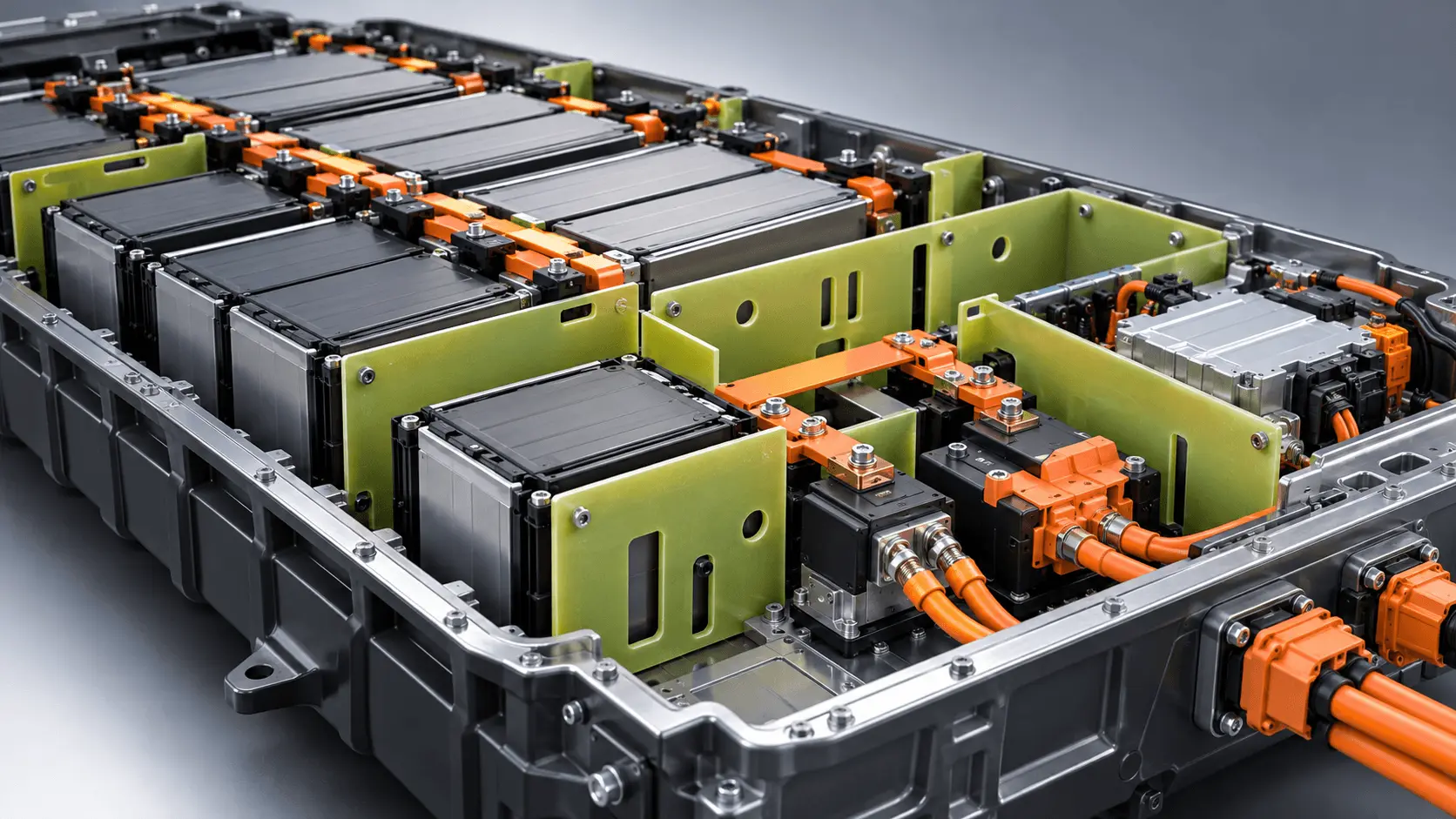
Why Use FR4 as Rigid Insulation in EV Battery Packs?
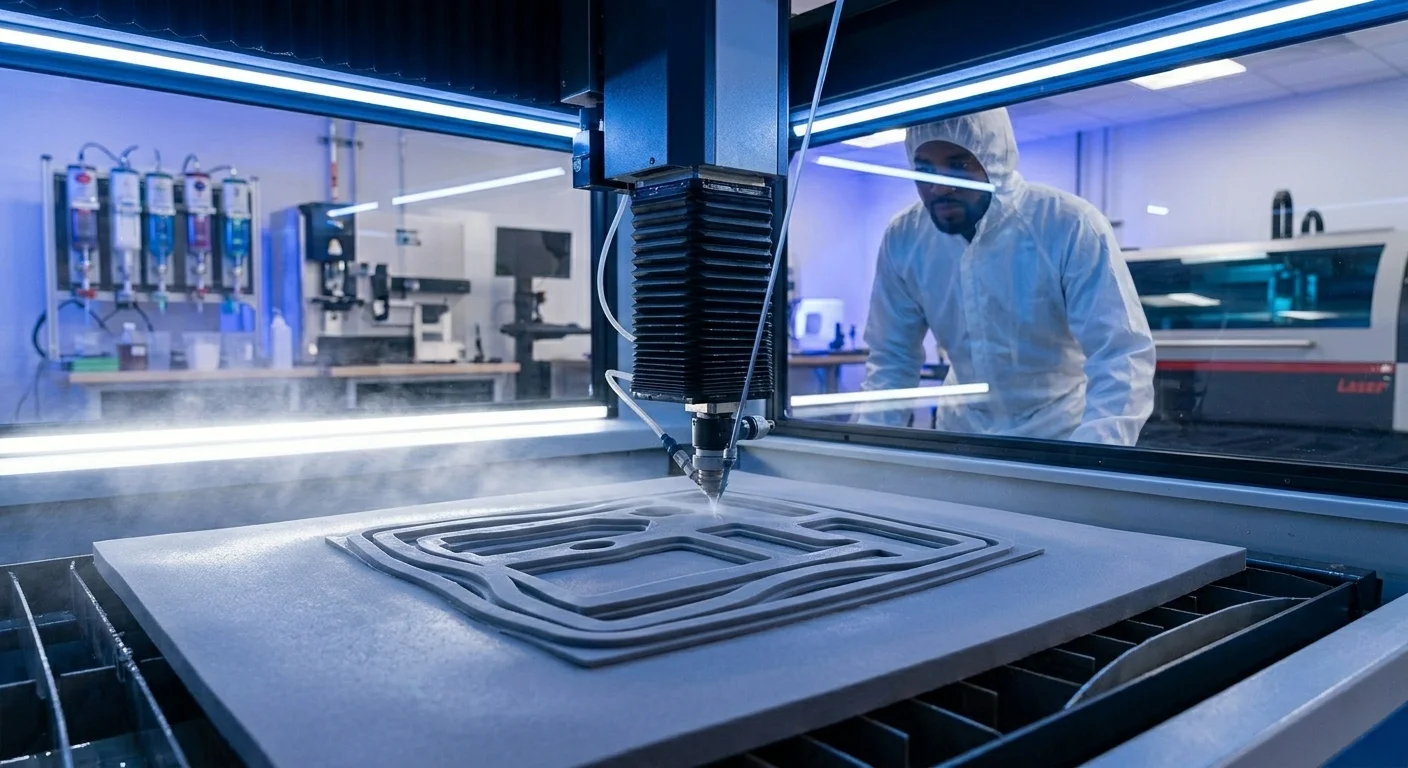
What Makes Flame Retardant Polycarbonate Ideal For Batteries?
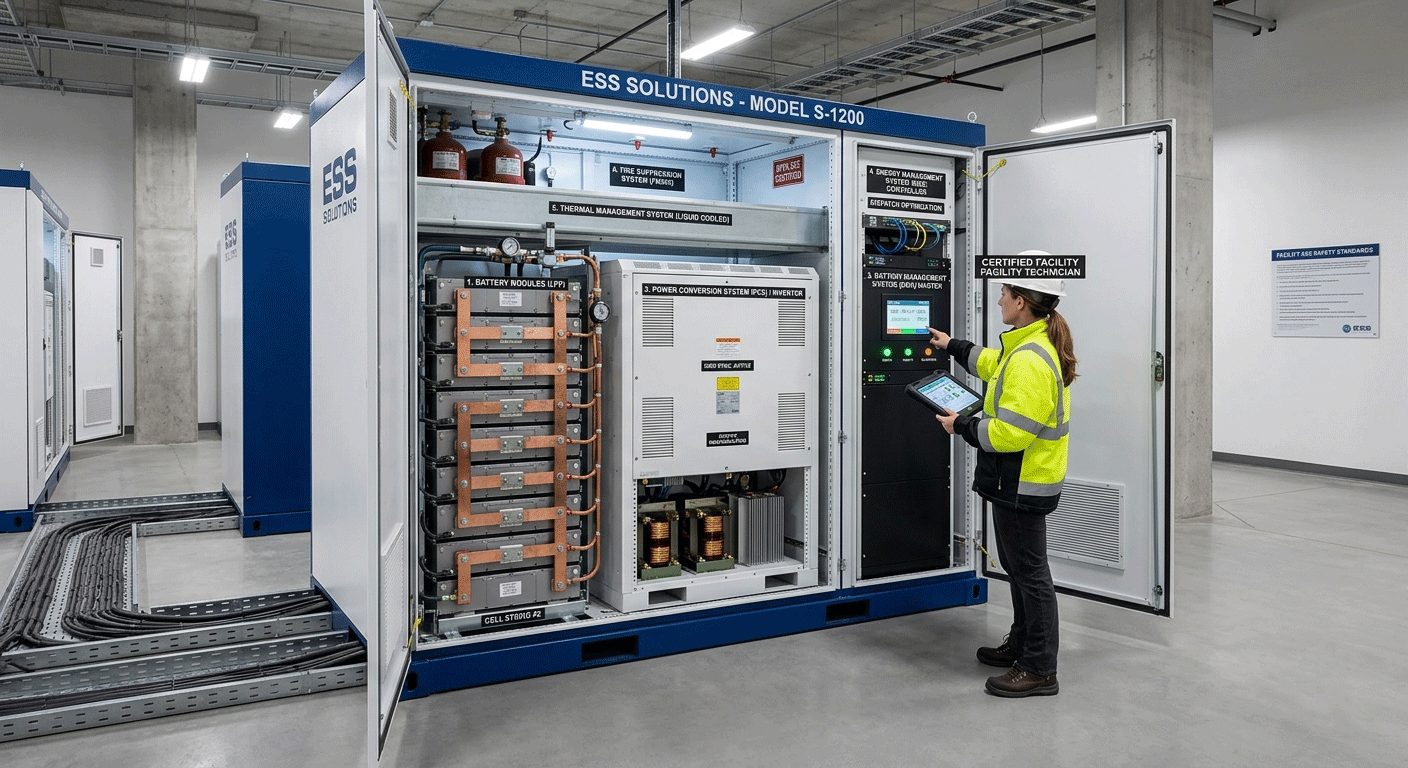
What Are the Main Components Inside an ESS Storage Solution?
How Does Battery Aerogel Insulation Work in EV Packs?
How Do You Measure Particle Shedding From Die-Cut Aerogel?
How Is Aerogel Used Near EV Battery Module End Plates?
 betty wong