

How Can Buyers Verify Aerogel Grades for EV Battery Use?
Table of Contents
A supplier calls its material “EV-grade aerogel” and sends a datasheet showing an impressively low thermal conductivity. Is that enough to approve the pad for a battery pack? Usually, no. In a real EV module, the aerogel is compressed, die-cut, laminated, exposed to humidity and vibration, and expected to remain in position while cells swell over years of cycling. For buyers, the real question is not whether the brochure looks good—it is whether the exact grade, construction, and production lot can deliver the required thermal barrier performance in your battery design.
⚑ QUICK ANSWER
Why “EV-Grade Aerogel” Is Not Enough Information
“EV-grade” is useful commercial shorthand, but buyers should not treat the phrase as a complete technical specification. Aerogel products used around battery cells are engineered systems: the silica-based aerogel core may be reinforced with fibers, laminated to films, coated, encapsulated, combined with pressure-sensitive adhesive, or tuned for a specific stress-strain response. Two materials both described as “aerogel battery pads” can therefore behave very differently after compression or during a high-temperature event.
This is also why a buyer should avoid approving a material by product family name alone. For EV programs, the controlled item should be a defined grade or part number tied to a revision-controlled specification. That specification should identify the nominal construction, thickness range, key performance limits, test methods, accepted tolerances, packaging condition, and change-notification requirements. If the supplier cannot connect a quotation, sample, CoA, and mass-production shipment to the same controlled identity, grade verification is incomplete.
Industry insight: leading battery-barrier suppliers increasingly describe cell-to-cell aerogel barriers as engineered parts rather than generic off-the-shelf insulation. That distinction matters. The thermal barrier has to perform mechanically and thermally through end of life, not just produce one attractive room-temperature conductivity number in a laboratory.
The 10 Checks Buyers Should Use to Verify an Aerogel Grade
1. Confirm the exact material identity and construction
Start with identity. Request the manufacturer name, exact grade, supplier part number, construction revision, nominal basis weight or density if applicable, reinforcement type, surface film or encapsulation, adhesive system, and country or site of manufacture. If the converter is not the aerogel producer, ask how the incoming raw material is identified and how that identity is preserved through slitting, lamination, die-cutting, inspection, and packing.
The purpose is not paperwork for its own sake. A change in reinforcement, film thickness, binder chemistry, adhesive, or lamination process can alter compression response, particle shedding, dielectric behavior, or heat transfer. A reliable supplier should be able to trace a finished die-cut part back to the raw-material lot and the controlled process route used to manufacture it.
2. Verify thermal conductivity with the test conditions, not just the number
Thermal conductivity is the first number most buyers compare, and it is also one of the easiest numbers to compare incorrectly. Ask for the test method, specimen thickness, mean test temperature, hot- and cold-side temperatures, orientation, conditioning state, and whether the sample was tested free, lightly loaded, or at a defined compression. ASTM C177 and ASTM C518 are widely used methods for steady-state thermal transmission of insulation, but the reported value is meaningful only when the specimen and conditions are clear.
For a flat pad, a quick first-order comparison uses thermal resistance, R = t/k, where t is thickness and k is thermal conductivity. This immediately shows why “lower k” does not automatically mean “better part”. A slightly higher-conductivity material at a greater retained thickness can provide more steady-state resistance than a thinner material with a lower headline k value. In EV packs, however, thermal runaway is a transient, extreme-temperature event, so steady-state R-value is only a screening parameter—not a complete propagation prediction.
Buyer rule: reject thermal-conductivity claims that do not state the test method and conditions. A number without temperature, thickness, and compression state is not an apples-to-apples purchasing specification.
3. Check performance at the actual assembly compression
Aerogel placed between prismatic or pouch cells is rarely operating as an uncompressed laboratory coupon. Module clamping, cell dimensional tolerance, assembly stack-up, and cell swelling create pressure throughout life. That pressure changes pad thickness, contact area, and sometimes the effective thermal path. Therefore, the buyer should request a compression curve or stress-strain data across the expected operating range, plus retained thickness after loading and unloading.
A strong specification defines more than initial thickness. It can include force at selected compression percentages, allowable compression range, compression set or thickness recovery, and performance after repeated cycling. For cell-to-cell barriers, consider beginning-of-life, nominal-life, and end-of-life stack conditions. If the aerogel only meets the thermal target when new and uncompressed, it may not be the correct grade for the module.
This is one reason battery-specific aerogel systems are often engineered to combine thermal resistance with a controlled mechanical response. The pad can function as both a thermal barrier and part of the cell compression strategy, but only when its force-deflection behavior is characterized and matched to the pack design.
4. Verify thickness, tolerance, and dimensional capability on the finished part
A battery designer buys a finished component, not a theoretical material property. Ask for nominal thickness, thickness tolerance, thickness measurement method, and inspection sampling plan on the converted part. Then verify outline dimensions, slot and hole position, edge condition, liner registration, adhesive placement, and any no-adhesive zones required by the drawing.
For thin thermal barriers, dimensional variation can create local pressure peaks or gaps. A pad that is too thick can disturb module clamping force; one that is too thin can reduce thermal resistance or fail to maintain contact. Complex cutouts can also create narrow bridges, tear points, or unnecessary heat-transfer paths. DFM review should therefore happen before tooling is frozen, especially for multi-layer laminated constructions.
5. Evaluate dielectric performance only in the construction that will be used
Some aerogel barriers are required to provide electrical isolation in addition to thermal protection; others sit in locations where a separate dielectric film performs that function. If electrical insulation is part of your requirement, request dielectric breakdown or dielectric strength data and, where relevant, volume or surface resistivity. ASTM D149 is a common method for dielectric breakdown strength of solid insulating materials, while ASTM D257 covers DC resistance and resistivity measurements.
The important purchasing insight is that electrical data should correspond to the final construction. Encapsulation film, adhesive, cut edges, pores, dust contamination, humidity exposure, and compression can all change practical insulation behavior. ASTM itself cautions that dielectric test results should be interpreted with application-specific functional tests rather than used as a direct guarantee of in-service behavior. For this reason, do not accept a dielectric value from a different thickness or a different laminated stack as automatic proof for your part.
6. Separate small-flame ratings from thermal-runaway performance
Flammability data can be useful, but buyers should understand what it proves. If a supplier presents UL 94 data, verify the exact material construction and thickness covered by that rating. UL 94 is a small-scale ignition and flame-spread classification for polymeric materials. It is not a certification that an aerogel pad will stop propagation between EV cells during thermal runaway.
For battery safety, ask a different question: what evidence shows that this barrier performs under the heat flux, gas, flame, pressure, geometry, and dwell time expected in the target module? The most valuable evidence is application-representative testing—first at coupon or fixture level, then in the actual cell spacing and clamping condition, and ultimately at module or pack level according to the OEM’s validation plan.
Do not let one certificate answer the wrong question. UL 94, dielectric tests, thermal conductivity, and thermal-propagation testing measure different failure modes.
7. Verify environmental durability: temperature, humidity, fluids, vibration, and aging
A suitable grade must survive more than a single abuse event. Battery barriers live through years of thermal cycling, humidity exposure, vehicle vibration and shock, and changing compression as cells age. Request environmental conditioning data that reflects the intended operating envelope. Depending on the application, this can include high/low-temperature exposure, humidity aging, thermal cycling, vibration, mechanical fatigue, and compatibility with expected process or service fluids.
IEC 60068-2-64, for example, provides a framework for broadband random-vibration testing used to identify mechanical weakness or performance degradation. An OEM may use different automotive specifications, but the procurement principle is the same: the grade should be validated after environmental exposure, not only before it. Recheck thickness, adhesion, particle release, dielectric behavior, and thermal performance after conditioning where these are critical characteristics.
8. Examine dusting, edge integrity, encapsulation, and cleanliness
Aerogel’s porous structure can create handling and particle-control challenges if the material or conversion process is poorly matched to the application. Buyers should inspect cut edges, surface integrity, powder release, liner cleanliness, and packaging. If an encapsulated construction is used, verify that the film remains sealed or intact through die cutting and assembly. If adhesive is used, evaluate whether the adhesive edge can collect particles or interfere with venting, compression, or electrical clearances.
This is a conversion-quality issue as much as a raw-material issue. A high-performing blanket can become a poor EV component if cutting creates damaged edges, lamination introduces wrinkles, or adhesive registration varies. Cleanroom or controlled-environment converting, documented inspection, and suitable packaging can therefore be decisive for programs with strict particle and assembly requirements.
9. Demand lot-level evidence, not one historical test report
Third-party test reports are useful for design qualification, but they do not prove every future shipment is identical. For production purchasing, define what appears on the Certificate of Analysis or inspection report for each lot. Typical controlled characteristics might include thickness, dimensions, visual condition, basis weight or density, and other critical-to-quality parameters agreed during qualification.
The supplier should also maintain lot traceability from incoming material through converted parts. Automotive quality systems place strong emphasis on identification, traceability, controlled process changes, and documented production approval. AIAG’s PPAP framework is specifically intended to demonstrate that the production process can consistently meet the engineering design record and specification during an actual production run.
10. Lock change control before SOP
The final verification question is simple: what can change without your approval? A supplier may need to change an aerogel source, reinforcement, film, adhesive, liner, die-cutting method, production site, test method, or inspection equipment over a multi-year vehicle program. Your purchasing specification should define notification and requalification triggers.
For automotive programs, approve a golden sample or boundary samples, freeze the bill of materials and process route, and connect them to the drawing revision and PPAP status. A lower-cost substitute that looks similar should never enter serial production through an uncontrolled material change. In many programs, disciplined change management creates more long-term risk reduction than one additional laboratory test at the sourcing stage.

What Documents Should an EV Buyer Request From an Aerogel Supplier?
A good verification package is layered. No single document is enough. The technical datasheet describes typical or specified properties; the SDS or article information supports safe handling; third-party reports can confirm specific laboratory tests; the CoA or lot inspection report provides production evidence; and PPAP documents connect the approved design to a controlled manufacturing process.
| Document | What It Should Prove | Buyer Check | Typical Timing |
| TDS / controlled specification | Target properties, construction and test methods | Match grade, thickness, revision and conditions | RFQ / design |
| SDS / AIS | Handling and composition-related safety information | Confirm document matches exact product family | RFQ / receiving |
| Third-party test report | Independent evidence for specific property or test | Match sample ID, thickness, construction and date | Qualification |
| CoA / lot inspection report | Production-lot identity and agreed critical characteristics | Match shipment lot and acceptance limits | Every lot |
| PPAP / PSW package | Production process can meet design/specification consistently | Confirm approved drawing, process, material and revision | Before SOP / changes |
| Change notification | Control of source, formulation, process or site changes | Define requalification triggers | Program life |
Buyers should also check document dates and revision levels. An old report may have been generated on a different material formulation, different thickness, or different production site. If a supplier cites a test report, ask for the sample identification used in that report and confirm that it maps to the grade on your quotation. For safety-critical parts, this simple cross-check can expose documentation gaps before they become program risks.
How to Compare Two Aerogel Quotes Without Being Misled
Suppose Supplier A quotes a 1.0 mm pad at a very low thermal conductivity, while Supplier B quotes a 1.5 mm pad with a slightly higher k-value and a documented compression curve. The cheaper-looking or lower-k option is not automatically better. Normalize the comparison to the actual installed condition.
| Comparison Item | Supplier A | Supplier B | Why It Matters | Buyer Action |
| Thermal conductivity | Lower headline k | Slightly higher k | Conditions may differ | Normalize test method/temperature |
| Nominal thickness | 1.0 mm | 1.5 mm | R depends on t/k | Compare installed thickness |
| Compression data | Not supplied | Full curve supplied | Pack load changes thickness | Model BOL/EOL stack |
| Final construction | Raw blanket data | Laminated part data | Conversion changes interfaces | Test final part |
| Traceability | Generic batch label | Raw-to-finished lot link | Automotive change control | Prefer controlled identity |
| Validation support | Material sample only | DFM + production sample | Reduces late redesign | Assess total program risk |
A useful sourcing worksheet calculates or compares retained thickness at assembly pressure, estimated steady-state thermal resistance, force at target compression, thickness recovery, and total converted-part cost. Then add non-numeric risks: documentation quality, traceability, dusting, edge integrity, delivery stability, change control, and responsiveness during validation. For EV programs, the lowest raw-material price can be expensive if it creates extra module builds, validation failures, or an engineering change after tooling release.
Why Buyers Must Validate the Finished Die-Cut Aerogel Pad
One of the most important procurement insights is that raw aerogel qualification and finished-part qualification are not the same task. Die cutting can change edge geometry. Lamination adds interfaces. Pressure-sensitive adhesive adds a different polymer layer. Encapsulation can trap air, wrinkle, or alter surface friction. Release liners affect assembly. Even the direction of the material web can matter for dimensional behavior or process stability.
Therefore, the production-representative sample should use the same raw-material grade, same laminate stack, same adhesive, same tool concept, and the same key manufacturing process planned for serial production. Prototype parts cut by hand from a laboratory sheet may be acceptable for early thermal screening, but they should not be the only basis for approving a high-volume die-cut component.
At the module level, validate the pad at the designed compression, cell spacing, end-plate force, cooling arrangement, and venting configuration. Look for bypass heat paths through busbars, frames, cooling plates, bolts, or unprotected edges. A premium aerogel pad cannot compensate for a thermal bridge elsewhere in the module. This is why experienced buyers review the barrier as part of the complete thermal-propagation architecture.
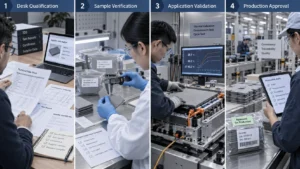
A Practical Four-Stage Aerogel Grade Verification Workflow
Stage 1 — Desk qualification before requesting samples
Screen the supplier with the exact grade TDS, construction drawing, available third-party reports, quality certifications, manufacturing location, raw-material source control, and proposed inspection plan. Resolve obvious mismatches before ordering samples. Ask the supplier to mark which properties are typical values and which are guaranteed specification limits.
Stage 2 — Incoming sample verification
Measure thickness and key dimensions, inspect surfaces and edges, check mass or basis-weight consistency if relevant, confirm lot labels, and compare the sample to the documentation. Run simple compression and handling checks before expensive abuse testing. If electrical isolation is required, perform the agreed dielectric screening on the final construction. Keep retained samples from each evaluated lot.
Stage 3 — Application validation
Test the aerogel in the actual stack. Use the target compression and realistic interfaces. Depending on the program, perform thermal barrier fixture testing, environmental aging, vibration, compression cycling, and module-level propagation testing. The acceptance criterion should be the pack or module safety objective—not merely a material-property number.
Stage 4 — Production approval and ongoing control
After the design passes validation, freeze the specification, drawing, approved supplier and process, inspection characteristics, traceability method, packaging, and change-notification rules. Complete the required APQP/PPAP package for automotive customers. During serial production, monitor the critical-to-quality characteristics that correlate with performance and periodically audit traceability from finished part back to raw material.
Common Red Flags When Sourcing Aerogel for EV Batteries
- A thermal conductivity value is shown with no test method, mean temperature, thickness, or compression state.
- The supplier uses “EV grade” as the main evidence but cannot provide a controlled material grade or revision.
- The test report sample ID does not match the grade being quoted.
- Only raw blanket data is available even though the delivered part will be laminated, encapsulated, or adhesive-backed.
- A UL 94 rating is presented as proof of thermal-runaway propagation resistance.
- The supplier cannot provide a compression curve or explain how thickness changes under the module’s clamping load.
- Samples have no raw-material lot identification or production traceability.
- The prototype is made from one material source, but production may use an “equivalent” source without customer approval.
- Dusting, damaged cut edges, wrinkles, or inconsistent adhesive registration are visible on samples.
- The supplier cannot define what changes require customer notification or requalification.
Industry Insight: EV Aerogel Purchasing Is Moving From Datasheet Approval to System Evidence
The direction of the EV industry is clear: safety requirements are becoming more system-focused, and suppliers are being asked for evidence that survives the jump from material coupon to complete battery pack. China’s mandatory GB 38031-2025, published on March 28, 2025 and implemented on July 1, 2026, is now in force. The standard covers traction-battery safety and includes thermal-propagation analysis and verification requirements at pack or system level.
For buyers, the implication is significant. A raw material with excellent thermal conductivity can still fail to deliver the desired system result if it compresses excessively, shifts, creates a gap, degrades after aging, or is bypassed by a conductive structural path. Procurement specifications are therefore becoming more multidisciplinary: thermal, mechanical, electrical, manufacturing, cleanliness, traceability, and quality-system evidence increasingly appear in the same sourcing package.
Another trend is the move toward multifunctional barriers. Cell-to-cell parts may need to manage expansion force while delaying heat transfer, maintain dielectric isolation, survive environmental aging, and remain thin enough to protect energy density. This pushes grade selection away from “which aerogel has the lowest k?” and toward “which finished construction preserves the required performance over the whole battery lifecycle?”
What Should Buyers Put in an Aerogel RFQ?
A precise RFQ produces better technical proposals and makes supplier comparison faster. At minimum, provide the battery application and cell format, drawing or target geometry, nominal gap, desired installed thickness, expected compression range or clamping force, operating temperature range, dielectric requirement if any, adhesive or non-adhesive preference, environmental requirements, annual volume, sample quantity, PPAP level, and required validation standards.
- Application: cell-to-cell, module end plate, lid/cover, side wall, vent-zone protection, or another location.
- Cell chemistry and format: prismatic, pouch, or cylindrical; NMC, LFP, or other chemistry if relevant to the test plan.
- Nominal and worst-case gap, stack tolerance, target compression, and end-of-life swelling assumptions.
- Thermal target: barrier time, maximum cold-side temperature, heat-flux target, or module-level non-propagation objective.
- Electrical target: required dielectric withstand, insulation resistance, or separate dielectric-film architecture.
- Part construction: bare, encapsulated, laminated, adhesive-backed, liner type, tabs, cutouts, and prohibited adhesive areas.
- Dimensional tolerances and critical-to-quality features.
- Environmental and durability test matrix.
- Traceability, CoA, APQP/PPAP, change-control, packaging, cleanliness, and labeling requirements.
- Forecast volumes, SOP timing, prototype schedule, and target cost.
This information lets the converter propose the right material and manufacturing route rather than quoting a generic aerogel sheet. It also reduces late-stage redesign: the die-cut shape, adhesive pattern, encapsulation and inspection plan can be optimized during DFM instead of after the thermal validation is already complete.
How Boost Insulation Can Support Aerogel Grade Verification and Conversion
For overseas EV battery buyers, the useful supplier is not only the company that can source aerogel—it is the company that can convert a controlled material into a repeatable battery component and provide the evidence needed for qualification. Boost Insulation positions its Dongguan operation around EV battery insulation, precision die cutting, laminating, rapid prototyping, and automotive quality support.
For a new aerogel project, Boost can review your drawing and application conditions during DFM, help compare candidate constructions, prepare production-representative die-cut samples, and define inspection characteristics for thickness, geometry, visual quality, and traceability. The company states that it supports IATF 16949/ISO 9001 quality systems, APQP and PPAP submissions, lot-to-lot traceability, controlled-environment die cutting and assembly, and rapid custom sampling.
The best starting point is not “quote 1 mm aerogel”. Send the cell format, gap, target compression, drawing, thermal objective, dielectric requirement, adhesive/encapsulation preference, expected annual volume, and validation requirements. That gives the engineering team enough information to recommend a build that can be tested as a real part rather than a generic material sample.
RFQ CTA — Need to qualify an aerogel pad for an EV battery module? Send Boost Insulation your drawing, target thickness/compression, thermal requirements, and annual volume. Request a DFM review and production-representative samples for validation.
FAQ: Verifying Aerogel Grades for EV Battery Use
Is there one universal “EV-grade aerogel” certification?
No single grade name replaces application qualification. Treat “EV-grade” as a supplier or application description and verify the controlled construction, test data, lot identity, manufacturing process, and module-level performance required by your program.
What is the most important value on an aerogel datasheet?
There is no single decisive value. Thermal conductivity is important, but buyers also need installed thickness, compression response, durability, construction details, and the test conditions behind every property. For cell-to-cell barriers, performance under the actual clamping condition is particularly important.
Should I compare aerogel grades only by W/m·K?
No. Compare retained thickness and thermal resistance at the intended compression, then evaluate transient barrier performance in an application-representative test. Also compare mechanical, electrical, cleanliness, traceability, and manufacturing factors.
Does UL 94 V-0 prove an aerogel can stop thermal runaway?
No. UL 94 is a small-scale flammability classification for polymeric materials and does not by itself demonstrate cell-to-cell thermal propagation protection. Thermal-runaway performance should be validated with representative heat exposure and ultimately at module or pack level.
Do I need dielectric data for every aerogel pad?
Only when electrical isolation is part of the pad’s function or the design specification requires it. If the aerogel is combined with a dielectric film, test the final laminate rather than assuming the core material’s electrical properties describe the complete part.
Why do buyers request a compression curve?
Because the pad’s installed thickness and force response change under module clamping and cell swelling. The compression curve helps the battery engineer determine whether the barrier will maintain acceptable mechanical loading and thermal resistance throughout the lifecycle.
What should be included on a production CoA?
The exact contents should be agreed during qualification. Common items include grade/part number, lot number, manufacturing date, thickness, key dimensions or other critical characteristics, inspection status, and references that allow traceability back to incoming raw material.
When should a buyer require PPAP?
For automotive serial-production programs, PPAP is commonly used when the customer requires formal evidence that the production process can consistently meet the engineering design record and specification. The required submission level and documents should be defined by the OEM or Tier-1 customer.
Final Takeaway
The most reliable way to verify an aerogel grade for EV battery use is to stop treating the grade name as the proof. Verify the exact construction, test conditions, compression response, final-part dimensions, electrical and environmental performance where required, lot traceability, and change control. Then confirm the finished die-cut barrier in the actual battery stack.
That approach gives purchasing, engineering, quality, and safety teams the same reference point. It also makes supplier comparison more rational: instead of buying the lowest k-value or the lowest price per square meter, you are buying a controlled component with evidence that it can perform in your module through production and vehicle life.
Related Posts:
How to Choose EV Battery Cell Insulation Pads?
How Does Aerogel Work With Polycarbonate Insulation?
Why Does Mica Insulation Survive High Heat in EV Batteries?
How Does Mica Insulation Compare With Polycarbonate?
Why EV Battery Modules Need Specialized Insulation?
How Much Delay Can an Aerogel Barrier Provide in EV Packs?
 betty wong