How Does Aerogel Work With Polycarbonate Insulation?
Table of Contents
If your design already uses polycarbonate for electrical insulation, why add aerogel at all? And if aerogel is such an effective thermal barrier, why not use it by itself? In EV batteries and high-voltage electronics, the answer is increasingly about combining functions rather than asking one material to do everything. A well-designed aerogel and polycarbonate insulation stack can control heat transfer, preserve dielectric isolation, protect fragile thermal layers, and make a complex insulation part easier to assemble at production scale.
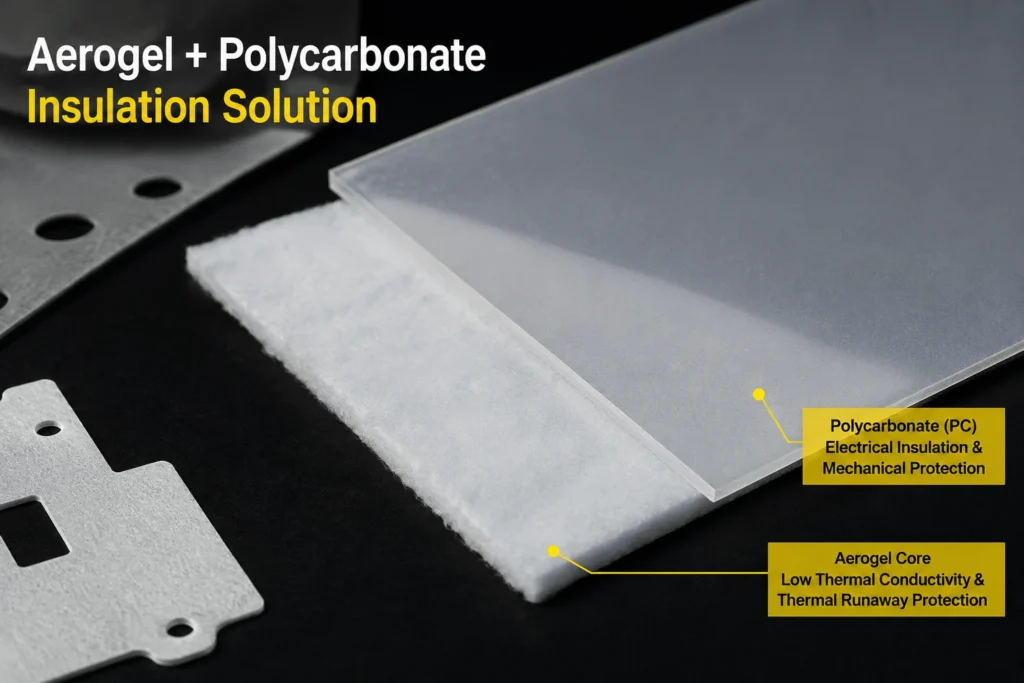
Aerogel works with polycarbonate insulation by providing the low-thermal-conductivity layer while polycarbonate provides electrical insulation, mechanical protection, dimensional stability, and a durable surface for handling or assembly. In EV battery packs, the two materials can be laminated, layered, or die-cut as separate but coordinated parts. Aerogel is typically selected to slow heat transfer and thermal propagation; flame-retardant polycarbonate is selected to isolate high voltage, protect the aerogel layer, and support a repeatable assembly. The best construction depends on heat flux, voltage, compression, flame exposure, available space, and the required safety tests.
Why Aerogel and Polycarbonate Are Complementary Materials
Aerogel and polycarbonate solve different engineering problems. That distinction is the starting point for a reliable design. Silica-aerogel-based battery barriers are engineered around very low heat transfer and thermal-runaway mitigation. Automotive products in this category are also designed to retain performance under compression, vibration, shock, humidity, and repeated mechanical loading. Polycarbonate, by contrast, is an engineering thermoplastic valued for toughness, electrical insulation, manufacturability, and—in flame-retardant grades—self-extinguishing behavior under specified test conditions.
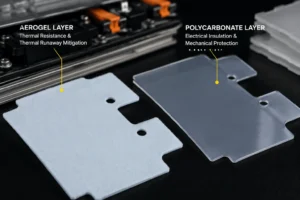
Putting the two together creates a functional division of labor. The aerogel layer becomes the thermal resistor. The polycarbonate layer becomes the electrical and mechanical interface. Depending on the geometry, the PC layer can also help contain or protect a softer aerogel composite from abrasion during die cutting, transport, automated placement, and service. This is particularly useful when the insulation part must be thin, clean, dimensionally repeatable, and easy for operators or robots to install.
That does not mean every EV battery needs a bonded aerogel-PC laminate. In many programs, the better solution is two separate die-cut components placed in the same stack-up. Separating the layers can simplify qualification, allow each material to move or compress as intended, and prevent an adhesive from becoming an unwanted thermal bridge. The correct architecture is determined by the failure mode, not by the marketing name of the material.
What Does the Aerogel Layer Actually Do?
The primary value of aerogel in an insulation stack is thermal resistance. Its highly porous structure suppresses heat transfer through a very thin section compared with many conventional polymeric insulators. In a battery module, that can buy time by reducing the rate at which heat from a failing cell reaches the next cell, a module wall, a busbar region, a sensor, or another temperature-sensitive component.
For EV engineers, the critical point is that aerogel performance should be evaluated in the condition in which the part will actually operate. A datasheet conductivity value alone is not enough. Cell-to-cell barriers may be compressed throughout the vehicle life. Pack-level parts see vibration, humidity, dimensional tolerances, adhesive interfaces, and thermal cycling. Automotive aerogel suppliers therefore emphasize compression behavior and lifecycle durability, not only the initial laboratory conductivity number.
Aerogel is especially useful when the design has little thickness available but still needs a meaningful reduction in heat flux. This is one reason aerogel has gained traction in cell-to-cell thermal-runaway barriers. As cell energy density rises and pack architectures become more space-efficient, designers have less room to solve thermal propagation with thick, low-cost foams. A thin high-performance barrier can protect packaging efficiency while preserving safety margin.
What Does the Polycarbonate Insulation Layer Add?
Polycarbonate adds a different group of properties. A properly specified electrical or flame-retardant PC film can provide dielectric isolation, puncture and tear resistance, dimensional control, a smooth handling surface, and geometry that is straightforward to die cut. It can be formed around tabs, busbars, module walls, housings, connectors, and other high-voltage features where an aerogel-only part may not provide the desired mechanical behavior.
Modern flame-retardant PC grades can also offer useful electrical tracking resistance and flammability performance. For example, Covestro publishes a flame-retardant Macroion grade with UL 94 V-0 at a specified thickness, CTI 600, and an electric strength of 31 kV/mm. Those figures are grade-specific and should never be transferred automatically to another PC film, but they illustrate why engineering teams use polycarbonate as an electrical safety material in high-voltage assemblies.
The limitation is equally important: polycarbonate should not be treated as a substitute for a dedicated aerogel thermal barrier when the main requirement is to minimize conductive heat transfer or delay thermal propagation. A V-0 rating describes behavior in a standardized flammability test at a defined thickness; it does not mean that a thin PC film can absorb the same heat flux, survive the same direct thermal-runaway exposure, or provide the same insulation time as an aerogel barrier.
Aerogel vs. Polycarbonate Insulation: What Each Layer Contributes
| Design requirement | Aerogel layer | Polycarbonate insulation layer |
| Reduce heat transfer | Primary function; high value when thickness is limited | Secondary contribution; not usually the main thermal barrier |
| Delay cell-to-cell thermal propagation | Often a strong candidate when validated for the cell chemistry and compression state | Can support the system, but should not be assumed to replace a dedicated thermal barrier |
| Electrical isolation | Depends on the specific aerogel composite and construction | Strong function for suitable electrical/FR grades |
| Mechanical protection | Automotive composites are engineered for durability, but the thermal layer remains performance-sensitive | Provides toughness, puncture resistance, shape control, and handling support |
| Flammability | Product-specific; some battery aerogel barriers are designed for severe thermal events | FR grades may achieve UL 94 classifications at specified thicknesses |
| Precision die cutting | Possible, but process control is important for edge quality and particulate management | Highly suitable for precision die-cut films and formed insulation parts |
| Compression response | Critical design variable for cell-to-cell barriers | More rigid; useful as a carrier or protective facing, depending on thickness |
| Best role in a hybrid stack | Thermal resistor / propagation barrier | Dielectric barrier / mechanical skin / carrier / protective layer |
How Can Aerogel and Polycarbonate Be Combined in a Real Part?
There are several practical architectures. The best one depends on where the insulation sits in the battery and what the neighboring components do during normal operation and failure.
1. Polycarbonate Facing + Aerogel Thermal Core
A thin PC facing can be placed on one or both sides of an aerogel barrier. The polycarbonate acts as a robust external surface while the aerogel supplies most of the thermal resistance. This structure can make the part easier to handle, reduce scuffing during assembly, and add a dedicated electrical insulation layer toward a busbar, enclosure, or conductive bracket.
This construction is attractive for larger module or pack barriers that must survive multiple handling steps before final assembly. It can also help when the customer wants a clean outer surface for labels, alignment marks, optical inspection, or adhesive placement. The tradeoff is added thickness, added interfaces, and the possibility that the facing or adhesive changes the thermal path.
2. Aerogel Barrier + Separate Die-Cut PC Electrical Insulator
In many EV designs, keeping the aerogel and PC as separate parts is technically cleaner. The aerogel can be compressed or positioned exactly where thermal resistance is needed, while the PC film is placed around terminals, busbars, module walls, or pack hardware that requires dielectric protection. Each material can then be qualified against the test that matches its function.
This architecture also gives the design team more freedom to change one layer without requalifying the complete laminate. If the pack voltage changes, the PC thickness or grade can be adjusted. If the thermal-runaway target becomes more severe, the aerogel construction can be changed. For platforms with several battery capacities or cell variants, this modularity can reduce engineering risk.
3. Local Aerogel Inserts Inside a Larger Polycarbonate Insulation Part
Another strategy is to use a larger die-cut or thermoformed PC insulation part as the base geometry and place aerogel only in thermal hot zones. This can reduce aerogel consumption and target the material where heat flux is highest—for example near selected cell faces, vent paths, module interfaces, or surfaces above known thermal-runaway trajectories.
This is often a cost-effective approach when the entire component does not need premium thermal insulation. The PC layer can cover a broad area for high-voltage isolation, while the aerogel insert is reserved for locations that need a lower effective thermal conductance. Precision converting becomes important because the insert must remain correctly registered after handling, vibration, and thermal cycling.
4. Multi-Layer Stack With Adhesive, Foam, Mica, or Other Functional Layers
Real battery insulation is rarely a two-material problem. Aerogel and polycarbonate may sit next to pressure-sensitive adhesive, silicone foam, mica, ceramic paper, PET, PI film, graphite, EMI shielding, or structural tape. A thin foam may manage tolerance and compression. Mica may be added where direct flame or hot-particle exposure is dominant. A PC film may isolate high voltage. Aerogel may reduce through-thickness heat transfer. The successful part is therefore a system, not a material sample.
For sourcing teams, this changes the supplier question. Instead of asking, ‘Can you die cut aerogel?’ ask whether the converter can control the entire stack: incoming material traceability, lamination pressure, adhesive selection, registration between layers, release liner design, dust control, slit quality, die-cut tolerance, packaging, and inspection. These process variables determine whether the laboratory material properties survive into mass production.
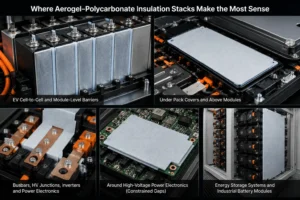
Where Does an Aerogel-Polycarbonate Insulation Stack Make the Most Sense?
EV Cell-to-Cell and Module-Level Barriers
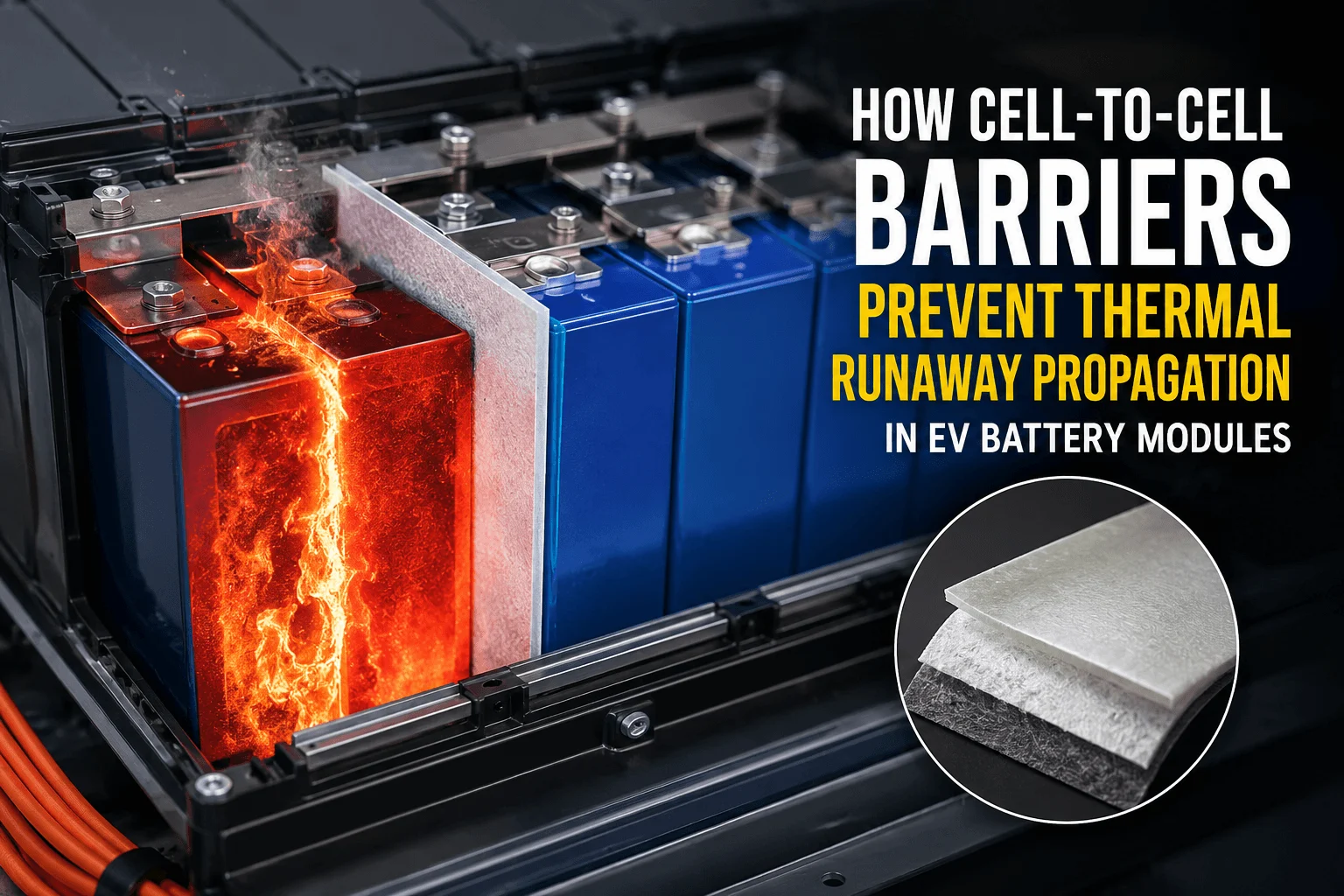
Cell-to-cell barriers are one of the clearest applications for aerogel because the design objective is to slow heat transfer from a failing cell to its neighbor. A PC component can be used nearby when the same region also includes electrically live hardware, a rigid locating feature, or an abrasion risk. The exact stack is cell-format dependent: prismatic, pouch, and cylindrical cells create very different compression, venting, and contact conditions.
For prismatic cells, compression over life may be a defining requirement, so the engineer should characterize thermal resistance at the compressed thickness rather than the free-state thickness. For cylindrical cells, geometry and vent paths can create localized jet exposure that requires careful material placement. For pouch cells, the stack may need to accommodate swelling and pressure while maintaining electrical separation.
Under Pack Covers and Above Modules
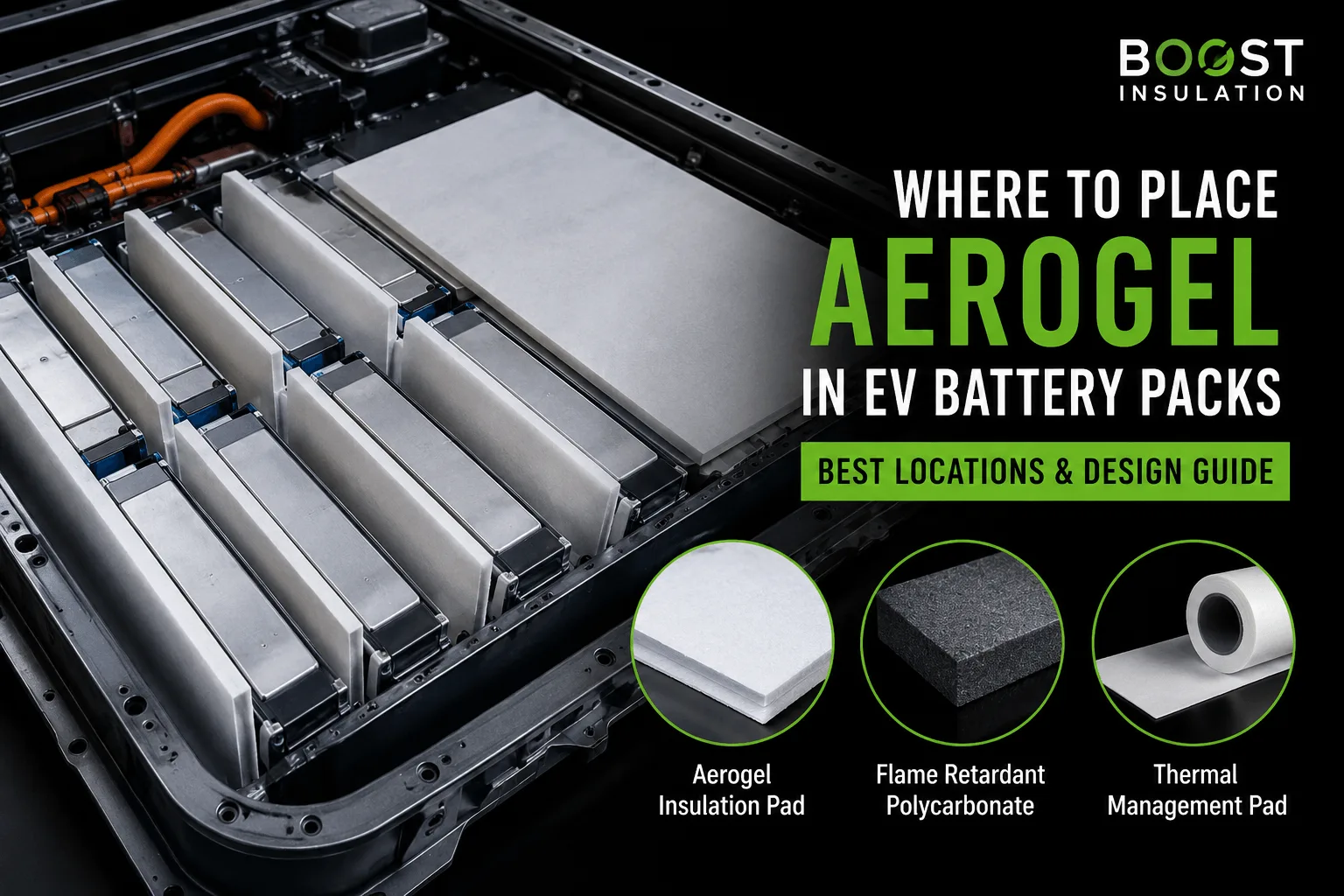
Under a battery pack cover, the job may shift from cell-to-cell heat transfer to protection of the lid, passenger compartment, wiring, sensors, or service components. Aerogel can contribute a high thermal resistance layer, while PC can provide a dielectric liner, a protective facing, or a formed electrical barrier. If direct flame, hot gas, or molten particles are expected, the complete stack must be tested against that exposure; a thin PC surface should not be assumed to survive simply because it carries a flame-retardant classification.
Busbars, HV Junctions, Inverters, and Power Electronics
Aerogel-PC combinations can also be useful around high-voltage power electronics where a hot component sits close to a conductive enclosure or another temperature-sensitive device. Polycarbonate is valuable for creepage/clearance management and dielectric isolation; aerogel can reduce heat flow through a constrained gap. In these applications, designers also need to consider EMI, outgassing, adhesive aging, service temperature, and whether the assembly must be reworkable.
Energy Storage Systems and Industrial Battery Modules
Stationary energy storage is less constrained by vehicle mass but can be more demanding in service duration, cabinet density, ventilation strategy, and fire-safety requirements. Aerogel can help isolate cells or modules, while PC can provide electrical barriers, labels, covers, shields, or enclosure-adjacent insulation. The same layered-design logic applies: separate thermal, electrical, flame, mechanical, and assembly requirements before selecting the materials.
Five Engineering Questions That Determine Whether the Combination Will Work
1. What Is the Real Thermal Failure Mode?
Start with the heat source. Is the objective to reduce steady-state conduction, delay propagation from one cell to another, protect a pack cover during a short high-flux event, or shield electronics from a nearby hot surface? These are different problems. Aerogel is valuable for low heat transfer, but the thickness, density, reinforcement, and compression state must match the specific heat-flux profile.
A common sourcing mistake is to compare only thermal conductivity at room temperature. Thermal runaway is a transient event involving radiation, convection, conduction, hot gas, and sometimes direct flame or ejecta. The complete barrier should be validated under a test that reasonably represents the actual hazard.
2. What Voltage and Electrical Tracking Risk Must the PC Layer Manage?
If the polycarbonate layer is part of the high-voltage isolation system, specify more than ‘PC film.’ The design should define minimum thickness after forming, dielectric withstand requirement, CTI or tracking requirement where relevant, flammability classification at the actual thickness, temperature exposure, humidity aging, and the expected creepage/clearance geometry.
As EV platforms move toward higher voltage, electrical insulation cannot be treated as a cosmetic liner. The PC grade, edges, cutouts, fastener clearances, burrs on neighboring metal, contamination, and compression all affect the final dielectric system. A mechanically perfect aerogel barrier will not compensate for a poor high-voltage insulation design.
3. Will the Aerogel Be Compressed?
Compression can be beneficial when the aerogel barrier is designed to double as a tolerance-management or cell-compression element, but it changes geometry and can change thermal behavior. The engineer should define the nominal compression, maximum stack tolerance, end-of-life compression, and recovery requirement. Material selection should then be based on performance within that operating window.
This is one of the strongest reasons to involve a converter early. Die-cut dimensions are not the only critical tolerance. Thickness, lamination pressure, adhesive thickness, liner release, and the relationship between the aerogel edge and the PC edge can determine how the part compresses in the final pack.
4. Does the Adhesive Help or Hurt the Design?
Pressure-sensitive adhesive can dramatically simplify assembly, but it is not neutral. An adhesive adds another thermal path and another polymer layer. It may soften at elevated temperature, creep under load, interact with surface treatments, or create a path for contamination at the edge. A full-surface adhesive can also change the compression behavior of a soft aerogel composite.
Good DFM often uses adhesive selectively. Instead of covering the entire thermal barrier, small locating zones or perimeter strips may be enough to hold the part during assembly. The correct pattern depends on the heat path and the required retention force. Adhesive supplier data should be checked for temperature, flammability, dielectric behavior, and compatibility with both surfaces.
5. Can the Part Be Manufactured Consistently at Volume?
A prototype cut by hand can hide problems that become expensive at 100,000 pieces. Aerogel composites can generate edge debris if converted with the wrong tooling. Thin PC can curl, scratch, or hold static charge. Multi-layer registration can drift. Release liners may tear during automated placement. A large part can trap air during lamination. These are manufacturing issues, but each one can become a safety or yield issue in production.
The target should therefore be a design that can be measured and controlled. Critical-to-quality dimensions might include outer profile, hole position, minimum edge distance, layer-to-layer registration, total thickness, adhesive coverage, and exposed-aerogel edge condition. For automotive programs, the manufacturing plan should connect these CTQs to APQP/PPAP documentation and lot traceability.
DFM Guidelines for Custom Die-Cut Aerogel + Polycarbonate Parts
For a China-based die-cut insulation supplier, DFM is where much of the commercial value is created. The most effective projects usually begin before the CAD drawing is frozen. Small changes in geometry or layer architecture can reduce scrap, simplify tooling, improve assembly, and avoid unnecessary material cost.
- Define the function of every layer. Do not add PC merely because the aerogel feels fragile, and do not add aerogel merely to make a PC insulator sound more advanced.
- Specify the minimum functional area rather than automatically covering the complete panel with aerogel. Local thermal inserts can reduce cost and weight.
- Keep thermal bridges under control. Fasteners, metal spacers, dense adhesive zones, and compressed edges can bypass the intended aerogel heat path.
- Use generous internal radii when practical. Sharp corners can increase stress, complicate stripping, and reduce die life.
- Control exposed edges. If particulate cleanliness is critical, consider facings, edge encapsulation, process changes, or packaging that protects the cut edge.
- Design release liners for the assembly process. A split liner, extended tab, or staged peel can matter more to line speed than a small material-price difference.
- Set realistic tolerances by feature. A busbar clearance may need a tighter tolerance than the outer perimeter of a large thermal sheet.
- Validate the exact laminate. Material datasheets for separate layers do not automatically predict the performance of a bonded multilayer part.
How Should Engineers Validate an Aerogel-Polycarbonate Stack?
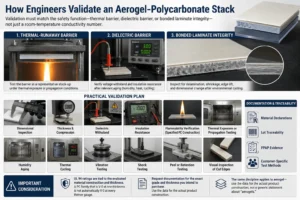
Qualification should follow the actual safety function. For a thermal-runaway barrier, test the barrier in a representative stack-up rather than relying only on a room-temperature conductivity report. For a dielectric barrier, test voltage withstand and insulation resistance after the aging conditions that matter to the application. For a bonded laminate, inspect for delamination, shrinkage, edge lift, and dimensional change after environmental cycling.
A practical validation plan may include dimensional inspection, thickness and compression measurements, dielectric withstand, insulation resistance, flammability verification for the specified PC construction, thermal exposure or propagation testing, humidity aging, thermal cycling, vibration, shock, peel or retention testing, and visual inspection of cut edges. Automotive programs may add material declarations, lot traceability, PPAP evidence, and customer-specific test methods.
One detail deserves special attention: UL 94 ratings are tied to the evaluated material construction and thickness. A PC family that is V-0 at one thickness is not automatically V-0 at every thinner gauge. Buyers should request documentation for the exact grade and thickness they intend to purchase. The same discipline applies to aerogel—use the data for the actual product construction, not a generic statement about ‘aerogels
Industry Insight: EV Insulation Is Moving Toward Functional Layering
The most important industry trend is not simply ‘more aerogel’ or ‘more flame-retardant plastic.’ It is the move toward multifunctional, application-specific stacks. Battery packs are becoming thinner, cell-to-pack designs reduce intermediate structure, and high-voltage architectures increase the importance of electrical isolation. At the same time, thermal-propagation performance remains a system-level safety concern. These pressures make it harder for a single material to satisfy every requirement efficiently.
Major engineering-plastics suppliers now promote polycarbonates and related thermoplastics for battery housings, module boxes, lids, and high-voltage parts because they can combine insulation, toughness, part integration, and lightweight design. In parallel, automotive aerogel suppliers are developing thin barriers specifically for battery thermal-runaway mitigation. The convergence of these two material families points toward a broader design philosophy: use each material where its performance creates the most value, then convert them into an assembly-friendly component.
For procurement teams, this favors suppliers that understand both materials and converting. A low-cost die cutter may be able to cut a rectangle, but the sourcing risk appears later if the aerogel frays, the PC wrinkles, the adhesive fails, the layer registration drifts, or documentation cannot support automotive quality requirements. The commercial decision should consider total installed cost and qualification risk, not only raw-material price per square meter.
When Is Aerogel + Polycarbonate Better Than Aerogel Alone?
The hybrid approach is usually worth evaluating when the thermal barrier also needs one or more of the following: defined dielectric isolation, a durable handling surface, puncture resistance, automated placement, complex openings around HV hardware, dimensional reinforcement, clean presentation, or integration with a larger formed insulation geometry. Polycarbonate gives the engineer more control over these non-thermal functions.
Aerogel alone may be preferable when the component only needs thermal resistance and adding a PC facing would increase thickness, cost, thermal bridging, or qualification burden without solving a real problem. The rule is simple: every layer should have a measurable function.
When Is Polycarbonate Better Without Aerogel?
If the main requirement is electrical isolation, flame-retardant behavior under the applicable polymer test, abrasion resistance, impact protection, a printed/formed insulator, or a low-cost high-volume dielectric film—and the thermal gradient is modest—an FR polycarbonate part may be sufficient by itself. Adding aerogel would increase cost and process complexity without creating meaningful system value.
This is common in busbar covers, terminal shields, BMS insulation, connector barriers, and many electronics applications. The design should still be checked against the maximum local temperature and any credible fault condition, but not every high-voltage component needs a premium thermal barrier.
How to Specify an Aerogel-Polycarbonate Insulation Part in an RFQ
A good RFQ gives the converter enough engineering information to recommend the correct material stack without exposing unnecessary intellectual property. Instead of sending only a 2D drawing, include the functional boundary conditions.
- Application: EV battery, ESS, inverter, charger, power module, or electronics enclosure.
- Location: cell-to-cell, module-to-module, under lid, busbar/HV region, side wall, controller, or enclosure interface.
- Thermal requirement: normal operating temperature, fault temperature, heat-flux or propagation target, and exposure duration if known.
- Electrical requirement: system voltage, dielectric withstand target, insulation resistance, CTI/creepage needs, and any customer-specific standard.
- Flammability requirement: exact standard, classification, and minimum material thickness for the selected construction.
- Mechanical requirement: compression range, pressure, puncture risk, vibration, allowable thickness stack-up, and flatness.
- Environmental requirement: humidity, coolant/electrolyte exposure, thermal cycling, service life, and storage conditions.
- Assembly requirement: PSA or no PSA, liner design, placement method, poka-yoke features, labeling, packaging, and cleanliness level.
- Geometry: CAD/PDF/DXF drawing, critical dimensions, tolerance classes, holes, slots, bend lines, and no-cut zones.
- Program information: prototype quantity, annual volume, SOP date, PPAP level, traceability, and required certificates.
Providing these inputs allows a supplier to compare several constructions instead of simply quoting the material named on the drawing. In many projects, that is where cost reduction happens: the engineer can narrow the aerogel coverage, simplify the PC geometry, eliminate unnecessary adhesive, or choose a thickness that meets the requirement without overdesign.
Why Source Custom Aerogel and Polycarbonate Insulation From Boost Insulation?
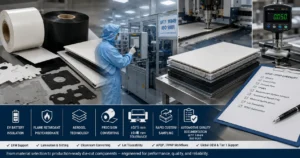
Boost Insulation positions its manufacturing around EV battery insulation, flame-retardant polycarbonate, aerogel, and precision converting. For buyers, the relevant advantage is not merely access to raw sheet materials. The value is the ability to move from material selection to a production-ready die-cut component through DFM, lamination, slitting, precision tooling, inspection, rapid samples, and automotive-quality documentation.
According to Boost Insulation’s current manufacturing information, the company supports IATF 16949 and ISO 9001 quality systems, APQP/PPAP workflows, lot traceability, cleanroom converting, and precision die cutting with tolerances as tight as ±0.05 mm for suitable designs. It also promotes rapid custom sampling for development programs. For overseas OEMs and Tier 1 suppliers, these capabilities can reduce the number of vendors needed for a multilayer insulation project and shorten the loop between design changes and physical validation.
The strongest supplier relationship is still engineering-led. Send the target temperature exposure, voltage, compression window, material thickness constraints, drawing, and annual volume. A qualified converter should be able to explain where aerogel adds value, where polycarbonate adds value, whether the layers should be bonded or separate, and which tests should be run before mass production.
Frequently Asked Questions
Can aerogel be laminated directly to polycarbonate film?x
Yes, some constructions can be laminated, but direct lamination is not automatically the best design. The adhesive, lamination pressure, aerogel facing, expected compression, temperature exposure, and thermal-bridge risk must be evaluated. In some battery applications, separate die-cut layers are preferable.
Does polycarbonate improve the thermal insulation of aerogel?
Polycarbonate can add a small amount of thermal resistance, but its main contribution is usually electrical insulation, mechanical protection, dimensional stability, and manufacturability. The aerogel layer remains the primary low-conductivity component in most hybrid designs.
Can flame-retardant polycarbonate replace aerogel in an EV battery?
Not when the principal requirement is a high-performance thermal barrier or cell-to-cell propagation delay. FR polycarbonate can be excellent for dielectric and flame-retardant functions, but its UL 94 classification does not make it equivalent to an automotive aerogel thermal-runaway barrier. Use the material that matches the failure mode.
Can aerogel replace polycarbonate insulation?
Sometimes, but only if the aerogel product itself meets all required electrical, mechanical, cleanliness, assembly, and durability requirements. Many applications still benefit from a dedicated PC film or formed part because it provides a robust dielectric interface and repeatable geometry.
What thickness of aerogel and polycarbonate should an EV battery use?
There is no universal thickness. Aerogel thickness should be selected from the thermal exposure, allowable heat transfer, compression state, and propagation target. PC thickness should be selected from the grade-specific dielectric, flammability, mechanical, and forming requirements. The final stack must also fit the pack tolerance and assembly process.
Is a bonded aerogel-PC laminate better for automated assembly?
It can be. A single multilayer part reduces part count and can simplify placement, but only if the laminate remains dimensionally stable and the adhesive is reliable. Separate layers may be more robust when the aerogel needs independent compression or when the thermal design is sensitive to adhesive coverage.
What information should I send to a die-cut insulation supplier?
Send a drawing plus functional requirements: operating and fault temperature, voltage, flammability target, compression range, environmental conditions, assembly method, prototype quantity, annual volume, and any PPAP or traceability requirements. This gives the supplier enough context to recommend a practical stack rather than quoting an arbitrary material.
Conclusion: Use Aerogel for the Heat Path and Polycarbonate for the Interface
Aerogel and polycarbonate insulation work best together when each material is assigned the job it performs well. Aerogel is the thermal resistor: it is used to limit heat transfer and support thermal-propagation control in thin spaces. Polycarbonate is the electrical and mechanical interface: it provides dielectric isolation, toughness, clean handling, dimensional control, and manufacturing flexibility. Together, they can form a compact multilayer insulation system for EV batteries, energy storage, power electronics, and other high-voltage equipment.
The engineering question is therefore not, ‘Which material is better?’ It is, ‘Which failure modes must this part control, and what is the simplest stack that controls them?’ If your project needs custom aerogel, flame-retardant polycarbonate, adhesive-backed insulation, or a multilayer die-cut assembly, send Boost Insulation your drawing and operating requirements for a DFM and material review before locking the design.
Technical References Used for Fact-Checking
- Aspen Aerogels — Battery Thermal Barriers / PyroThin: https://www.aerogel.com/industries/battery-thermal-barriers/
- Aspen Aerogels — Battery Electric Vehicles: https://www.aerogel.com/industries/battery-thermal-barriers/battery-electric-vehicles/
- Covestro — Makrolon FR6019 CTI technical data: https://solutions.covestro.com/en/products/makrolon/makrolon-fr6019-cti_000000000086738554
- SABIC — EV Batteries / thermoplastic battery components: https://www.sabic.com/en/industries/automotive/polymers/evbatteries
- Boost Insulation — manufacturing capabilities and EV battery insulation: https://boostinsulation.com/
Related Posts:
How Do Cell-to-Cell Barriers Prevent Thermal Runaway?
Where Is Aerogel Used Inside Modern EV Battery Packs?
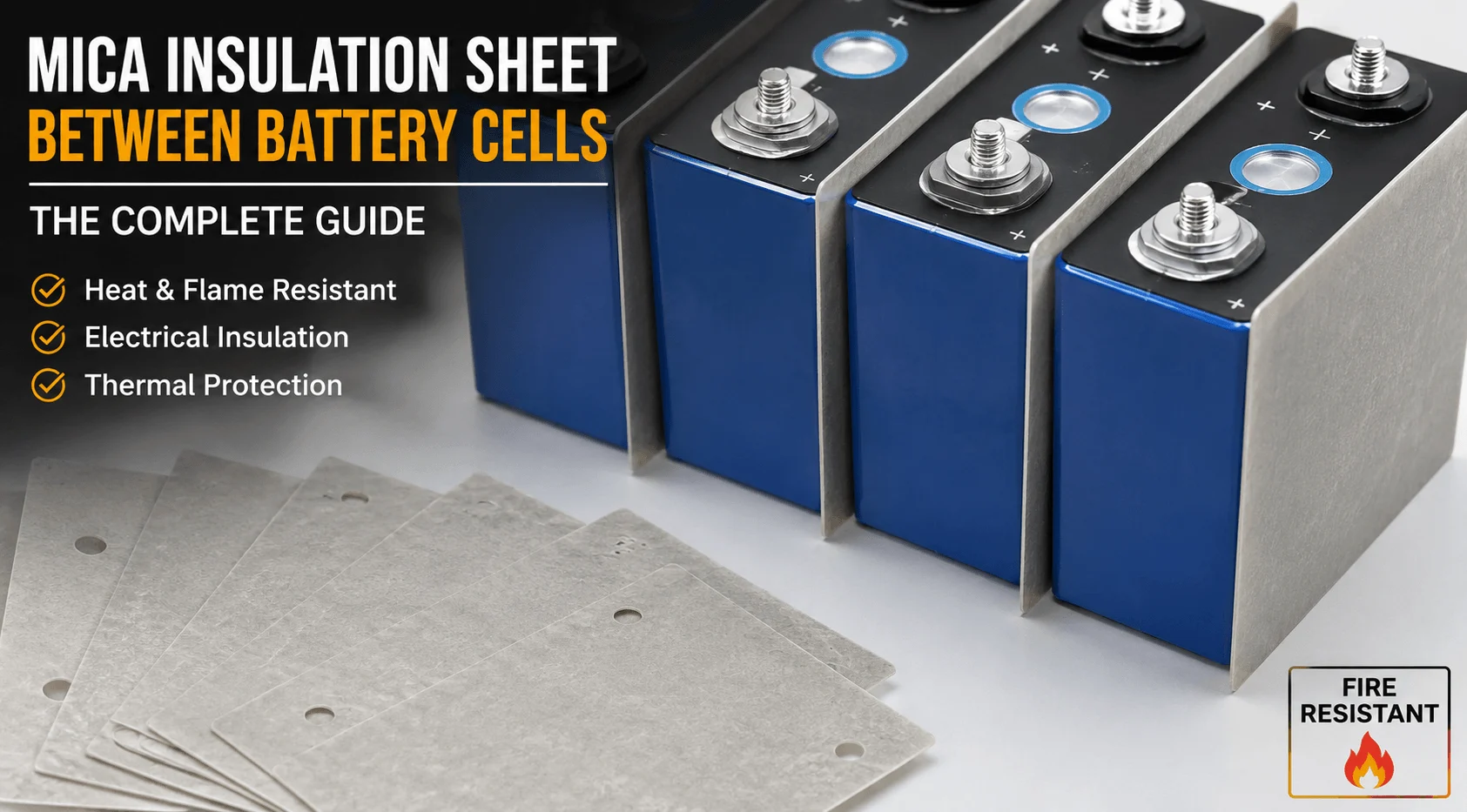
Can a Mica Insulation Sheet Work Between Battery Cells?
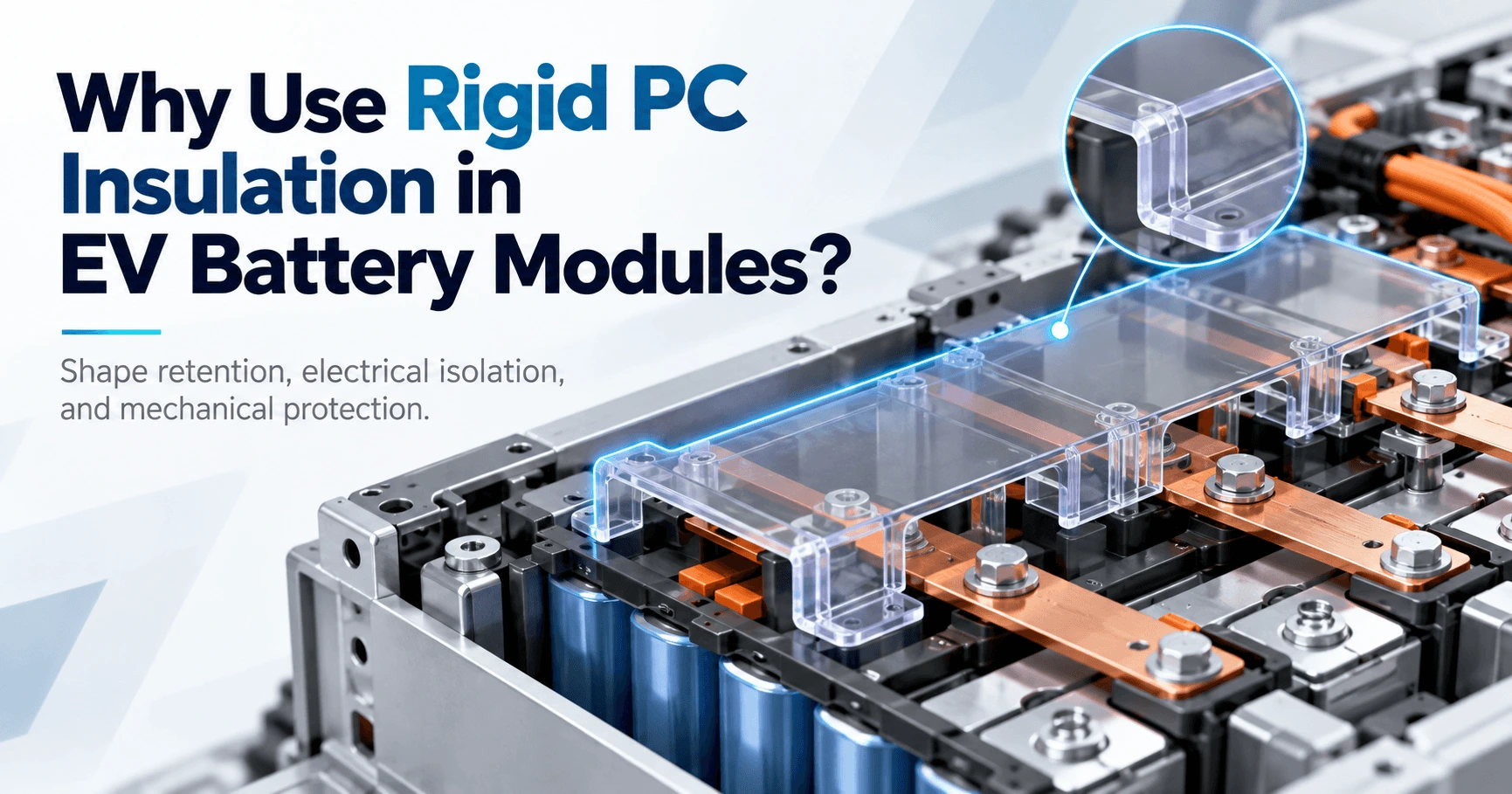
Why Use Rigid PC Insulation in EV Battery Modules?
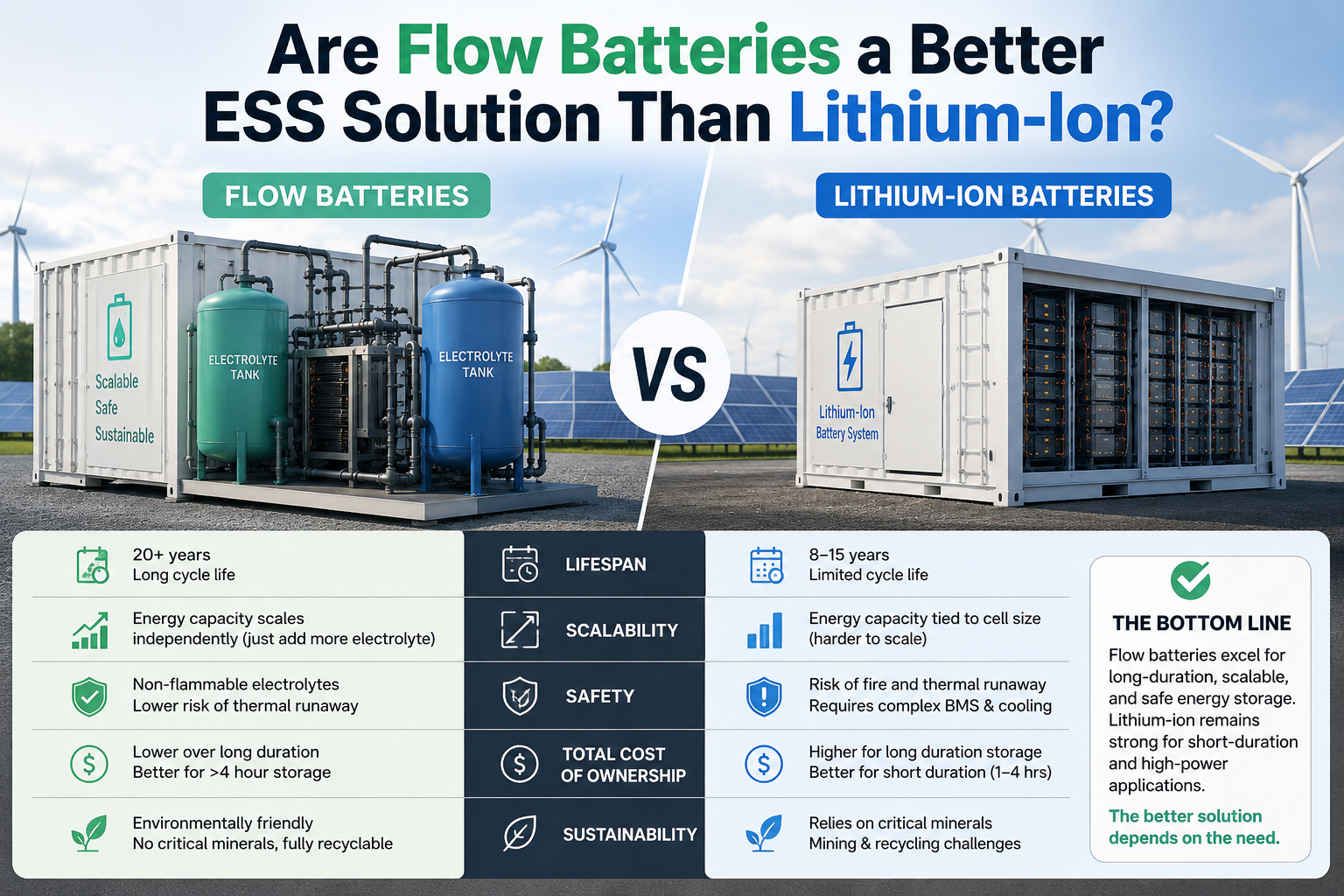
Are Flow Batteries a Better ESS Solution Than Lithium-Ion?
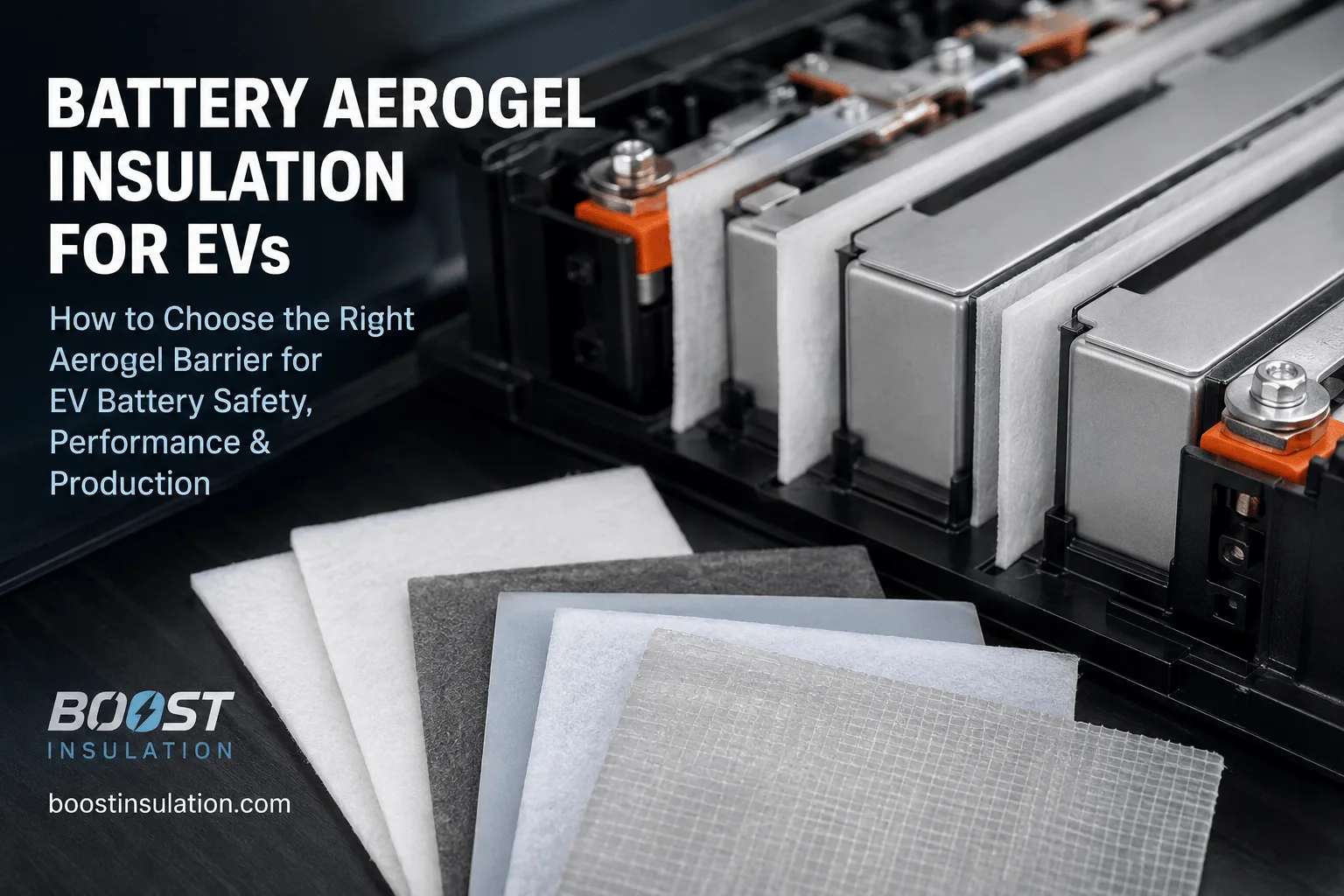
How Do You Choose Battery Aerogel Insulation for EVs?
 betty wong