Is Flame Retardant Polycarbonate Better Than Acrylic?
Table of Contents
Walk into any industrial trade show, and you will find two materials competing for the same product space more often than almost any other pairing: flame retardant polycarbonate and acrylic. Both are clear-capable, lightweight, and visually similar in a product display. Both are used in enclosures, lighting, displays, and protective covers. And both have passionate advocates who will tell you their preferred material is the obvious choice.
But here is the thing: one of those advocates is right, and the other is specifying a material that could fail a fire certification, shatter under an impact load, or yellow and crack within two years of outdoor UV exposure. The right answer depends entirely on what you are actually building — and the consequences of getting it wrong range from a failed product launch to a fire safety liability that no manufacturer wants to face.
This article gives you an honest, engineering-grounded comparison between flame retardant polycarbonate (FR-PC) and acrylic (PMMA) across every dimension that matters to product designers, procurement engineers, and safety managers. No marketing spin — just the data you need to make the right call.
⚑ QUICK ANSWER
The sections below break down every category in detail — backed by material data, real-world application context, and the engineering trade-offs that most datasheets don’t tell you.
MATERIAL FUNDAMENTALS
FR-PC (Flame Retardant Polycarbonate) Acrylic (PMMA — Polymethyl Methacrylate)
Before comparing, it is worth establishing what each material actually is — because many of the performance differences trace directly back to their molecular structures.
Flame Retardant Polycarbonate (FR-PC)
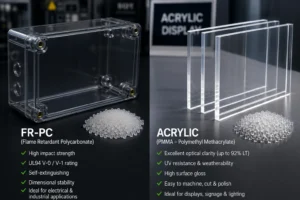
Polycarbonate is an amorphous thermoplastic built around bisphenol A (BPA) and carbonate linkages, giving it an aromatic backbone that naturally resists combustion better than aliphatic polymers. Flame retardant grades add halogenated or phosphorus-based additives to push fire performance from the baseline HB rating up to V-0 or V-1 — the ratings required by most electrical, electronic, automotive, and industrial safety standards. FR-PC is tough, dimensionally stable, and can be processed into complex thin-wall geometries.
Acrylic — PMMA (Polymethyl Methacrylate)
Acrylic is a transparent thermoplastic derived from methyl methacrylate monomer. Its tightly packed, linear polymer chains give it exceptional optical clarity — light transmission up to 92%, better than glass in many comparisons — along with excellent UV resistance and surface gloss. But its all-carbon backbone burns readily, and despite some marketed “fire-resistant” acrylic grades, standard PMMA achieves only UL94 HB — the lowest rating in the UL94 framework. Specialty FR acrylic grades exist but remain limited compared to the FR-PC offering.
FIRE SAFETY COMPARISON
1. Fire Safety: The Most Consequential Difference
This is where the comparison is most decisive — and where specifying the wrong material creates the greatest risk.
How Acrylic Burns
Acrylic is a highly combustible polymer. When exposed to flame, PMMA pyrolyzes rapidly and almost entirely back to its monomer — methyl methacrylate — which is itself a flammable gas. This means acrylic burns cleanly, intensely, and with very little char residue to interrupt the combustion cycle. Standard PMMA has a Limiting Oxygen Index (LOI) of approximately 17–18% — well below ambient oxygen levels, meaning it will sustain combustion readily once ignited.
Standard acrylic fire performance: UL94 HB (horizontal burn only). Acrylic burns at rates up to 40mm per minute in horizontal tests. It is not self-extinguishing. It produces burning drips that can spread fire. Specialty FR acrylic grades may achieve V-2 in limited configurations, but V-0 acrylic does not exist as a commercially mainstream material.
How FR-PC Performs in Fire
Flame retardant polycarbonate is engineered specifically to interrupt the combustion cycle at multiple points. PC’s aromatic backbone promotes surface char formation — a physical barrier that cuts off oxygen and heat transfer to the unburned polymer beneath. FR additives enhance this by either releasing radical-quenching gases (halogenated grades) or accelerating char formation through phosphorus-based condensed-phase action (halogen-free grades). The result is a material that self-extinguishes within 10 seconds with no burning drips — the definition of UL94 V-0.
FR-PC fire performance: UL94 V-0 at wall thicknesses as low as 0.4mm (halogenated grades) or 1.0mm (halogen-free grades). LOI of 28–36% depending on formulation. Glow Wire Ignition Temperature (GWIT) up to 825°C for premium grades — critical for EU household appliance and industrial applications.
| Fire Property | FR-PC | Acrylic / PMMA |
| UL94 Rating | V-0 / V-1 / V-2 | HB (V-2 in limited FR grades) |
| LOI Value | 28–36% | 17–18% |
| Self-Extinguishing | Yes — within 10 sec (V-0) | No — continues to burn |
| Burning Drips | None at V-0 / V-1 | Yes — fire spread risk |
| Char Formation | Dense, protective char layer | Minimal — burns to monomer gas |
| EU GWIT Rating | Up to 825°C | Typically not rated |
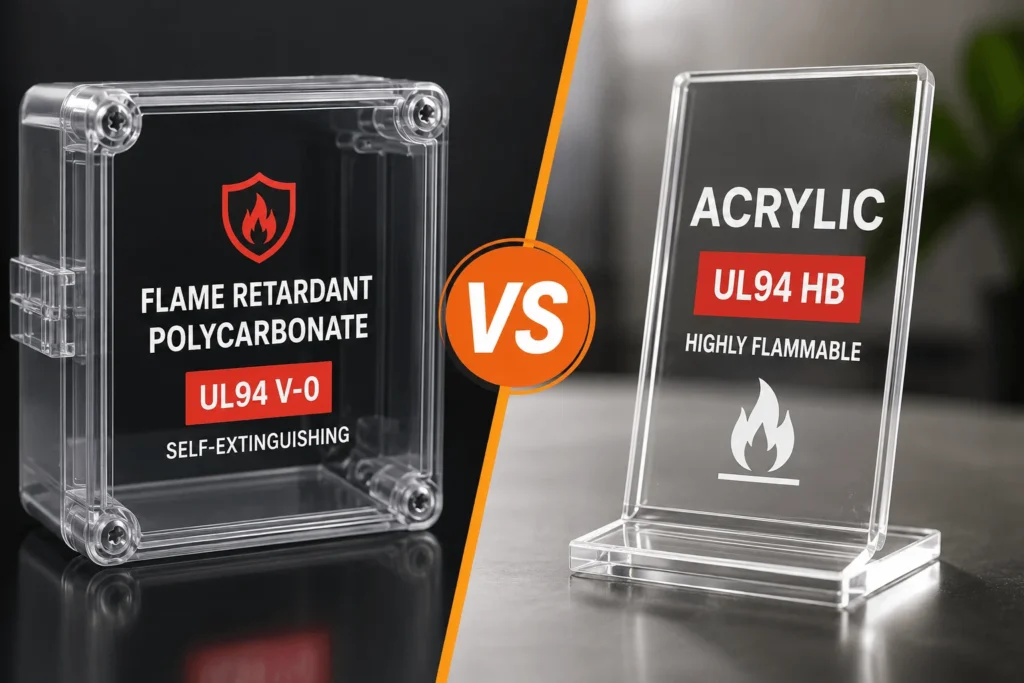
The verdict on fire safety is unambiguous: for any application involving electrical power, potential ignition sources, or regulatory fire certification requirements, FR-PC wins definitively. Acrylic is not a candidate for UL, CE, or IEC fire certification in most electrical and electronic product categories.
MECHANICAL PERFORMANCE
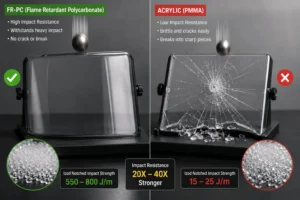
2. Impact Resistance: FR-PC’s Structural Advantage
Polycarbonate’s reputation as the “virtually unbreakable” plastic is well-earned, and FR-PC largely retains this advantage despite the additive loading. Acrylic, by contrast, is notoriously brittle — a characteristic that defines both its applications and its limitations.
FR-PC Impact Performance
Standard polycarbonate achieves Izod notched impact strength of 800–900 J/m. FR-PC grades, depending on the additive system and loading level, typically retain 550–800 J/m — still among the highest impact resistance values of any commercially available engineering thermoplastic. At thin wall thicknesses, FR-PC maintains this toughness far better than acrylic, making it the preferred material for enclosures that must survive handling, transportation vibration, and occasional physical impact without cracking.
Acrylic Impact Performance
PMMA has an Izod notched impact strength of approximately 15–25 J/m — roughly 20 to 40 times lower than FR-PC. Acrylic is not simply less tough; it is genuinely brittle. Under impact, it fractures with sharp, potentially dangerous edges. This brittleness is why acrylic display cases crack when dropped, why acrylic windows shatter under hail or debris, and why acrylic is not used in applications where physical safety under impact is a design requirement.
Impact ratio: FR-PC is typically 20–40x more impact-resistant than acrylic by Izod notched test. For any application involving safety glazing, protective covers, portable equipment, or any part exposed to physical handling and potential impact — FR-PC is the only technically defensible choice.
The one nuance: impact-modified acrylic grades exist that partially close this gap, but they do so at the cost of the optical properties that are acrylic’s primary advantage, and they still do not approach FR-PC’s impact performance.
OPTICAL PERFORMANCE
3. Optical Clarity: Acrylic’s Undisputed Advantage
This is where acrylic genuinely outperforms FR-PC — and where many designers and product engineers correctly choose PMMA over polycarbonate regardless of fire considerations.
Acrylic Optical Properties
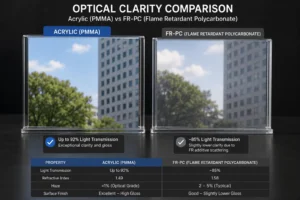
PMMA achieves light transmission of up to 92% — higher than standard glass (approximately 90%) and significantly better than polycarbonate. Its refractive index of 1.49 is consistent and predictable, its haze value is extremely low (<1% for optical grades), and its surface naturally polishes to a brilliant gloss. For lenses, light pipes, display glazing, signage, and any application where visual clarity is the primary performance metric, acrylic sets the standard.
Acrylic optical benchmark: 92% light transmission, refractive index 1.49, haze <1%. These values are achievable without specialized coatings or post-processing, making acrylic the default choice for lighting diffusers, optical instruments, aquarium panels, and retail display applications.
FR-PC Optical Properties
Standard clear polycarbonate achieves approximately 88–89% light transmission — slightly below acrylic. FR-PC compounds typically sacrifice additional clarity, as FR additives introduce light-scattering effects, and most FR-PC grades are opaque or translucent rather than optically transparent. Attempts to achieve V-0 fire ratings in fully transparent polycarbonate are possible in specialized formulations, but they are expensive, limited in color options, and still fall short of PMMA’s optical performance.
For applications where transparency, visual clarity, and color accuracy are critical — display cases, retail fixtures, optical lenses, aquarium walls, architectural glazing — acrylic is the better material, and the fire performance gap must be managed through application design rather than material substitution.
4. UV Resistance and Weatherability
For outdoor or UV-exposed applications, both materials behave very differently — and the comparison is more nuanced than many buyers expect.
Acrylic UV Resistance
PMMA is one of the most UV-resistant plastics commercially available. Its tight polymer structure resists UV-induced chain scission, and its outdoor stability is exceptional — well-formulated acrylic can maintain optical clarity and mechanical properties for 10 years or more of outdoor UV exposure without significant yellowing. This makes it the material of choice for outdoor signage, skylights, greenhouse glazing, and architectural cladding.
FR-PC UV Resistance
Standard polycarbonate is notoriously poor at UV resistance — it yellows, crazes, and loses impact strength with outdoor exposure unless stabilized with UV absorbers or protective coatings. FR-PC grades may compound this issue, as some FR additives accelerate UV degradation. However, UV-stabilized FR-PC grades are available — co-extruded PC sheet with UV-protective cap layers, or UV-stabilized injection-molding compounds — that significantly improve outdoor performance.
For outdoor or high-UV-exposure applications without strict fire certification requirements, acrylic is the superior choice for UV resistance and long-term optical stability. For outdoor applications that also require fire certification, UV-stabilized FR-PC is the necessary trade-off.
5. Heat Resistance: FR-PC Maintains the Advantage
Both materials are amorphous thermoplastics with relatively high heat resistance compared to commodity plastics, but polycarbonate carries a meaningful advantage at elevated temperatures.
Comparison at a Glance
- 115–130°C (standard FR grades); 120–140°C (high-heat FR-PC grades with copolymer base): FR-PC Heat Deflection Temperature (HDT @ 1.82 MPa)
- 80–100°C for standard grades; up to 110°C for heat-resistant formulations: Acrylic HDT (@ 1.82 MPa)
This 20–30°C advantage in HDT matters significantly in applications near heat sources — LED driver housings, equipment enclosures in warm server rooms, automotive interior components exposed to solar loading, and parts mounted near motors or transformers. In these environments, acrylic parts can soften, deform, or lose dimensional stability at temperatures that FR-PC handles without issue.
For applications with continuous operating temperatures above 85°C — including most industrial and automotive interior specifications — FR-PC is the appropriate material and acrylic is not.
6. Chemical Resistance: Acrylic’s Unexpected Advantage
This comparison often surprises engineers who default to assuming polycarbonate is more robust in all properties.
Standard polycarbonate is vulnerable to a broader range of chemicals than acrylic — particularly aromatic solvents, strong bases, gasoline, and many cleaning agents. Stress cracking under solvent exposure is a known failure mode for PC components in service environments with chemical exposure. FR-PC inherits this vulnerability.
Acrylic demonstrates better resistance to dilute acids, aliphatic hydrocarbons, and many common cleaning agents, and is less prone to stress cracking in many chemical environments. However, both materials are attacked by acetone, MEK, and chlorinated solvents.
For applications with direct chemical exposure — laboratory equipment covers, certain medical device housings, industrial process sight glasses — the chemical resistance profile of each material must be verified against the specific exposure scenario. Neither material is universally chemically resistant, but acrylic’s resistance profile is broader for common industrial environments.
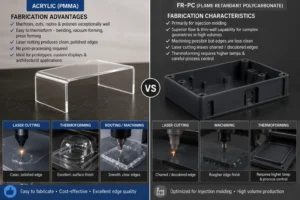
7. Machinability, Fabrication, and Surface Finishing
Acrylic Fabrication Advantages
Acrylic machines, cuts, routs, and polishes exceptionally well. Its relatively low melting point makes it easy to thermoform into complex shapes — bending, vacuum forming, and press forming are all viable without expensive tooling. Laser cutting produces clean, polished edges on acrylic with no post-processing required. For prototype runs, custom display fixtures, and architectural applications where cutting-to-size and edge quality matter, acrylic’s fabrication characteristics are a genuine advantage.
FR-PC Fabrication Characteristics
FR-PC is primarily an injection-molding material, where its superior flow and thin-wall capability allow highly complex geometries in high volumes. Machining FR-PC is possible but produces less clean edges than acrylic, and laser cutting tends to produce charred or discolored edge surfaces. Thermoforming FR-PC is viable, particularly for sheet stock, but requires higher temperatures and more careful process control than acrylic forming.
For low-volume, cut-to-shape applications — retail displays, custom covers, bespoke enclosures — acrylic’s fabrication versatility makes it easier and cheaper to work with. For high-volume injection-molded production, FR-PC’s material and processing advantages dominate.
8. Cost Comparison: More Nuanced Than It Appears
Raw material cost is frequently cited as acrylic’s primary advantage over FR-PC, but the full cost picture deserves careful examination.
| Cost Factor | FR-PC | Acrylic |
| Raw material price/kg | Moderate-high premium vs standard PC | Typically 20–40% lower than FR-PC |
| Tooling cost (injection molding) | Standard injection mold tooling | Standard injection mold tooling |
| Thermoforming / fabrication | Higher cost, less clean finish | Lower cost, excellent edge quality |
| Certification cost savings | UL-listed material — fast certification | Requires workarounds or alternatives |
| Replacement / repair cost | High impact = fewer breakages | Brittle — higher breakage rate |
| Lifetime cost (outdoor use) | UV stabilization needed — higher | Excellent UV longevity — lower |
The cost comparison is application-specific. For fire-regulated electrical products, FR-PC’s certification pathway savings dwarf the material cost premium. For outdoor display applications without fire requirements, acrylic’s lower material cost and superior weatherability make it the economically rational choice over FR-PC’s lifetime.
HEAD-TO-HEAD SCORECARD
9. FR-PC vs Acrylic: Complete Head-to-Head Scorecard
| Category | Winner | FR-PC Performance | Acrylic Performance |
| Fire Safety / UL94 | FR-PC | V-0, self-extinguishing | HB — burns vigorously |
| Impact Resistance | FR-PC | 550–800 J/m (Izod notched) | 15–25 J/m — brittle |
| Optical Clarity | Acrylic | ~85–89% light transmission | Up to 92% — industry benchmark |
| UV / Weather Resistance | Acrylic | Requires UV stabilization | Excellent — 10+ year outdoor life |
| Heat Resistance (HDT) | FR-PC | 115–130°C standard; 140°C high-heat | 80–100°C — lower thermal limit |
| Chemical Resistance | Acrylic | Moderate — solvent-sensitive | Better broad chemical resistance |
| Machinability / Fabrication | Acrylic | Good for injection molding | Excellent — laser cut, thermoform |
| Regulatory Compliance | FR-PC | UL, CE, IEC, automotive spec | Limited — HB only for most regs |
| Raw Material Cost | Acrylic | Higher (15–40% premium over acrylic) | Lower — commodity pricing |
| Surface Hardness | Acrylic | Scratches more easily | Harder surface, scratch-resistant |
| Overall: Regulated applications | FR-PC | Clear winner — fire, impact, certs | Not suitable |
| Overall: Optical/display applications | Acrylic | Adequate if fire not required | Clear winner — clarity, UV, cost |
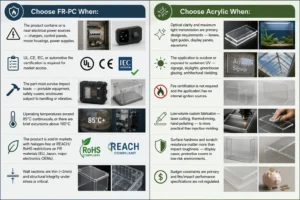
10. Which Material Belongs in Which Application?
Rather than a generic “better” verdict, the right question is: better for what? The answer is application-specific and consistent.
Choose FR-PC When:
- The product contains or is near electrical power sources — chargers, control panels, motor housings, power supplies.
- UL, CE, IEC, or automotive fire certification is required for market access.
- The part must survive impact loads — portable equipment, safety covers, enclosures subject to handling or vibration.
- Operating temperatures exceed 85°C continuously, or there are brief excursions above 100°C.
- The product is sold in markets with halogen-free or REACH/RoHS restrictions on FR materials (EU, Japan, major electronics OEMs).
- Wall sections are thin (<2mm) and structural integrity under stress is critical.
Choose Acrylic When:
- Optical clarity and maximum light transmission are primary design requirements — lenses, light guides, display panels, aquariums.
- The application is outdoor or exposed to sustained UV — signage, skylights, greenhouse glazing, architectural cladding.
- Fire certification is not required and the application has no internal ignition sources.
- Low-volume custom fabrication — laser cutting, thermoforming, hand polishing — is more practical than injection molding.
- Surface hardness and scratch resistance matter more than impact toughness — display cases, protective covers in low-risk environments.
- Budget constraints are primary and fire/impact performance specifications are not regulated.
The Bottom Line: A Clear Answer When You Know What You’re Building
Flame retardant polycarbonate is not universally better than acrylic — but it is unambiguously better for every application where fire safety, impact resistance, and regulatory compliance are non-negotiable. In the world of electrical and electronic products, EV systems, industrial controls, and automotive components, FR-PC is simply the only material that can do the job. Acrylic cannot achieve the fire ratings these applications require, and no amount of clever design or coating technology closes that gap.
Acrylic, on the other hand, is genuinely the superior material when optical performance, UV stability, and cost are the primary drivers — and when fire regulations are either absent or manageable through application design. Its clarity, longevity, and fabrication versatility make it irreplaceable for display, signage, optical, and architectural applications.
The most common mistake in this comparison is treating it as a general preference question rather than an application-specific engineering decision. Match the material to the requirement — and if that requirement includes a UL94 V-0 certification or an IEC fire test, you already have your answer.
Need FR-PC for a Regulated Application? Let’s Find the Right Grade.
We supply a comprehensive range of flame retardant polycarbonate compounds — UL94 V-0 and V-1 rated, halogenated and halogen-free, standard and high-heat grades — with full certification documentation, lot-specific COAs, and application engineering support. Whether you are transitioning from acrylic, specifying a new product, or troubleshooting a certification failure, our technical team can help you select and qualify the right FR-PC grade for your specific application, wall thickness, and regulatory environment.
Contact us today to request a datasheet, a material sample, or a free application consultation. Tell us your wall thickness, market, and current material — we’ll have a grade recommendation back to you within 24 hours.
Related Posts:
What Makes Flame Retardant Polycarbonate Ideal For Batteries?
How Does a Mica Insulation Sheet Protect Battery Pack Lids?
How Do You Choose Battery Aerogel Insulation for EVs?
What Temperature Can a Mica Insulation Sheet Withstand?
What is UL94 V0? Guide to Flame Retardant PC Film Testing
How Does Mica Insulation Compare With Polycarbonate?
 betty wong